
London Breakout Strategy: How to Trade the Session Open
Learn the London breakout strategy step by step. Covers entry and exit rules, best currency pairs, risk management, and how to automate it with an EA.

What Is the London Breakout Strategy?
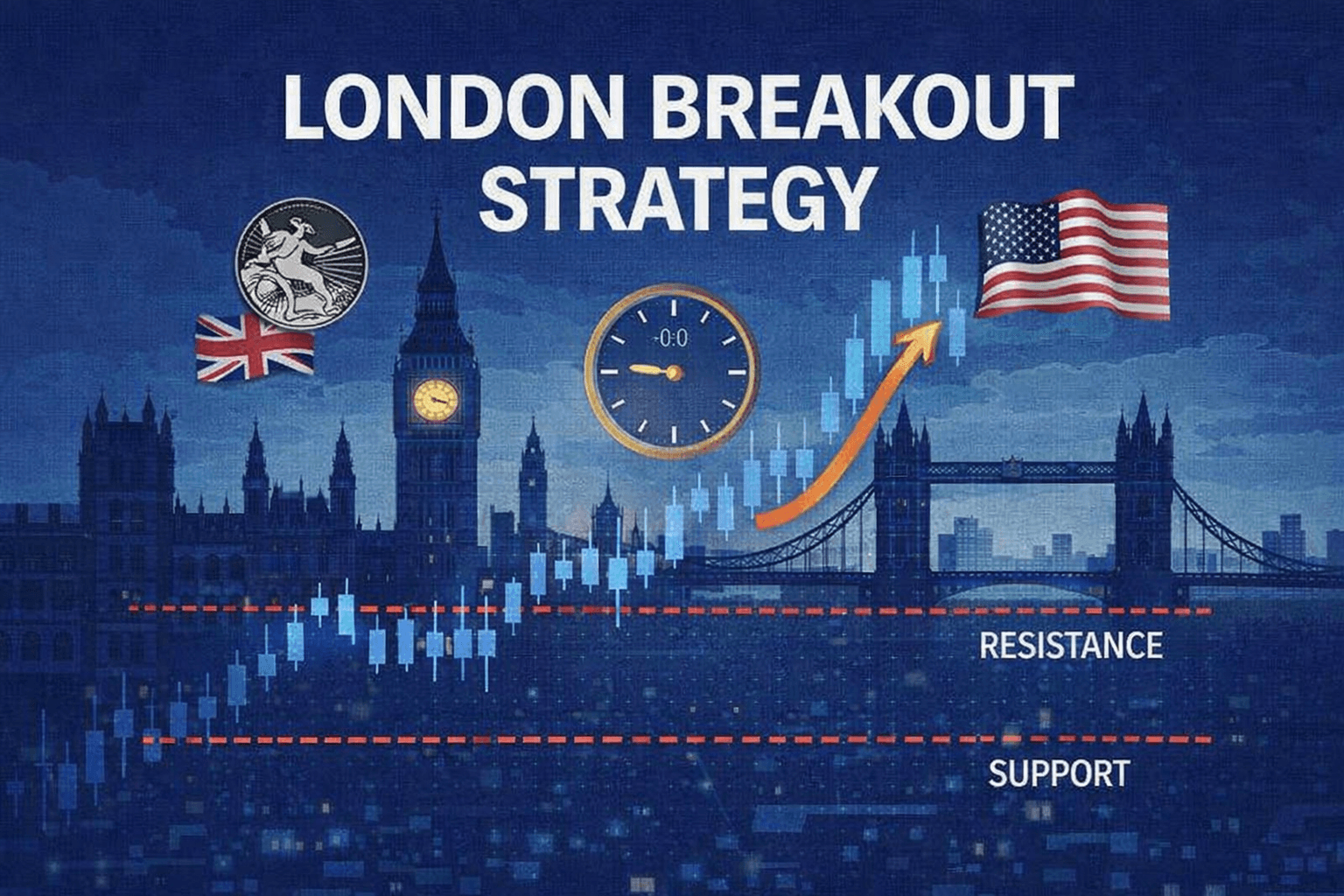
The London breakout strategy is a day trading approach that targets the sharp price movement that typically occurs when the London forex session opens. Traders identify a price range formed during the quieter Asian session, then trade the breakout when London liquidity floods the market.
It works because the London session is the highest-volume forex session on the planet. When traders in London, Frankfurt, and Zurich arrive at their desks, the burst of institutional order flow pushes price out of tight Asian ranges. That momentum is what breakout traders aim to capture.
The strategy is popular for a good reason. The rules are objective, the setup repeats every trading day, and risk can be defined before the trade is placed. Whether you execute manually or run a breakout EA on a VPS, the core logic stays the same.
Why the London Session Creates Breakout Opportunities
Roughly 35-40% of daily forex volume passes through London. The session runs from 8:00 AM to 4:30 PM GMT (3:00 AM to 11:30 AM EST). During the Asian session that precedes it, price action on major pairs tends to consolidate into a narrow range.
When London opens, institutional traders begin placing large orders. These orders push price directionally, breaking through the high or low of the overnight range. The result is a clean breakout move, often within the first one to three hours of the session.
The London open is the single most consistent window for breakout trading in forex. It combines high liquidity, institutional order flow, and a clearly defined pre-session range.
This pattern is not random. The Bank for International Settlements (BIS) reports that the UK accounts for approximately 38% of global forex turnover. That concentration of volume creates predictable surges in volatility at the session open.
Asian Session Range: Your Setup Window
The Asian session typically runs from midnight to 8:00 AM GMT. During this period, major pairs like EUR/USD and GBP/USD tend to trade in a tight range because the primary liquidity providers in Europe and North America are offline.
This low-volatility window is exactly what makes the London breakout work. The tighter the Asian range, the more explosive the London breakout tends to be. Traders measure this range and use it as the foundation for their entry levels.

London Breakout Strategy Rules: Step-by-Step
Here is a complete set of rules for trading the London breakout. These rules can be adapted for manual execution or coded into an Expert Advisor for automated trading.
Step 1: Define the Asian Session Range
Between midnight and 7:00 AM GMT, mark the highest high and lowest low on your chart. Use the 15-minute or 30-minute timeframe for precision. This range becomes your breakout zone.
Some traders use a slightly tighter window, such as 2:00 AM to 6:00 AM GMT, to filter out early Asian spikes. Either approach works. The key is consistency: use the same time window every day.
Step 2: Place Pending Orders
At 7:00 AM GMT (or your chosen pre-London time), place two pending orders:
- Buy stop: 3-5 pips above the Asian session high
- Sell stop: 3-5 pips below the Asian session low
The buffer of 3-5 pips helps filter minor wicks that poke above or below the range without genuine momentum behind them.
Step 3: Set Stop-Loss Levels
For a buy trade, place the stop-loss at the Asian session low (or 5 pips below it). For a sell trade, place the stop-loss at the Asian session high (or 5 pips above it). This defines your maximum risk per trade.
If the Asian range is unusually wide (above 60 pips on EUR/USD, for example), consider skipping the session. Wide ranges mean the stop-loss distance is too large relative to the expected breakout move, which destroys your risk-reward ratio.
Step 4: Set Take-Profit Targets
There are several approaches to take-profit:
- Fixed ratio: Set take-profit at 1.5x to 2x the Asian range width
- Range-based: Target 1x the range width for the first partial close, then trail the remainder
- Time-based exit: Close all positions by 12:00 PM GMT (end of the London-New York overlap)
Many experienced traders combine a fixed partial exit with a trailing stop. For example, close 50% at 1:1 risk-reward and trail the remaining 50% with a 20-pip trailing stop.
Step 5: Cancel Unfilled Orders
If neither pending order triggers by 10:00 AM GMT, cancel both. The breakout window has passed, and entering later exposes you to mid-session noise without the clean momentum of the session open.
Step 6: One-Cancels-Other (OCO) Logic
When one pending order fills, immediately cancel the other. You do not want both orders active simultaneously. If the market breaks out upward, your sell stop should be removed, and vice versa. Most breakout EAs handle this automatically.
Best Currency Pairs for the London Breakout
Not every pair reacts equally to the London open. The best candidates are those with high volume during the European session and tight Asian session ranges.
| Currency Pair | Avg Asian Range (pips) | London Breakout Suitability | Notes |
|---|---|---|---|
| GBP/USD | 30-50 | Excellent | The top choice. Strong London session volatility. |
| EUR/USD | 20-40 | Very Good | Most liquid pair. Clean breakouts. |
| EUR/GBP | 15-30 | Good | Tight range, smaller moves. Lower risk option. |
| USD/CHF | 20-35 | Good | Moves inversely to EUR/USD. Avoid trading both. |
| EUR/JPY | 30-50 | Moderate | Higher volatility. Wider stops needed. |
| GBP/JPY | 40-70 | Moderate | Very volatile. Experienced traders only. |
GBP/USD is the preferred pair for most London breakout traders. Sterling is heavily traded during the London session, and the pair consistently produces clean breakout moves with follow-through.
EUR/USD is a strong second choice. It has the tightest spreads and the highest global volume, which reduces slippage on entries. For traders running automated systems, EUR/USD often produces the most reliable backtesting results.
Pairs to Avoid
Avoid pairs that are primarily active during other sessions. AUD/USD and NZD/USD have already completed their main moves during the Asian session. USD/CAD tends to be more active during the New York session when Canadian data is released. Exotic pairs carry wider spreads that eat into breakout profits.

Risk Management for London Breakouts
The London breakout is a high-probability setup, but no strategy wins every time. Proper risk management separates profitable traders from those who blow accounts.
Position Sizing
Risk 1-2% of your account per trade. Calculate your position size based on the distance from your entry to your stop-loss. If the Asian range is 40 pips wide, your stop-loss distance is roughly 45 pips (including the buffer). Adjust lot size so that a full stop-out costs no more than 1-2% of equity.

Maximum Daily Loss
Set a daily loss limit of 2-3% of your account. If your first London breakout trade is stopped out, do not re-enter or revenge trade. The breakout window is specific. Once it passes, the edge disappears for that day.
Filtering Bad Setups
Not every day produces a tradeable London breakout. Skip the trade when:
- The Asian range is wider than 60 pips (EUR/USD) or 80 pips (GBP/USD)
- A major news event is scheduled within the first hour of the London session (NFP, ECB, BoE rate decisions) — check the Forex Factory calendar daily
- Monday morning following a weekend gap
- Friday afternoon (reduced liquidity, possible position squaring)
Filtering bad setups is just as important as executing good ones. Experienced London breakout traders often find that skipping 1-2 days per week improves their win rate by 10-15%.
Dealing with False Breakouts
False breakouts are the biggest risk. Price pushes past the Asian range, triggers your entry, then reverses. To reduce false breakout losses:
- Wait for a candle close above or below the range before entering (instead of pending orders)
- Add a volume or momentum filter (e.g., the breakout candle must have above-average volume)
- Use a wider buffer (7-10 pips instead of 3-5) on volatile pairs like GBP/JPY
No filter eliminates false breakouts completely. They are a cost of doing business with breakout strategies. Your job is to keep individual losses small so that winning breakouts more than compensate.
Automating the London Breakout with an EA
The London breakout strategy is one of the most popular strategies to automate with an Expert Advisor. The rules are purely mechanical: fixed times, fixed levels, fixed exits. This makes it ideal for algorithmic execution.
Why Automate?
The London session opens at 8:00 AM GMT. If you live in North America, that is 3:00 AM EST. Most traders cannot consistently wake up at that hour to place orders. An EA handles this automatically, executing the strategy every trading day without fatigue or emotion.
Automation also eliminates hesitation. When a breakout triggers, the EA enters instantly. Manual traders often second-guess their entries, wait for confirmation, and miss the initial move. In fast markets, a delay of even a few seconds can mean entering at a worse price.
Popular London Breakout EAs
Several London breakout Expert Advisors are available on the MQL5 marketplace and from third-party developers. For a detailed comparison, see our guide to the best forex breakout EAs. Look for EAs that allow you to customize:
- Asian range start and end times
- Buffer pips above and below the range
- Stop-loss and take-profit rules
- Order expiry time
- Lot sizing (fixed or percentage-based)
Before running any EA on a live account, test it thoroughly on a demo account for at least 2-3 months. Verify that the backtest results hold in forward testing with realistic spreads and slippage.

VPS Requirements for London Breakout EAs
Running a breakout EA on your home computer is risky. Internet outages, power failures, Windows updates, and computer restarts can all cause missed trades or orders that remain open without proper management.
A trading VPS solves every one of these problems. Your EA runs 24/5 on a dedicated server with 100% uptime during trading hours. The connection to your broker stays active even when your home PC is off.
For the London breakout specifically, server location matters. An LD4-located VPS sits inside London’s primary financial data center. This means sub-millisecond execution times to brokers like IC Markets, Exness, and FTMO that have matching engines in the same facility. When a breakout triggers and every millisecond counts, that proximity is a tangible advantage.
The minimum specs for running a London breakout EA are straightforward: 2 CPU cores, 2GB RAM, and enough storage for MT4 or MT5. If you run multiple EAs or multiple chart windows, step up to 4GB RAM.
London Breakout Variations
The classic London breakout has several variations that traders have developed over the years. Each aims to improve win rate or risk-reward.
Box Breakout
Instead of using the entire Asian session range, draw a box around the last 2-4 hours before London opens (5:00 AM to 7:00 AM GMT). This produces a tighter range with closer stop-losses, improving risk-reward ratios. The trade-off is that you get stopped out more often because the box boundaries are closer to the current price.
London Open Range Breakout
Wait for the first 30 minutes of the London session (8:00 AM to 8:30 AM GMT) to complete. Then trade the breakout of that 30-minute range. This variation avoids the pre-London manipulation that sometimes occurs but sacrifices some of the initial momentum.
Session Overlap Breakout
Some traders focus on the London-New York overlap (1:00 PM to 4:30 PM GMT) instead of the London open. This window combines liquidity from both sessions and can produce strong directional moves, especially when US economic data is released.
Multiple Timeframe Confirmation
Before entering a London breakout, check the daily chart for the prevailing trend. Only take breakouts in the direction of the daily trend. This filter reduces the number of trades but significantly improves the win rate for those that are taken.
Common Mistakes to Avoid
Even a good strategy can lose money if executed poorly. Here are the most common mistakes London breakout traders make:
- Trading every day: Not every London open produces a clean breakout. Learn to sit out on days with wide Asian ranges or major scheduled news.
- Moving stop-losses: Once your stop is set, leave it. Widening your stop to avoid getting stopped out is how small losses become large ones.
- Ignoring spreads: At the exact moment of the London open, spreads can widen temporarily. Account for this in your buffer pips and use a broker with consistently tight spreads.
- Over-leveraging: The temptation to size up because the strategy “always works” leads to inevitable blowups. Stick to 1-2% risk per trade.
- Running EAs without VPS: Home internet and power are not reliable enough for automated time-sensitive strategies. A VPS is not optional for serious EA traders.

Backtesting the London Breakout
Before committing real capital, backtest the strategy across multiple years of data. Here is how to approach it:
Data Requirements
You need tick-level or 1-minute data for accurate backtesting. The strategy is time-sensitive, and using higher-timeframe candles will miss the precise breakout levels. MT4 and MT5 both support importing high-quality historical data from sources like Dukascopy or your broker.
Key Metrics to Track
| Metric | What to Look For |
|---|---|
| Win Rate | 50-60% is typical for London breakout strategies |
| Profit Factor | Above 1.3 indicates a viable edge |
| Max Drawdown | Should not exceed 15-20% on a properly sized account |
| Average Win vs. Loss | Average win should be at least 1.2x the average loss |
| Monthly Return | Consistent 2-5% monthly is realistic |
Be skeptical of backtests that show unrealistic returns. A London breakout strategy that consistently delivers 5-10% monthly on backtests is likely overfitted to historical data. Look for steady, modest returns across different market conditions.
Frequently Asked Questions
What time does the London breakout strategy start?
The setup begins when you define the Asian session range, typically from midnight to 7:00 AM GMT. The actual breakout trade triggers when the London session opens at 8:00 AM GMT. Most breakout moves occur within the first one to three hours of the London session.
Can you trade the London breakout on a small account?
Yes. The strategy works on any account size as long as you apply proper position sizing. With micro lots (0.01), you can trade the London breakout with as little as $200-500. The key is maintaining the 1-2% risk rule per trade regardless of account size.
Is the London breakout strategy profitable in 2026?
The London breakout remains profitable because the underlying driver (institutional order flow at the London open) has not changed. The London session still accounts for the largest share of daily forex volume. However, profitability depends on proper execution, risk management, and filtering out low-quality setups.
What is the best timeframe for the London breakout?
The 15-minute or 30-minute chart works best for identifying the Asian range and monitoring the breakout. Some traders use the 5-minute chart for precise entries. Avoid using the 1-hour chart, as it can obscure the exact breakout timing and lead to late entries.
Do I need a VPS to run a London breakout EA?
A VPS is strongly recommended for any automated London breakout strategy. The strategy is time-sensitive and requires your EA to be running before the London session opens. A VPS provides 100% uptime during trading hours, sub-millisecond execution to major brokers, and eliminates the risk of missed trades from home internet or power outages.
Which broker is best for the London breakout strategy?
Choose a broker with tight spreads during the London session, fast execution, and servers located in London (LD4) or New York (NY4). IC Markets, Exness, and FTMO are popular choices among London breakout traders because of their ECN execution and low latency infrastructure.
How do I filter out false breakouts?
Common filters include waiting for a candle close beyond the range (rather than using pending orders), adding a momentum indicator like RSI or ATR, checking the daily trend direction, and using a wider buffer above and below the Asian range. No single filter is perfect, but combining two or three reduces false signals significantly.

About the author
Matthew Hinkle
Lead Writer & Full Time Retail Trader
Matthew is NYCServers' lead writer. In addition to being passionate about forex trading, he is also an active trader himself. Matt has advanced knowledge of useful indicators, trading systems, and analysis.
Areas of Expertise