
Prop Firm Taxes Explained: US Trader Payout Guide
Learn how prop firm profits are taxed in the US. Covers 1099 reporting, self-employment tax, deductions for VPS and software, quarterly payments, and more.
How Prop Firm Profits Are Taxed in the US
You passed the challenge, got funded, and pulled your first payout. Now comes the part nobody talks about during those flashy marketing campaigns: taxes. Prop firm taxes catch a lot of traders off guard, and the confusion is understandable. You’re not an employee. You don’t own the capital. Yet the IRS absolutely expects its cut.
This guide breaks down exactly how prop firm payouts are taxed for US-based traders, what forms to expect, which deductions you can claim, and how to structure your trading to keep more of what you earn. Whether you trade through FTMO, Topstep, The5ers, or any other funded program, the tax treatment follows the same general framework.
Disclaimer: This article is for educational and informational purposes only. It does not constitute tax, legal, or financial advice. Tax laws change frequently, and individual circumstances vary. Always consult a qualified tax professional or CPA familiar with trading income before making decisions about your tax obligations.
Are Prop Firm Payouts Taxable Income?
Yes. Every dollar you receive as a payout from a proprietary trading firm is taxable income in the United States. There’s no special exemption for prop firm profits, no loophole because you’re trading someone else’s capital, and no gray area the IRS hasn’t thought about.
The IRS treats prop firm payouts as ordinary income. It doesn’t matter whether the firm calls it a “profit split,” a “performance fee,” or a “payout.” If money lands in your bank account, it’s income. Period.
Many traders assume that because they don’t own the trading capital, the profits aren’t really “theirs” until withdrawal. That’s not how it works. Your profit share agreement with the prop firm creates a clear income event when you receive funds.
Independent Contractor Classification
The vast majority of prop firms classify traders as independent contractors rather than employees. This distinction matters enormously for your tax situation. As an independent contractor, you’re responsible for:
- Reporting all income, even if you don’t receive a 1099 form
- Paying self-employment tax (Social Security and Medicare) on top of income tax
- Making quarterly estimated tax payments to the IRS
- Tracking your own expenses and deductions
Think of your prop firm trading like running a freelance business. The firm is your client. Your payouts are invoiced income. Your trading tools, VPS hosting for traders, and software are business expenses. That mental model will serve you well come tax season.
The 1099 Question: What Forms Will You Receive?
This is one of the most common questions funded traders ask, and the answer isn’t always straightforward.
US-Based Prop Firms
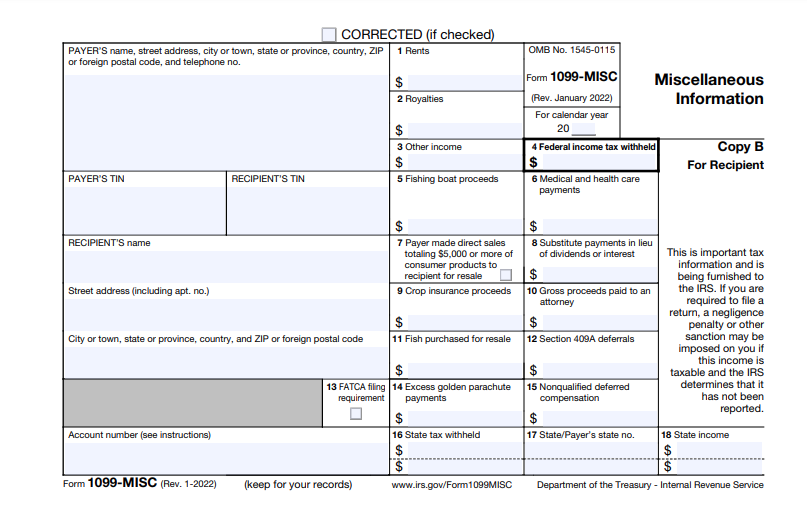
If you trade with a US-based prop firm and earn $600 or more in a calendar year, the firm is required to send you a 1099-NEC (Nonemployee Compensation) form. This replaced the old 1099-MISC Box 7 for independent contractor payments starting in 2020. You’ll receive this by January 31 of the following year.
The 1099-NEC reports your total payouts for the year. The firm also sends a copy to the IRS, so they already know how much you earned. Failing to report this income is a fast track to an audit notice.
Overseas Prop Firms
Here’s where it gets tricky. Many popular prop firms operate from outside the United States. Foreign companies are generally not required to issue 1099 forms to US traders. FTMO (Czech Republic), MyForexFunds’ successors, and numerous other firms headquartered abroad won’t send you tax forms.
Does that mean the income isn’t taxable? Absolutely not. You’re still required to report all worldwide income to the IRS regardless of whether you receive a 1099. The absence of a form doesn’t mean the absence of a tax obligation.
What to Do If You Don’t Receive a 1099
If a prop firm doesn’t send you a 1099, you still need to:
- Keep detailed records of every payout you receive
- Track dates, amounts, and the payment method (wire, crypto, PayPal, etc.)
- Screenshot your dashboard showing payout history
- Report the income on Schedule C of your tax return
Your bank statements serve as backup documentation. If the IRS ever questions your reported income, you’ll want a clear paper trail that matches your tax filings.
How to Report Prop Firm Income on Your Tax Return
Reporting prop firm income involves several forms, depending on your situation. Here’s the standard process for most funded traders.
Schedule C (Profit or Loss from Business)
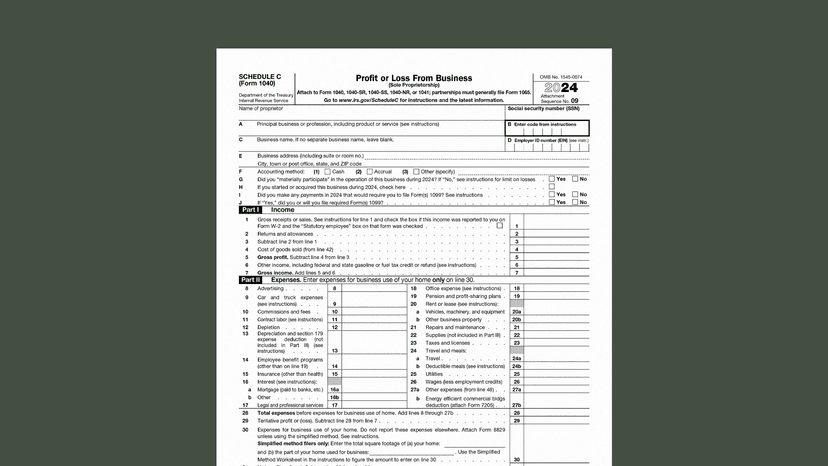
As an independent contractor, you’ll file Schedule C (Form 1040) to report your prop firm income and business expenses. This is the same form used by freelancers, consultants, and sole proprietors.
| Schedule C Line | What to Enter |
|---|---|
| Line 1 (Gross Receipts) | Total prop firm payouts for the year |
| Line 4 (Cost of Goods Sold) | Generally not applicable |
| Lines 8-27 (Expenses) | Deductible business expenses (see section below) |
| Line 31 (Net Profit/Loss) | Your taxable income from prop trading |
Your business activity code for prop trading is typically 523910 (Miscellaneous Intermediation) or 523130 (Commodity Contracts Dealing). Consult your CPA on which code best fits your situation.
Schedule SE (Self-Employment Tax)
Since you’re an independent contractor, you owe self-employment tax on your net prop firm income. This covers both the employer and employee portions of Social Security and Medicare taxes.
In 2026, the self-employment tax rate is 15.3% on the first $168,600 of net earnings (12.4% for Social Security plus 2.9% for Medicare). Income above that threshold still owes the 2.9% Medicare portion. If your total net earnings exceed $200,000 ($250,000 for married filing jointly), an additional 0.9% Medicare surtax applies.
That 15.3% hits hard. On a $50,000 net profit from prop trading, you’d owe roughly $7,065 in self-employment tax alone, before federal and state income tax even enters the picture. This is why deductions and entity structure matter so much.
Form 1040-ES (Quarterly Estimated Payments)
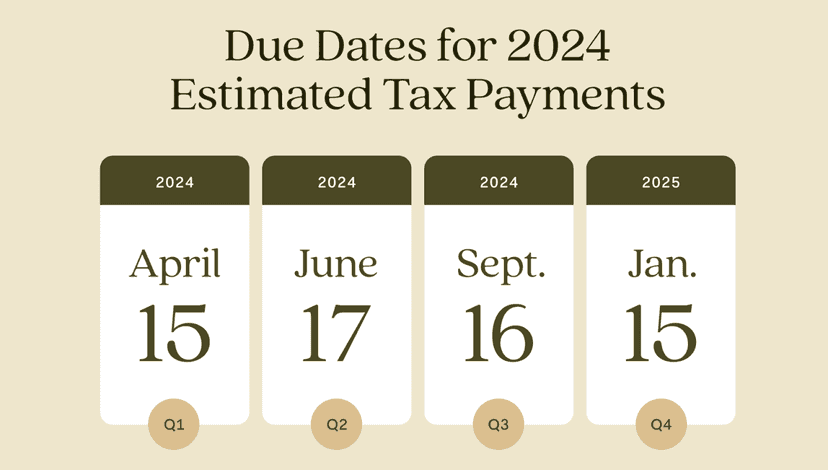
The IRS doesn’t want to wait until April to collect. If you expect to owe $1,000 or more in taxes for the year, you’re required to make quarterly estimated tax payments using Form 1040-ES.
The quarterly due dates for 2026 are:
- Q1: April 15, 2026
- Q2: June 15, 2026
- Q3: September 15, 2026
- Q4: January 15, 2027
Miss these deadlines and you’ll face underpayment penalties. A common strategy is to set aside 25-30% of every payout immediately into a separate savings account earmarked for taxes. That way, you’re never scrambling to cover a quarterly payment.

Prop Firm Tax Deductions: What Can You Write Off?
Here’s the silver lining. As a self-employed prop trader, you can deduct legitimate business expenses from your income, reducing your taxable amount. These deductions can save you thousands of dollars every year.
VPS and Server Costs
Your forex VPS subscription is a 100% deductible business expense. If you’re running EAs, algos, or simply need a stable connection to your prop firm’s platform, the cost of your VPS is directly tied to generating your trading income.
This applies to any VPS plan you use for trading. Whether you’re on a basic plan or running a dedicated server, the full monthly cost comes off your taxable income. Keep your invoices and receipts organized by month.
Common Deductible Expenses for Prop Traders
| Expense Category | Examples | Deductibility |
|---|---|---|
| VPS / Cloud Hosting | Forex VPS subscriptions, server costs | 100% |
| Trading Software | Platform fees, EA licenses, charting tools | 100% |
| Challenge Fees | Prop firm evaluation / challenge fees | 100% |
| Data Feeds | Market data subscriptions, news services | 100% |
| Education | Trading courses, mentorship, books | 100% |
| Internet | Home internet (business-use portion) | Partial |
| Home Office | Dedicated trading space in your home | Partial |
| Computer Hardware | Monitors, desktop, laptop, peripherals | 100% (or depreciated) |
| Professional Services | CPA fees, tax preparation, legal advice | 100% |
| Health Insurance | Self-employed health insurance premiums | 100% (on Form 1040) |
Challenge Fees Are Deductible
Every evaluation fee, challenge reset, or re-entry fee you pay to a prop firm is a deductible business expense. Even if you fail the challenge, those fees are still deductible because they represent a legitimate cost of doing business.
This adds up quickly. If you attempted three challenges at $500 each during the year, that’s $1,500 off your taxable income. Track every challenge purchase, including screenshots of payment confirmations and email receipts.
The Home Office Deduction
If you have a dedicated space in your home used exclusively and regularly for trading, you can claim the home office deduction. There are two methods:
- Simplified Method: $5 per square foot, up to 300 sq. ft. (max $1,500 deduction)
- Regular Method: Calculate the percentage of your home used for trading and apply that to rent/mortgage interest, utilities, insurance, and maintenance
The key word is “exclusively.” Your trading desk in the corner of your living room likely won’t qualify. A dedicated office or room used only for trading will.
Self-Employed Health Insurance Deduction
If you’re self-employed and not eligible for employer-sponsored health insurance, you can deduct 100% of your health insurance premiums. This isn’t a Schedule C deduction; it goes directly on your Form 1040 as an adjustment to income. But it can reduce your overall tax bill significantly.
Entity Structure: Should You Form an LLC or S-Corp?
Once your prop firm income reaches a certain level, operating as a sole proprietor starts to cost you real money in self-employment taxes. That’s when entity structure becomes relevant.
Sole Proprietor (Default)
If you do nothing, you’re a sole proprietor. You file Schedule C, pay self-employment tax on all net income, and move on. For traders earning under $40,000-$50,000 annually from prop firms, this is usually the simplest and most cost-effective approach.
Single-Member LLC
An LLC provides liability protection but doesn’t change your tax situation by default. A single-member LLC is a “disregarded entity” for tax purposes. You still file Schedule C and pay the same self-employment tax. The primary benefit is separating personal and business assets.
That said, an LLC gives you the option to elect S-Corp taxation, which is where real tax savings can happen.
S-Corp Election (Form 2553)
Filing Form 2553 lets your LLC be taxed as an S-Corporation. This is the go-to strategy for self-employed individuals earning a significant income, and it works well for funded traders.
Here’s how it saves money: As an S-Corp, you pay yourself a “reasonable salary” and take the remaining profits as distributions. Self-employment tax only applies to the salary portion. The distributions are not subject to the 15.3% SE tax.
Example: You earn $120,000 from prop firm payouts. As a sole proprietor, you’d owe SE tax on the full amount (roughly $16,956 after the deduction). As an S-Corp, you pay yourself a $60,000 salary and take $60,000 in distributions. SE tax now applies only to the $60,000 salary, saving you approximately $8,478 in self-employment tax.
The trade-off: S-Corps require more administrative overhead. You’ll need to run payroll, file a separate business tax return (Form 1120-S), and potentially pay for additional accounting services. Most CPAs say the S-Corp election makes sense when your net self-employment income consistently exceeds $60,000-$80,000 per year.
When to Consult a Tax Professional
Entity structure decisions have long-term implications. An S-Corp elected too early can cost more in accounting fees than it saves in taxes. Elected too late, you’ve left money on the table. Work with a CPA who understands self-employment income and, ideally, has experience with trading businesses.
State Tax Implications for Prop Firm Traders
Federal taxes are only part of the picture. Your state of residence plays a major role in your total tax burden.
States with No Income Tax
If you live in one of these nine states, you won’t owe state income tax on your prop firm payouts:
- Alaska
- Florida
- Nevada
- New Hampshire (no tax on earned income; taxes interest and dividends)
- South Dakota
- Tennessee
- Texas
- Washington
- Wyoming
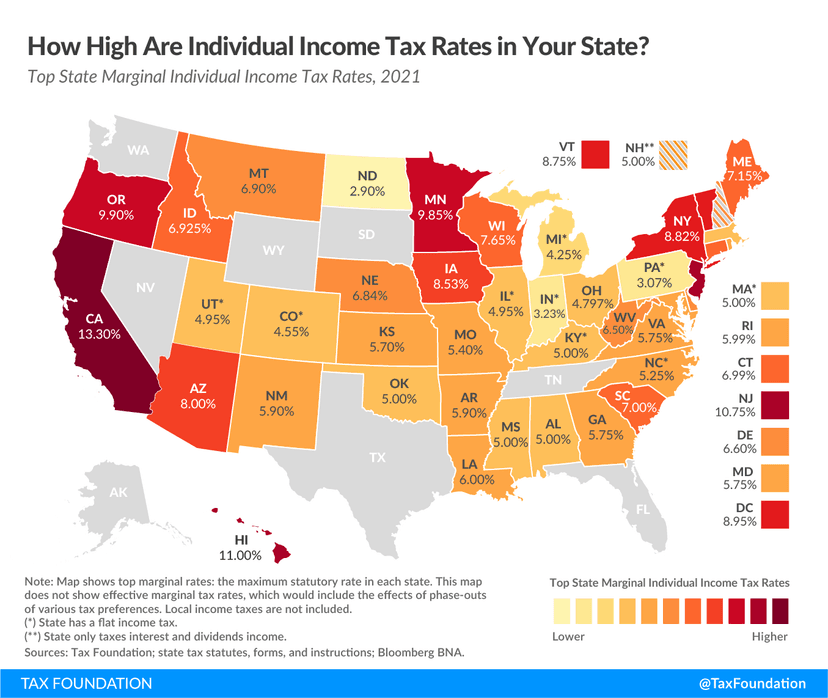
Some funded traders intentionally relocate to no-income-tax states once their trading income reaches a level where the savings justify the move. Florida and Texas are popular choices in the trading community.
High-Tax States to Be Aware Of
On the other end of the spectrum, states like California (up to 13.3%), New York (up to 10.9%), and New Jersey (up to 10.75%) will take a substantial additional cut. If you’re earning $100,000+ from prop trading in California, your combined federal, state, and self-employment tax rate can approach 45-50% before deductions.
New York City residents face an additional city income tax on top of the state tax, pushing the effective rate even higher. Your location directly impacts how much of your payouts you actually keep.
Tax Strategies for Funded Traders
Beyond basic deductions and entity structure, there are several strategies that can help funded traders optimize their tax situation.
Retirement Account Contributions
Self-employed individuals have access to powerful retirement savings vehicles that reduce taxable income:
- SEP IRA: Contribute up to 25% of net self-employment earnings (max $69,000 in 2026). Easy to set up and fund.
- Solo 401(k): Allows both employee contributions ($23,000 + $7,500 catch-up if 50+) and employer contributions (up to 25% of net earnings). Total limit of $69,000 in 2026.
- Traditional IRA: Up to $7,000 ($8,000 if 50+) with potential tax deduction depending on income level.
A Solo 401(k) is especially powerful for prop traders. On $100,000 of net self-employment income, you could potentially shelter over $40,000 from taxes in a single year. That’s a significant reduction in your tax bill.
Track Everything, All Year
Don’t wait until March to start gathering receipts. Set up a system from day one:
- Use accounting software (QuickBooks Self-Employed, Wave, or FreshBooks)
- Maintain a dedicated business bank account for trading income and expenses
- Save receipts for every business purchase
- Screenshot prop firm dashboards showing payout history monthly
- Log challenge fees, platform subscriptions, and VPS costs as they occur
Good recordkeeping is your best defense in an audit and your best weapon for maximizing deductions.
The QBI Deduction (Section 199A)
The Qualified Business Income deduction allows eligible self-employed individuals to deduct up to 20% of their qualified business income from their taxable income. If your prop firm income qualifies (which depends on your total taxable income and filing status), this can be a meaningful deduction.
For single filers in 2026, the full deduction applies if your taxable income is under approximately $191,950. Above that threshold, the deduction begins to phase out for certain “specified service trades or businesses.” Trading may fall into this category, so work with your CPA to determine eligibility. For a broader look at how forex profits are taxed under Section 988 and Section 1256, see our forex tax guide for US, UK, and EU traders.

Common Mistakes Prop Firm Traders Make with Taxes
Avoid these pitfalls that cost funded traders money and create problems with the IRS.
Mistake 1: Not Reporting Income Without a 1099
If an overseas prop firm doesn’t send you a 1099, you still owe taxes. The IRS has access to international banking records and payment platform data. Unreported income is a red flag that can trigger an audit.
Mistake 2: Forgetting Quarterly Estimated Payments
The underpayment penalty isn’t massive, but it’s entirely avoidable. Set calendar reminders for all four due dates and transfer funds from your tax savings account on time.
Mistake 3: Missing Deductions
Many funded traders pay more tax than they should simply because they don’t track their expenses. That VPS subscription, those challenge fees, your TradingView plan, the new monitor you bought, all deductible. Leaving these off your return is leaving money on the table.
Mistake 4: Mixing Personal and Business Finances
Running prop firm payouts into your personal checking account and paying for groceries alongside trading software makes bookkeeping a nightmare. Open a separate business checking account. It costs nothing at most banks and makes tax time far less painful.
Mistake 5: Waiting Until April to Do Everything
If you wait until tax season to gather records, calculate estimated payments, and understand your obligations, you’re already behind. Start the year with a plan. Set aside money from every payout. Track expenses monthly. Tax season should be a filing event, not a research project.
VPS Costs as a Tax Deduction
For traders who run EAs, algos, or simply need a reliable connection for daily trading on their prop firm accounts, a VPS is an essential business tool. The IRS allows you to deduct the full cost of tools and services that are “ordinary and necessary” for your business. A forex VPS clearly meets that standard.
If you spend $25-$60 per month on a VPS, that’s $300-$720 per year in deductions. Running a dedicated server for multiple prop firm accounts or high-frequency strategies could put that number at $1,500+ annually. Every dollar deducted reduces your taxable income dollar for dollar.
Check our forex VPS plans to ensure your trading setup never misses a beat.
Crypto Payouts and Additional Considerations
Some prop firms offer payouts in cryptocurrency (typically USDT, USDC, or Bitcoin). This introduces an extra layer of tax complexity.
When you receive crypto as payment for services, the fair market value at the time of receipt is your taxable income. If you then hold that crypto and sell it later at a different price, you’ll also have a capital gain or loss to report. You’re effectively dealing with two taxable events: the income event and the later disposition.
If you convert crypto payouts to USD immediately, your capital gain or loss is typically negligible. But if you hold crypto received from prop firm payouts, you’ll need to track your cost basis (the value when received) and report gains or losses when you eventually sell or convert.
International Reporting Requirements
If your prop firm holds funds in a foreign account on your behalf and the aggregate balance exceeds $10,000 at any point during the year, you may need to file an FBAR (FinCEN Form 114). This applies to foreign financial accounts, and the penalties for non-compliance are severe.
Additionally, if the balance exceeds higher thresholds ($50,000 for single filers at year-end, or $75,000 at any point), you may also need to file Form 8938 (Statement of Specified Foreign Financial Assets) with your tax return.
Most prop firm dashboard balances are not considered “foreign financial accounts” for FBAR purposes because the trader doesn’t own the capital. However, if you receive payouts into a foreign bank account or foreign payment platform that you control, those accounts may trigger reporting requirements. Discuss this with your CPA.
Frequently Asked Questions
Do You Pay Taxes on Prop Firm Profits?
Yes. All prop firm payouts are taxable income in the United States. They’re treated as self-employment income and reported on Schedule C of your federal tax return. You’ll owe both income tax and self-employment tax (15.3%) on your net earnings.
Do Prop Firms Send 1099 Forms?
US-based prop firms that pay you $600 or more in a year are required to send a 1099-NEC. However, many popular prop firms are based overseas and are not obligated to issue 1099s. Regardless of whether you receive a form, you must report all prop firm income on your tax return.
Can You Deduct Prop Firm Challenge Fees on Your Taxes?
Yes. Challenge fees, evaluation fees, and reset fees paid to prop firms are deductible business expenses. They qualify as ordinary and necessary costs of operating your trading business, even if you fail the challenge.
How Much Should You Set Aside for Taxes from Prop Firm Payouts?
A conservative approach is to set aside 25-30% of every payout for taxes. This covers federal income tax, self-employment tax, and state income tax for most traders. If you’re in a high-tax state like California or New York, consider setting aside 35-40%.
Is a VPS Subscription Tax Deductible for Prop Firm Trading?
Absolutely. A forex VPS used for prop firm trading is a 100% deductible business expense. It qualifies as an ordinary and necessary tool for your trading business, whether you use it for running EAs, maintaining stable connections, or ensuring 24/7 uptime for your strategies.
Should You Form an LLC for Prop Firm Trading?
An LLC provides liability protection but doesn’t change your tax situation by default. The real tax benefit comes from electing S-Corp status, which can reduce self-employment tax once your income consistently exceeds $60,000-$80,000 per year. For traders earning less, the administrative costs of an entity may outweigh the benefits.
What Happens If You Don’t Report Prop Firm Income?
Failing to report taxable income can result in penalties, interest, and potential audit action. If a US-based prop firm filed a 1099 with the IRS and your return doesn’t match, you’ll receive a notice. For unreported income from foreign firms, the IRS can still discover discrepancies through bank records and international information sharing agreements.
The Bottom Line on Prop Firm Taxes
Prop firm taxes don’t have to be intimidating. The framework is straightforward: your payouts are self-employment income, you report them on Schedule C, you pay self-employment and income tax, and you deduct every legitimate business expense you can document.
The traders who end up in trouble are the ones who ignore their obligations, skip quarterly payments, or fail to track deductions. The traders who come out ahead are the ones who set aside money from every payout, keep clean records, claim every deduction they’re entitled to, and work with a CPA who understands trading income.
Your VPS, your challenge fees, your software subscriptions, your home office, these are all working to reduce your tax bill. Take advantage of them.
Disclaimer: This article is for informational purposes only and does not constitute tax, legal, or financial advice. Tax treatment of prop firm payouts can vary based on individual circumstances. Always consult a qualified CPA or tax professional familiar with trading income and U.S. tax regulations before making filing decisions.

About the author
Thomas Vasilyev
Writer & Full Time EA Developer
Tom is our associate writer, and has advanced knowledge with the technical side of things, like VPS management. Additionally Tom is a coder, and develops EAs and algorithms.
Areas of Expertise