
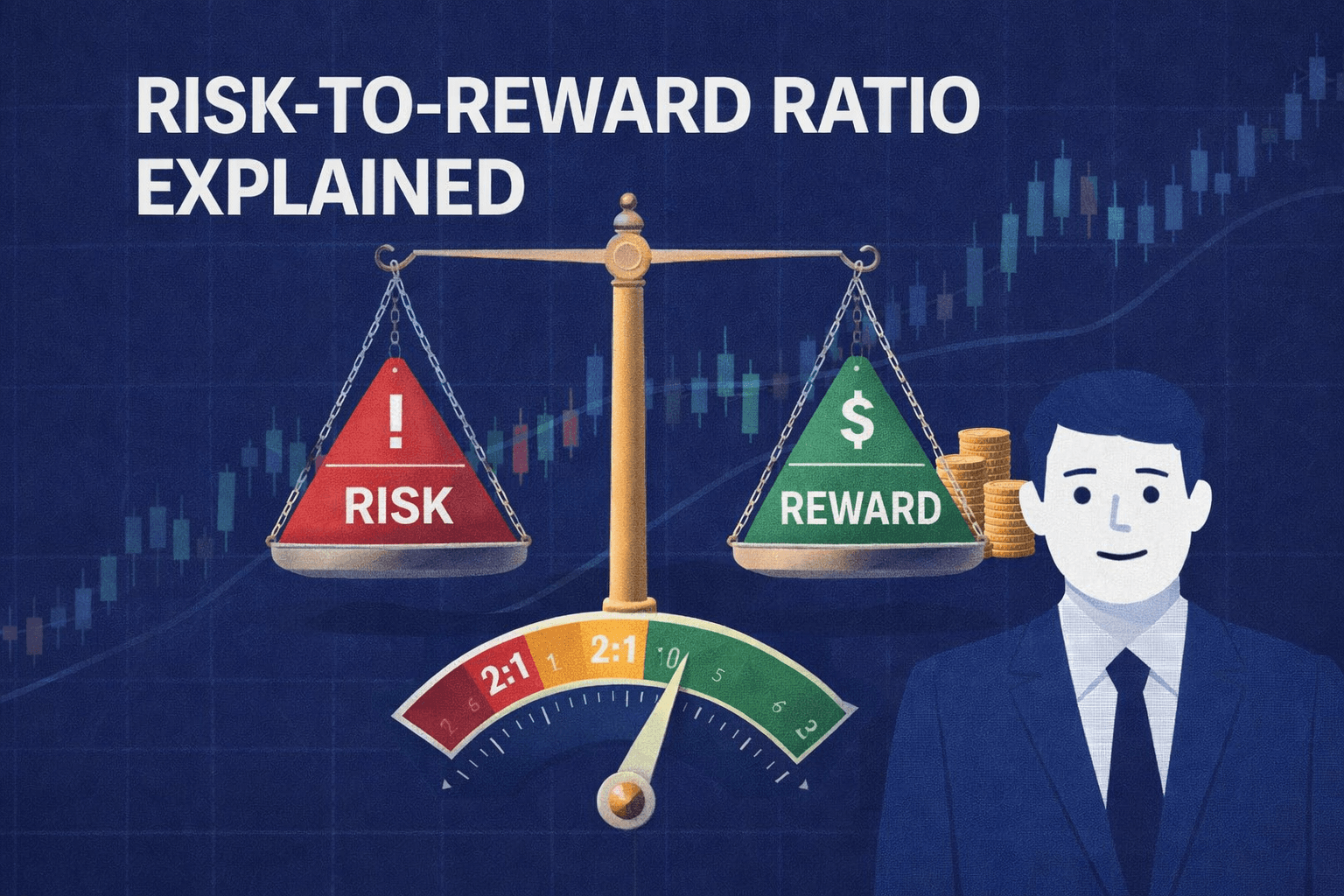
Risk-to-Reward Ratio Explained: How to Size Forex Trades
Learn how the risk-to-reward ratio works in forex trading, how to calculate it, and how to size your positions correctly for consistent profitability.
What Is the Risk-to-Reward Ratio?
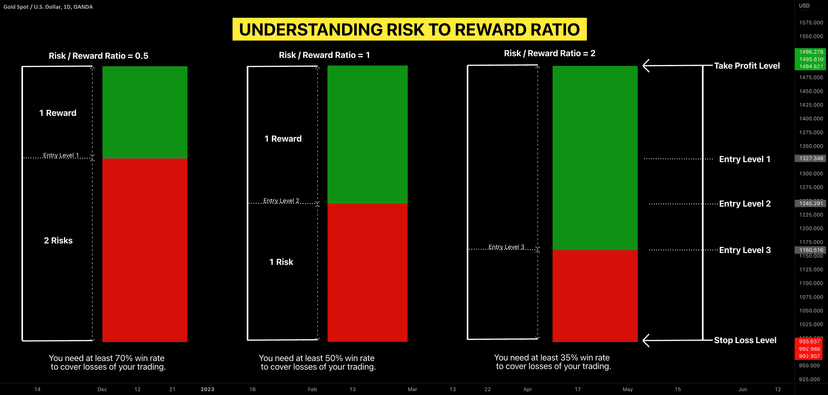
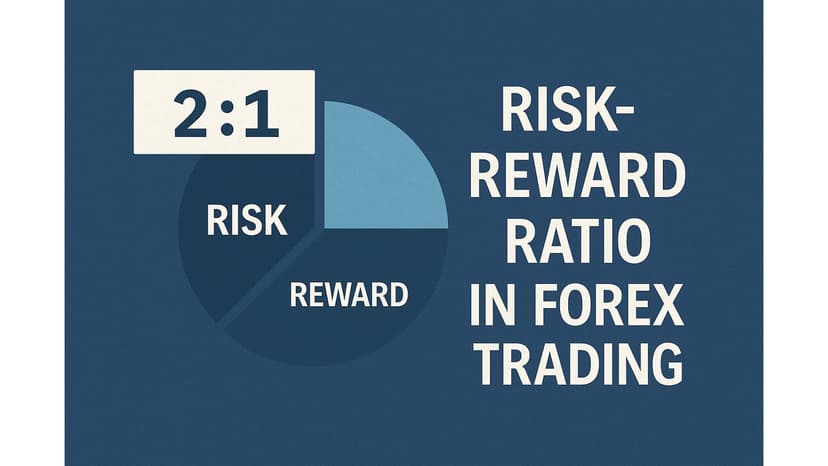
The risk-to-reward ratio (RRR) measures how much you stand to gain on a trade compared to how much you’re willing to lose. It’s one of the most important numbers in forex trading, and it determines whether your strategy can survive long enough to be profitable.
Here’s the simple version: if you risk 50 pips to make 100 pips, your risk-to-reward ratio is 1:2. For every dollar you put on the line, you expect to gain two dollars back.
Most traders obsess over win rate. They want to be right on every trade. But the math tells a different story. A trader who wins only 40% of the time can still grow their account consistently, as long as their average winner is at least twice the size of their average loser. That’s the power of a favorable risk-to-reward ratio.
This guide breaks down exactly how the ratio works, how to calculate it, and how to use it alongside position sizing to keep your trading account intact through losing streaks and volatile markets.
How to Calculate the Risk-to-Reward Ratio
The formula is straightforward:
Risk-to-Reward Ratio = (Entry Price − Stop Loss) ÷ (Take Profit − Entry Price)
Let’s walk through a real example. You spot a bullish setup on EUR/USD and enter a long position at 1.0850. Based on the chart structure, you place your stop loss at 1.0800 (50 pips of risk) and your take profit at 1.0950 (100 pips of potential reward).
Risk = 1.0850 − 1.0800 = 50 pips
Reward = 1.0950 − 1.0850 = 100 pips
RRR = 50 ÷ 100 = 0.5, expressed as 1:2
This means you’re risking 1 unit to potentially gain 2 units. If you took ten trades with this ratio and won just four of them, you’d still come out ahead:
| Outcome | Trades | Pips Per Trade | Total Pips |
|---|---|---|---|
| Winners | 4 | +100 | +400 |
| Losers | 6 | −50 | −300 |
| Net Result | 10 | +100 |
That’s 100 pips of profit with a 40% win rate. The ratio did the heavy lifting.
Why Win Rate Alone Doesn’t Tell the Full Story
It’s tempting to chase a high win rate. Nobody likes losing trades. But win rate without context is meaningless.
Consider two traders:
- Trader A wins 70% of the time but uses a 1:0.5 risk-to-reward ratio. They risk 100 pips to make 50 pips. After 100 trades: 70 winners at +50 pips = +3,500 pips. 30 losers at −100 pips = −3,000 pips. Net: +500 pips.
- Trader B wins only 40% of the time but uses a 1:3 ratio. They risk 50 pips to make 150 pips. After 100 trades: 40 winners at +150 pips = +6,000 pips. 60 losers at −50 pips = −3,000 pips. Net: +3,000 pips.
Trader B makes six times more profit despite winning less than half the time. The takeaway: the size of your wins relative to your losses matters more than how often you win.
Expectancy: The Number That Actually Matters
Expectancy combines win rate and risk-to-reward into a single metric that tells you how much you can expect to make (or lose) per trade on average. As BabyPips explains, the relationship between these two numbers determines your edge.
Expectancy = (Win Rate × Average Win) − (Loss Rate × Average Loss)
If your win rate is 45%, your average win is $200, and your average loss is $100:
Expectancy = (0.45 × $200) − (0.55 × $100) = $90 − $55 = +$35 per trade
A positive expectancy means your strategy is profitable over a large sample of trades. A negative expectancy means it’s not, regardless of how good individual trades feel.
Position Sizing: Turning the Ratio Into Dollar Amounts
Knowing your risk-to-reward ratio is only half the equation. The other half is position sizing, which determines how many lots you trade based on how much you’re willing to lose.
The golden rule: never risk more than 1–2% of your account on a single trade.
The Position Sizing Formula
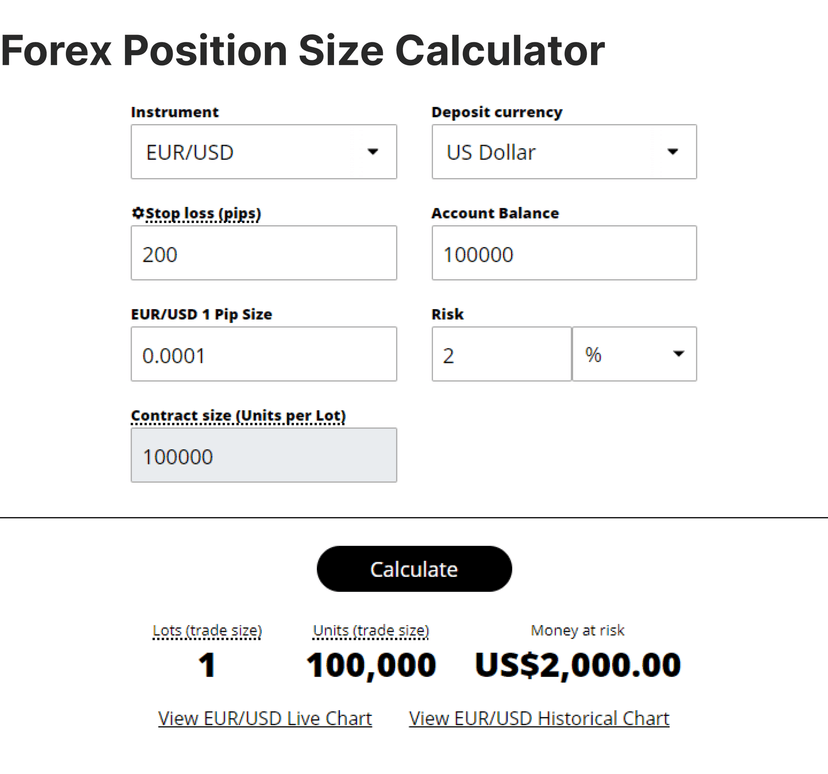
Position Size (in lots) = (Account Balance × Risk %) ÷ (Stop Loss in Pips × Pip Value)
Let’s break this down with a practical example:
- Account balance: $10,000
- Risk per trade: 1% = $100
- Stop loss distance: 40 pips
- Pair: EUR/USD (pip value for 1 standard lot = $10)
Position Size = $100 ÷ (40 pips × $10) = $100 ÷ $400 = 0.25 lots
With 0.25 lots, a 40-pip stop loss costs you exactly $100, which is 1% of your account. If your take profit is at 80 pips (a 1:2 RRR), you stand to gain $200. Tools like the Myfxbook position size calculator can automate this math for you.
Adjusting Lot Size by Stop Loss Distance
The relationship between stop loss distance and position size is inversely proportional. A wider stop requires a smaller position. A tighter stop allows a larger position. But the dollar amount at risk stays constant.
| Stop Loss (Pips) | Position Size (Lots) | Dollar Risk (1% of $10K) |
|---|---|---|
| 20 | 0.50 | $100 |
| 40 | 0.25 | $100 |
| 60 | 0.17 | $100 |
| 80 | 0.125 | $100 |
| 100 | 0.10 | $100 |
This table shows why position sizing is non-negotiable. Without it, a 100-pip stop loss on a full lot would cost $1,000, or 10% of the account. Two more trades like that and you’ve lost nearly a third of your capital.
Where to Place Your Stop Loss and Take Profit
A risk-to-reward ratio is only as good as the levels it’s based on. Setting a 1:3 ratio means nothing if your stop loss sits in the middle of normal price noise or your take profit targets a level the market rarely reaches.
Stop Loss Placement
Your stop loss should go where your trade idea is proven wrong, not where you feel comfortable losing.
- Support/resistance breaks: Place stops below support (for longs) or above resistance (for shorts), with a small buffer of 5–10 pips to account for spread and wicks.
- Swing highs and lows: If you’re trading a pullback entry, set the stop beyond the previous swing point.
- ATR-based stops: Use the Average True Range indicator to set stops based on actual volatility. A 1.5× ATR stop adapts to market conditions automatically.
Take Profit Placement
Your take profit level should sit at a price zone where the market has a structural reason to reverse or stall.
- Next key support or resistance level: The most reliable target.
- Fibonacci extensions: The 1.618 extension is a common swing trade target.
- Previous daily or weekly high/low: These levels attract institutional orders.
The key principle: set your stop and take profit based on the chart first, then calculate the resulting ratio. If the ratio doesn’t meet your minimum threshold (typically 1:1.5 or better), skip the trade.
Risk-to-Reward Ratios by Trading Style
Not every strategy demands the same ratio. Scalpers, day traders, and swing traders each have different expectations based on how long they hold positions and what kind of moves they target.
| Trading Style | Typical RRR | Typical Win Rate | Notes |
|---|---|---|---|
| Scalping | 1:1 to 1:1.5 | 55–65% | High frequency, tight stops, fast execution critical — use a latency checker tool to verify speeds |
| Day Trading | 1:1.5 to 1:2 | 45–55% | Balanced approach, closes by end of session |
| Swing Trading | 1:2 to 1:3 | 35–50% | Fewer trades, wider stops, bigger targets |
| Position Trading | 1:3 to 1:5+ | 30–40% | Multi-week holds, trend-following |
Scalpers accept a lower ratio because they compensate with a higher win rate and trade volume. Swing traders go the opposite direction: they accept more losing trades in exchange for larger winners that offset the losses.
Risk-to-Reward in Prop Firm Challenges
Prop firm traders face additional constraints that make risk-to-reward management even more critical. Most funded account challenges include daily drawdown limits (typically 4–5%) and maximum overall drawdown limits (8–12%). Blow either of those, and the challenge is over. Our guide to prop firm drawdown rules covers this in detail.
Here’s where the math gets practical. If your maximum daily drawdown is 5% and you risk 1% per trade, you can absorb five consecutive losers before breaching the limit. At 2% risk per trade, you only get two or three bad trades before you’re in danger.
Recommended Prop Firm Settings
- Risk per trade: 0.5–1% of the challenge account
- Minimum RRR: 1:2 or better
- Daily trade limit: 2–3 trades maximum to control drawdown exposure
- No revenge trading: After two consecutive losses, step away for the session
The consistency rules many prop firms enforce in 2026 also favor a steady risk-to-reward approach. Big wins on random days won’t pass the consistency check. Instead, you need a repeatable process that produces similar-sized gains across multiple trading days.

Automating Risk Management With EAs
Manual position sizing works, but it’s slow and prone to errors under pressure. That’s where Expert Advisors and automated risk management tools come in.
Many MT4 and MT5 EAs include built-in position sizing calculators that automatically adjust lot size based on your account balance, risk percentage, and stop loss distance. This removes the emotional element and ensures every trade follows the same rules.
What to Automate
- Lot size calculation: Based on account equity and predefined risk percentage
- Stop loss placement: ATR-based or fixed-pip stops applied automatically
- Take profit targets: Ratio-based targets (e.g., always 2× the stop loss)
- Trailing stops: Lock in profits as the trade moves in your favor
Running these tools on a trading VPS ensures they operate around the clock without interruption. A home computer that goes to sleep, restarts for updates, or drops its internet connection can miss critical trade management events. A forex VPS eliminates those risks with 24/7 uptime and sub-millisecond execution speeds.
Common Risk-to-Reward Mistakes
Even experienced traders fall into traps when applying the risk-to-reward ratio. Here are the most common errors and how to avoid them.
Setting Arbitrary Stop Losses
Using a fixed number like “always 30 pips” regardless of market structure is a recipe for getting stopped out by normal price movement. Your stop loss should reflect actual support/resistance levels and current volatility.
Chasing Unrealistic Ratios
Aiming for 1:5 or 1:6 sounds great on paper, but extremely wide targets rarely get hit. You end up watching winning trades reverse before reaching the take profit. A realistic 1:2 or 1:3 ratio with a solid win rate produces better results than an aspirational 1:5 ratio that never triggers.
Moving Stop Losses to Avoid a Loss
Widening your stop loss after the trade is open destroys your risk-to-reward calculation. If the original level was based on chart structure, moving it just delays the inevitable and increases the damage when the loss finally comes.
Ignoring Correlation Between Pairs
If you open three positions on EUR/USD, GBP/USD, and AUD/USD simultaneously, you’re essentially tripling your exposure to USD weakness. Even with proper position sizing on each trade, your total account risk could be 3–6% if all three go against you at once. Always account for correlated positions in your overall risk assessment.
Over-Leveraging
Leverage amplifies both gains and losses. A 50:1 leverage ratio doesn’t mean you should take larger positions. Always calculate your position size based on your actual account balance and risk tolerance, ignoring the leveraged buying power entirely.

Building a Risk-to-Reward Checklist
Before entering any trade, run through this quick checklist:
- Identify the setup: Is there a clear technical or fundamental reason for the trade?
- Set the stop loss: Place it where the trade idea is invalidated, based on market structure.
- Set the take profit: Target a logical price level with structural significance.
- Calculate the ratio: Is it 1:1.5 or better? If not, skip the trade.
- Size the position: Risk no more than 1–2% of your account.
- Check correlation: Are you already exposed to the same currency in other open trades?
- Execute and leave it: Don’t adjust stop loss or take profit after entry unless your management rules explicitly allow it (e.g., trailing stop).
Print this checklist or pin it next to your trading screen. Consistency in following these steps is what separates traders who survive from those who blow their accounts.
Frequently Asked Questions
What is a good risk-to-reward ratio for forex trading?
A minimum of 1:1.5 is generally recommended, but most professional forex traders target 1:2 or 1:3. The ideal ratio depends on your trading style and win rate. Scalpers can succeed with 1:1 if their win rate exceeds 55%, while swing traders typically need 1:2 or higher to offset their lower win rate.
How do I calculate position size based on my risk-to-reward ratio?
Use the formula: Position Size = (Account Balance × Risk Percentage) ÷ (Stop Loss in Pips × Pip Value). For example, with a $5,000 account, 1% risk ($50), and a 25-pip stop loss on EUR/USD, your position size would be 0.20 lots. The risk-to-reward ratio then determines your take profit: at 1:2, you’d target 50 pips of profit.
Can I be profitable with a low win rate?
Yes. With a 1:3 risk-to-reward ratio, you only need to win about 26% of your trades to break even (before costs). At a 35% win rate with 1:3, you’d be solidly profitable. The key is ensuring your winners are significantly larger than your losers.
Should I use the same risk-to-reward ratio for every trade?
Not necessarily. Your minimum threshold should remain consistent (e.g., never below 1:1.5), but the actual ratio will vary by trade setup. Some setups naturally offer 1:4 or better, while others might only justify 1:1.5. Let the chart dictate the ratio, then decide if it meets your minimum standard.
How does leverage affect risk-to-reward ratio?
Leverage doesn’t change your risk-to-reward ratio. It only amplifies the dollar amount of gains and losses. A 1:2 ratio is still 1:2 whether you’re trading with 10:1 or 100:1 leverage. However, higher leverage makes proper position sizing more critical because the dollar impact of each pip movement is larger.
What’s the difference between risk-to-reward ratio and expectancy?
The risk-to-reward ratio applies to individual trades, while expectancy measures the average profit or loss per trade across your entire strategy. Expectancy accounts for both win rate and the risk-to-reward ratio, giving you a complete picture of whether your approach is profitable over time.
How do prop firms use risk-to-reward ratios?
Prop firms don’t typically mandate a specific ratio, but their drawdown rules make favorable ratios essential. With daily drawdown limits of 4–5%, risking 1% per trade at a 1:2 ratio gives you breathing room to absorb losses without breaching limits. Many successful prop firm traders treat 1:2 as their absolute minimum to maintain consistency across evaluation phases.
Size Your Trades With Discipline
The risk-to-reward ratio isn’t a magic formula. It’s a discipline. Combined with proper position sizing, consistent stop loss placement, and a tested strategy, it transforms random trading into a structured business.
Start by defining your minimum acceptable ratio. Apply the position sizing formula to every trade without exception. Track your results over at least 50–100 trades before judging whether your approach works. And if you’re running EAs or managing multiple accounts, check our trading VPS plans to ensure your trading setup never misses a beat.
The traders who last in this market aren’t the ones who pick the most winners. They’re the ones who manage their losses and let the math work in their favor.

About the author
Matthew Hinkle
Lead Writer & Full Time Retail Trader
Matthew is NYCServers' lead writer. In addition to being passionate about forex trading, he is also an active trader himself. Matt has advanced knowledge of useful indicators, trading systems, and analysis.
Areas of Expertise