
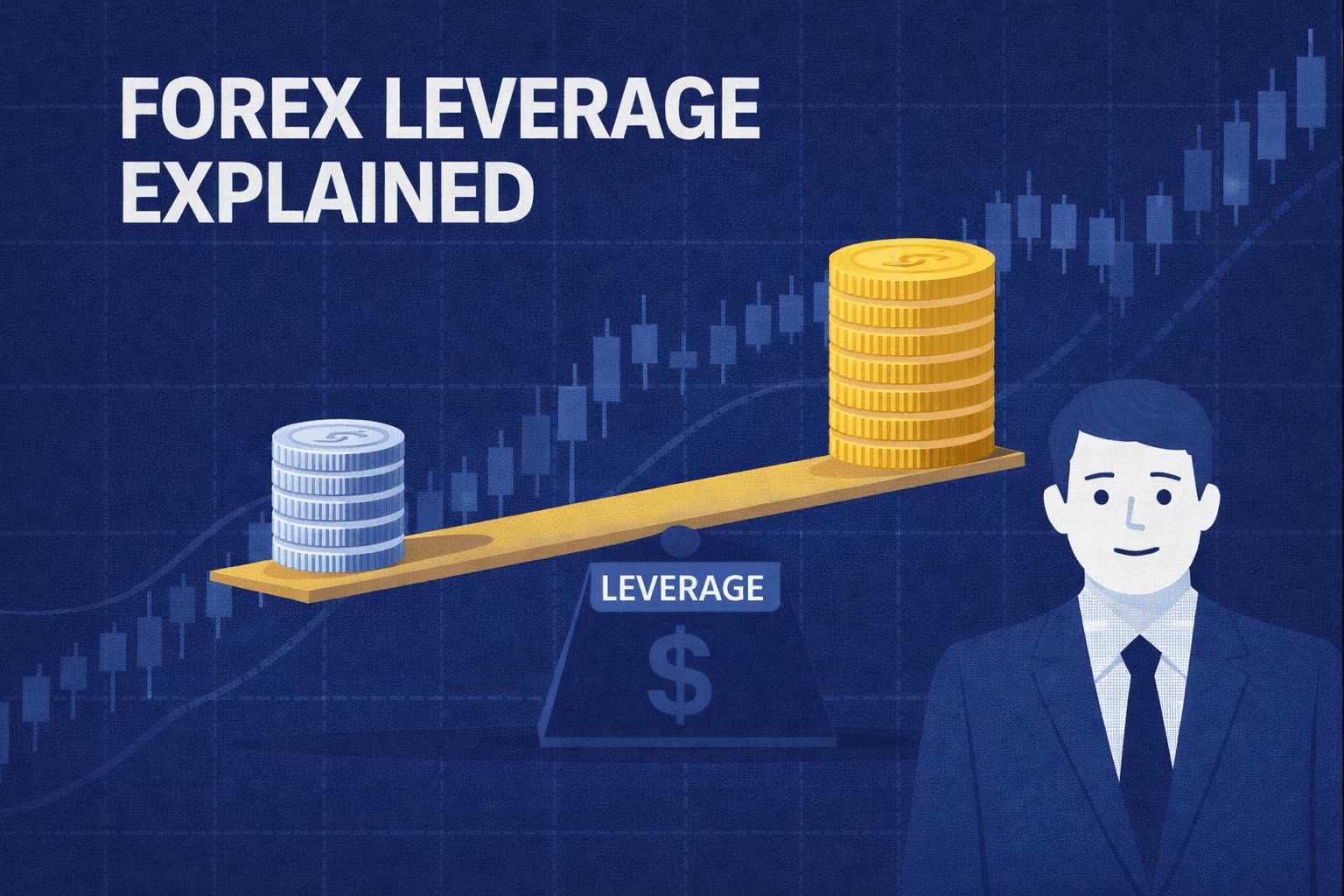
Forex Leverage Explained: How It Works, Risks & Limits
Forex leverage explained: how leverage and margin work, worked pip examples, margin calls, regulatory limits (US 50:1, EU/UK 30:1) and how to use it safely.
What Is Forex Leverage?
Forex leverage lets you control a currency position that is larger than the cash committed as margin. At 30:1 leverage, for example, $1 of required margin supports $30 of market exposure. The quick verdict is simple: leverage improves capital efficiency, but it magnifies losses just as quickly as gains.
Leverage is not a return multiplier you should automatically maximize. Your position size determines how many dollars you gain or lose per pip; the leverage ratio determines how much margin the broker sets aside to support that position. Using less of the buying power available to you is often the safer choice.
A leverage ratio is written as 30:1, 50:1, or 500:1. At 50:1, a $100,000 position requires $2,000 in margin. You still receive the full profit or loss from the $100,000 exposure, not only from the $2,000 deposit. That gap between exposure and margin is where both the usefulness and danger come from.
How Leverage and Margin Work Together
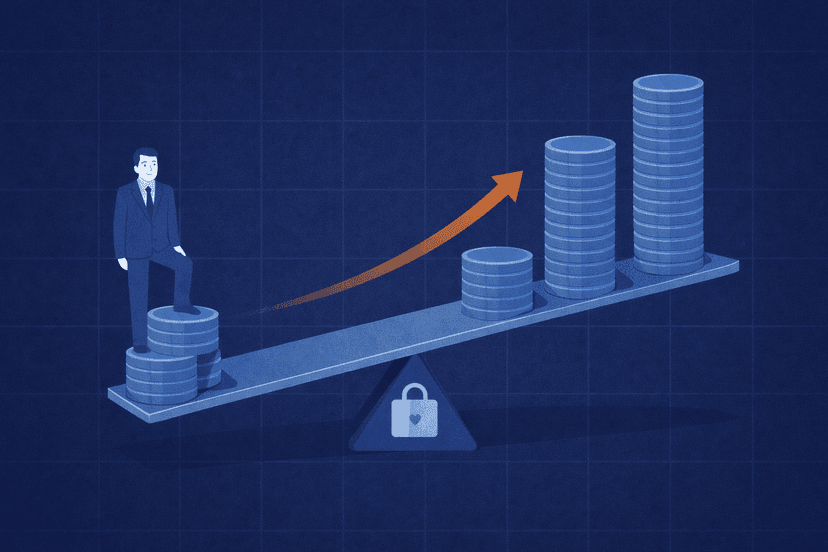
Leverage is the ratio; margin is the deposit. Do not use the terms interchangeably. The basic calculation is:
Required margin = Position size ÷ Leverage ratio
For a $50,000 position at 50:1, the forex margin requirement is $1,000. At 30:1, the same position needs about $1,666.67. The margin percentage is the inverse of the leverage ratio: 50:1 equals 2%, 30:1 equals about 3.33%, and 500:1 equals 0.2%.
Used Margin, Free Margin, and Margin Level
Used margin is the amount reserved for open positions. Free margin is the equity left to absorb losses or support new trades. As unrealized losses reduce equity, free margin falls even if you do not open another position.
Brokers commonly display margin level as a percentage:
Margin level = Equity ÷ Used margin × 100
If your equity is $5,000 and used margin is $2,000, the margin level is 250% and free margin is $3,000. A $1,000 open loss would reduce equity to $4,000, free margin to $2,000, and margin level to 200%. This is why the margin figure can deteriorate rapidly on an oversized leveraged trade.

A Worked Example: Forex Leverage in Action
Suppose you buy one standard lot of EUR/USD, representing 100,000 units. With 30:1 leverage, the required margin is approximately $3,333. For a USD-quoted pair such as EUR/USD, one pip on a standard lot is about $10; a mini lot is about $1 per pip, and a micro lot is about $0.10 per pip.
If EUR/USD rises 50 pips, the position gains approximately $500 before forex spread costs. If it falls 50 pips, the position loses approximately $500. On a $10,000 account, either move changes equity by about 5%. Relative to the $3,333 minimum margin alone, the move is roughly 15%.
The same market exposure produces the same dollar result regardless of the maximum ratio your broker offers. Higher leverage simply lets you establish that exposure with less required margin. The table below isolates the risk by assuming a $100,000 position and an account funded with only the minimum margin.
| Leverage ratio | Margin requirement | Margin for $100,000 | Loss on 1% adverse move | Loss vs. minimum-margin account |
|---|---|---|---|---|
| 30:1 | 3.33% | $3,333.33 | $1,000 | 30% |
| 50:1 | 2% | $2,000 | $1,000 | 50% |
| 100:1 | 1% | $1,000 | $1,000 | 100% |
| 500:1 | 0.2% | $200 | $1,000 | 500% |
A better-funded account would show a smaller loss as a percentage of total equity. The comparison is not a suggestion to fund only the minimum. It shows why tiny margin requirements can create a false sense that a large position is affordable.
The Risks: Margin Calls, Stop-Outs, and Negative Balance
A margin call occurs when account equity falls far enough that your margin level reaches the broker’s warning threshold. If losses continue, the broker can reach its stop-out threshold and close one or more positions. Exact warning and liquidation levels depend on the broker and the rules governing your account.
For EU retail CFD accounts, ESMA requires margin close-out when account funds fall to 50% of the minimum margin required for the open positions. This is a liquidation backstop, not a trading plan. A fast move can force the position closed before your market view has time to recover.
Consider an account with one position requiring $3,333 in minimum margin. A 50% close-out level corresponds to account funds of about $1,666.50. You should not plan to use that entire buffer: liquidation protects the broker’s margin requirement, while your objective is to keep losses within your own much smaller trade-risk limit.
Negative Balance Protection Has Limits by Region
EU and UK retail CFD accounts must include negative balance protection on a per-account basis. That means the client cannot lose more than the amount deposited in that protected account. The protection is not universal: accounts in other jurisdictions may not have it, especially when traders choose offshore entities for higher leverage.
Broker risk disclosures show how common losses are in leveraged CFD trading. IG states that 69% of its retail client accounts lose money when trading CFDs, while CMC Markets discloses 48% of retail investor accounts lose money. These figures describe different broker populations and should not be used as a head-to-head performance comparison, but both reinforce the same point: leverage does not create an edge.

Forex Leverage Limits by Region
There is no single global maximum for leverage in forex. Your cap depends on where you live, the instrument traded, your retail or professional classification, and the legal entity holding your account.
United States
Under the US Dodd-Frank framework, the CFTC authorizes the NFA to set retail forex security-deposit requirements. The NFA-set limits used in practice are 50:1 for major currency pairs and 20:1 for minor pairs, equivalent to 2% and 5% security deposits.
European Union and United Kingdom
ESMA’s retail CFD measures took effect on August 1, 2018, and the FCA made corresponding restrictions permanent in the UK. Retail leverage is capped at 30:1 on major currency pairs; 20:1 on non-major currency pairs, gold, and major equity indices; 10:1 on other commodities and non-major equity indices; 5:1 on individual equities; and 2:1 on cryptocurrencies.
Offshore Accounts
Offshore maximums vary by broker and jurisdiction, so verify the current limit rather than assuming a standard ratio. CMC Markets, for example, advertises retail leverage up to 200:1, equal to a 0.5% margin requirement, through certain jurisdiction-dependent CFD and FX Active offerings. A high advertised maximum is not evidence of better trading conditions.
- US retail forex: up to 50:1 on majors and 20:1 on minors under NFA-set requirements.
- EU and UK retail accounts: up to 30:1 on major currency pairs, with lower caps for riskier asset classes.
- Offshore entities: maximum leverage varies by broker and jurisdiction, often with weaker regulatory protection and no guaranteed negative balance protection.
How to Use Forex Leverage Safely
Start with the loss you can accept, not the position your available margin permits. A fixed risk-per-trade cap keeps exposure tied to account equity. If you choose a 1% cap on a $10,000 account, the planned loss is $100; your stop distance then determines the lot size.
For EUR/USD, a 50-pip stop on one standard lot represents about $500 of risk. To keep planned risk near $100, the position would be approximately 0.20 lots, where each pip is about $2. The broker might allow a much larger trade, but available buying power is not a position-sizing signal.
Stress-test the full account before entry. Add the planned losses from all open trades, then compare that total with equity and free margin. This simple check prevents several individually acceptable trades from combining into one oversized bet. Recalculate when you add a position rather than relying on the platform’s remaining-margin figure alone.
- Set the stop before calculating size: Put the exit where the trade thesis fails, then reduce lot size until the dollar risk fits your cap.
- Track effective leverage: Divide total open exposure by account equity. This shows how aggressively you are actually positioned, regardless of the broker’s maximum.
- Leave free margin: Do not treat every available dollar of margin as permission to add another trade.
- Account for combined exposure: Several positions can create a large total currency exposure even when each trade looks small by itself.
- Know your account rules: Confirm the margin-call level, stop-out level, leverage cap, and whether negative balance protection applies to the exact legal entity serving you.
Why Reliable 24/7 Execution Matters
Leverage makes missed trade-management actions more costly. If an EA is meant to place or adjust stops while you are away, the trading terminal must remain connected and running. A reliable forex VPS can keep the platform online 24/7 instead of depending on a home computer, power supply, and internet connection.
A VPS does not make leverage safer by itself, prevent losses, or override a broker stop-out. Its role is operational: keep automated risk controls available whenever the market is open and the strategy needs to act.
Conclusion: Treat Leverage as a Tool
Leverage controls how much margin supports a position; it does not determine whether the trade is good. The same ratio that makes a large position accessible can turn a routine market move into a large account loss.
Use position size, stop distance, and a fixed account-risk limit to control the downside. Keep spare margin, understand your jurisdiction’s protections, and choose lower effective leverage than the maximum when that is what your risk plan requires. Survival comes from controlling exposure, not maximizing buying power.
Forex Leverage FAQ
What does 50:1 leverage mean in forex?
It means each $1 of required margin can support $50 of position value. A $100,000 position therefore requires $2,000 in margin. Profit and loss are still calculated on the full $100,000 exposure.
What is the difference between leverage and margin?
Leverage is the exposure-to-margin ratio, while margin is the cash reserved to support an open position. At 30:1 leverage, the corresponding initial margin requirement is about 3.33%.
Can you lose more than your margin in forex?
Yes, the loss on a position can exceed the margin reserved for it because profit and loss apply to the full exposure. EU and UK retail CFD accounts include per-account negative balance protection, but that protection is not universal across jurisdictions.
Is higher leverage always riskier?
A higher available maximum does not increase loss if you keep the same position size. It becomes riskier when you use the extra buying power to take a larger position relative to account equity. Effective leverage matters more than the number advertised by the broker.
How much forex leverage should a beginner use?
There is no single suitable ratio for every trader. Choose position size from a predefined account-risk cap and stop distance, then check the resulting effective leverage. If the trade consumes most of your free margin, the position is too large even if the broker permits it.

About the author
Thomas Vasilyev
Writer & Full Time EA Developer
Tom is our associate writer, and has advanced knowledge with the technical side of things, like VPS management. Additionally Tom is a coder, and develops EAs and algorithms.
Areas of Expertise