
Prop Firm Consistency Rule: How It Works and How to Beat It
Learn how the prop firm consistency rule works, see the math behind it, and discover proven strategies to pass it without changing your trading style.
What Is the Prop Firm Consistency Rule?
The consistency rule is one of the most misunderstood requirements in prop trading. It’s a risk management constraint that prevents traders from passing a challenge or maintaining a funded account through one or two lucky trades. Instead, it forces you to demonstrate repeatable, steady performance over time.
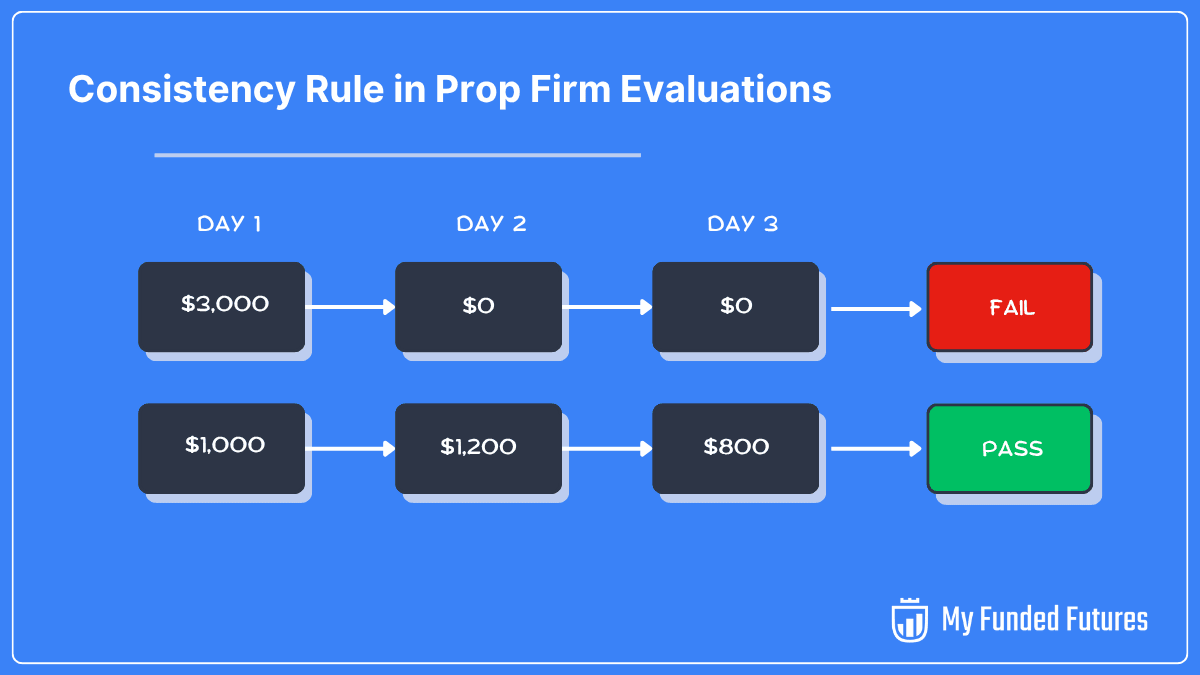
In simple terms, the consistency rule caps how much of your total profit can come from a single trading day. If your best day accounts for too large a percentage of your overall gains, you fail the rule, even if you hit every other target.
Prop firms introduced this rule for a straightforward reason: they want funded traders who generate predictable returns, not gamblers who swing for the fences. A trader who makes $10,000 in one day and $200 across the other 19 days is a liability. A trader who makes $500 per day across 20 days is an asset.
Why Prop Firms Enforce Consistency Rules
The consistency rule exists to protect both the firm and the trader. Here’s the logic from the firm’s perspective.
Risk Management at Scale
Prop firms fund thousands of traders simultaneously. If a significant chunk of those traders are taking outsized positions on random days, the firm’s aggregate risk exposure becomes unpredictable. The consistency rule forces position sizing discipline across the entire trader pool.
Filtering Out Luck vs. Skill
A 10% return during an evaluation sounds great on paper. But if 8% of that came from one news trade on NFP Friday, the firm has no evidence you can repeat it. The consistency rule is essentially a statistical filter, separating traders with an edge from those who got lucky once.
Protecting Traders from Themselves
Traders who rely on home-run trades tend to blow up accounts faster than anyone else. The consistency rule forces you to think in terms of daily risk budgets, which tends to improve longevity whether you trade prop or retail.
Key insight: The consistency rule isn’t designed to punish good traders. It rewards disciplined ones. If your strategy is already consistent, you won’t even notice the rule is there.
How the Consistency Rule Is Calculated
The exact formula varies by firm, but the most common version works like this:
The Standard Formula
The consistency rule typically states that no single trading day’s profit can exceed a fixed percentage of your total profit during the evaluation period. The most common threshold is 30%, though some firms use 40% or even 45%.
The formula is:
Consistency Score = (Best Single Day Profit / Total Profit) x 100
If the result exceeds the firm’s threshold (e.g., 30%), you violate the rule.
Worked Example: $100,000 Account
Let’s walk through a concrete scenario. You’re trading a $100,000 funded account with a 10% profit target ($10,000) and a 30% consistency rule.
| Day | Daily P&L | Running Total |
|---|---|---|
| Monday | +$1,200 | $1,200 |
| Tuesday | +$800 | $2,000 |
| Wednesday | +$4,500 | $6,500 |
| Thursday | +$1,500 | $8,000 |
| Friday | +$2,000 | $10,000 |
Consistency check: Best day is Wednesday at $4,500. Total profit is $10,000.
$4,500 / $10,000 = 45%
With a 30% consistency rule, this trader fails. Wednesday’s profit accounts for 45% of total gains, well above the 30% cap.
What Passing Looks Like
Now let’s see the same profit target hit with a consistent approach.
| Day | Daily P&L | Running Total |
|---|---|---|
| Week 1 | +$2,200 | $2,200 |
| Week 2 | +$2,500 | $4,700 |
| Week 3 | +$2,800 | $7,500 |
| Week 4 | +$2,500 | $10,000 |
Consistency check: Best week is Week 3 at $2,800. Total profit is $10,000.
$2,800 / $10,000 = 28%
This trader passes. No single period dominates the total P&L.
Variations in Calculation
Some firms calculate consistency differently. Here are the most common approaches:
- Daily cap method: No single day can exceed X% of total profit (most common, typically 30%)
- Weekly cap method: No single week can exceed X% of total profit (usually 40-45%)
- Lot size consistency: Your largest position can’t exceed X times your average position size
- Minimum trading days: You must trade at least X days, forcing activity distribution (not technically a consistency rule, but serves the same purpose)

Consistency Rules at Major Prop Firms in 2026
Not all prop firms enforce the same version of the consistency rule. Some don’t have one at all. Here’s how the major players stack up.
| Prop Firm | Consistency Rule | Threshold | When It Applies |
|---|---|---|---|
| FTMO | No formal consistency rule | N/A | N/A (uses max daily loss instead) |
| MyFundedFX | Yes | 30% daily cap | Funded phase only |
| The Funded Trader | Yes (select programs) | 30-40% daily cap | Challenge and funded |
| Topstep | Yes (consistency scaling) | Variable | Evaluation and funded |
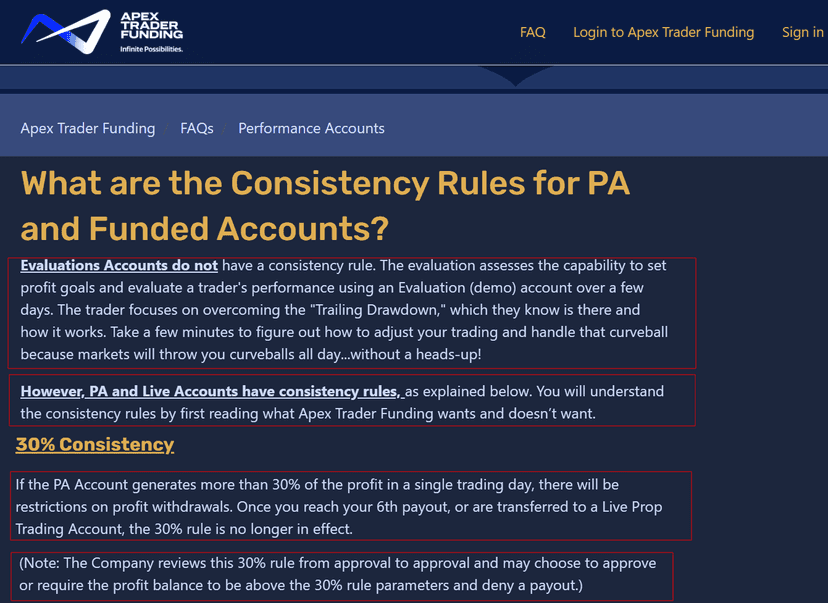
| Apex Trader Funding | Yes | 30% daily cap | Evaluation phase |
| FXIFY | No consistency rule | N/A | N/A |
| Maven Trading | No explicit rule | N/A | N/A (min trading days apply) |
| Goat Funded Trader | Optional (depends on plan) | 30% | Varies by plan type |
Important note: Firms change their rules frequently. Always check the latest terms before purchasing a challenge. The prop trading landscape shifted significantly heading into 2026, with several firms tightening or loosening rules in response to regulatory pressure and trader feedback. If you’re planning to use automation to maintain consistency, see our guide to the best EAs for passing prop firm challenges.
The FTMO Consistency Rule: Setting the Record Straight
There’s a lot of confusion around the FTMO consistency rule, so let’s be precise. FTMO does not have a formal consistency rule in the traditional sense. What they do have is a maximum daily loss limit (typically 5% of the initial account balance) and a maximum overall loss limit (typically 10%).
These loss limits indirectly promote consistency because you can’t risk your entire account on a single day. But FTMO won’t reject a payout simply because one day was more profitable than the others.
That said, FTMO has introduced scaling plans that reward consistent traders with higher account balances. The more consistently you perform, the faster you scale. So while there’s no hard consistency rule, consistent trading is still incentivized.
Why People Confuse FTMO with Consistency Rules
The confusion likely stems from three things:
- FTMO’s minimum trading day requirements (at least 4 calendar days during each evaluation phase)
- Their daily loss limit functioning as a soft consistency mechanism
- Other firms modeling their rules after FTMO and adding consistency rules on top
If you’re specifically looking for a firm without a traditional consistency rule, FTMO fits that description. But you’ll still need to manage risk daily.
How to Beat the Consistency Rule: 7 Proven Strategies
Let’s get practical. Here are seven concrete strategies to naturally comply with consistency rules without completely overhauling your trading approach.
1. Set a Daily Profit Cap
This is the most direct approach. If the consistency threshold is 30% and your profit target is $10,000, your best day can’t exceed $3,000. Once you hit that number, stop trading for the day.
Calculate your daily cap like this:
Daily Profit Cap = Total Profit Target x Consistency Threshold
For a $100,000 account with a $10,000 target and 30% rule: $10,000 x 0.30 = $3,000 max per day.
In practice, you want to aim for less than this. A buffer of $2,000-$2,500 per day gives you room for your other days to be smaller without triggering the rule.
2. Use Fixed Lot Sizing
Variable lot sizing is one of the fastest ways to fail the consistency rule. If you normally trade 1 lot but double up to 2 lots on a “high-conviction” setup, your P&L variance spikes immediately.
Stick to a fixed lot size throughout the evaluation period. If you trade 0.5 lots on EUR/USD, trade 0.5 lots every session. Your winners and losers will naturally stay within a tighter range.
3. Trade the Same Number of Sessions Per Day
Consistency isn’t just about money; it’s about behavior. If you trade 3 setups on Monday and 12 on Wednesday, your P&L distribution will be erratic. Aim for a fixed number of trade setups per session, typically between 2 and 5, and close your charts once you’ve hit that number.
4. Avoid News Events During Evaluations
High-impact news releases (NFP, FOMC, CPI) create abnormal volatility. One news trade can easily produce a P&L spike that blows your consistency score, even if the trade was well-managed.
During an evaluation with a consistency rule, consider sitting out major news events entirely. The risk-reward of news trading during an evaluation is poor when consistency is being measured.
Pro tip: Mark your economic calendar at the start of each evaluation period. Identify the high-impact events and plan your trading schedule around them.
5. Spread Your Profit Target Across Minimum Trading Days
Work backwards from the math. If you need $10,000 in profit and the firm requires a minimum of 10 trading days, your average daily target is $1,000. With a 30% consistency rule, your max daily profit is $3,000.
Build your trading plan to aim for $800-$1,200 per day. Some days you’ll hit $1,500, others $400. As long as no single day balloons past $3,000, you’re safe.
6. Bank Profits Early and Slow Down
A common mistake is starting conservatively, falling behind the profit target, and then increasing risk to catch up. This creates exactly the kind of P&L spike that triggers consistency violations.
Flip that approach. Start strong with your normal risk, and once you’re ahead of pace, reduce your lot sizes or take fewer trades. Front-loading your profits gives you a cushion to trade smaller later without pressure.
7. Keep Your EA Running 24/5 on a VPS
If you trade with an expert advisor, consistency depends on execution. Missed sessions because your home PC restarted, lost power, or dropped internet will create gaps in your trading record, followed by catch-up periods with larger positions.
Running your EA on a dedicated forex VPS optimized for prop trading ensures every session executes as planned. No missed entries, no catch-up trading, no P&L spikes from inconsistent uptime.

Common Mistakes That Trigger Consistency Violations
Even traders who understand the rule often trip over it. Here are the patterns we see most often.
Revenge Trading After a Loss
You have a -$800 day. The next morning, you double your lot size to “make it back.” You net +$3,200, which feels like a win until the consistency rule flags that day as an outlier. The revenge trade didn’t just recover your loss; it torpedoed your consistency score.
Scaling Up Mid-Evaluation
Some traders start with conservative sizing, gain confidence as the evaluation progresses, and gradually increase lots. By the final week, they’re trading 2-3x their original size. The last few days dominate the P&L, and the consistency rule catches it.
Holding Trades Overnight Into News
You enter a position at 3 PM EST and hold it through the Asian session. Overnight, a central bank announcement gaps the pair 80 pips in your favor. Your closed P&L for that day dwarfs everything else in your journal. The consistency rule doesn’t care that you didn’t actively trade the news; the result still counts.
Ignoring the Rule Until Payout
This is the most painful mistake. You hit your profit target, request a payout, and only then discover that your day-3 blowout trade represents 42% of your total profit. Now you need to keep trading to dilute that day’s percentage, risking the entire account in the process.
Track your consistency score daily. A simple spreadsheet with daily P&L and a running consistency check saves you from nasty surprises.
Consistency Rule Calculator: Do the Math Yourself
You don’t need a fancy tool. Here’s how to track your consistency in a spreadsheet or notebook.
Step-by-Step Calculation
- Record your daily P&L at the close of each trading day (include both realized and floating P&L if the firm counts open positions)
- Sum your total profit for the evaluation period so far
- Identify your best single day (the highest individual daily P&L)
- Divide best day by total profit: (Best Day / Total Profit) x 100
- Compare to the threshold: If the result exceeds the firm’s cap (e.g., 30%), you’re in violation
Example With Real Numbers
| Trading Day | P&L | Cumulative Total | Best Day | Consistency % | Status (30% Rule) |
|---|---|---|---|---|---|
| Day 1 | +$600 | $600 | $600 | 100% | N/A (too early) |
| Day 2 | +$450 | $1,050 | $600 | 57.1% | Failing |
| Day 3 | +$800 | $1,850 | $800 | 43.2% | Failing |
| Day 4 | +$550 | $2,400 | $800 | 33.3% | Failing |
| Day 5 | +$700 | $3,100 | $800 | 25.8% | Passing |
| Day 6 | +$650 | $3,750 | $800 | 21.3% | Passing |
| Day 7 | +$500 | $4,250 | $800 | 18.8% | Passing |
Notice how the consistency percentage naturally improves as you add more trading days with moderate gains. The key takeaway: time and steadiness are your allies. The more days you trade at a reasonable level, the less impact any single day has on your overall score.
Prop Firms Without a Consistency Rule
If the consistency rule doesn’t fit your trading style, several reputable firms in 2026 either don’t enforce one or offer plans without it.
Firms With No Consistency Rule
- FTMO – Uses daily loss limits instead (5% daily, 10% total). No formal consistency scoring.
- FXIFY – No consistency rule on any plan. Popular among swing traders and news traders.
- Maven Trading – No explicit consistency requirement. Minimum trading day requirements apply.
Firms With Optional Consistency Rules
- Goat Funded Trader – Some plan types include consistency rules, others don’t. Check the specific challenge you’re buying.
- The Funded Trader – Consistency requirements vary by program type. Their rapid challenge often has looser rules than the standard evaluation.
What to Consider Before Choosing a No-Consistency Firm
Firms without consistency rules often compensate with tighter rules elsewhere. You might face lower daily loss limits, stricter drawdown calculations, or higher profit targets. Always compare the full rule set, not just one parameter.
Also consider this: if you can’t pass a consistency rule, that might be a signal worth paying attention to. Consistent profitability is the foundation of long-term trading success. The rule might be frustrating, but the habit it builds is valuable.

How a VPS Helps You Maintain Consistency
Consistency isn’t just about strategy and discipline. It’s also about infrastructure. Your trading environment needs to be as reliable as your trading plan.
Eliminate Missed Sessions
Every missed trading session is a zero on your daily P&L. That means your profitable days carry more weight, pushing your consistency score higher. A VPS running 24 hours a day, 5 days a week eliminates downtime from power outages, internet drops, and Windows updates.
Consistent Execution Speed
Home internet latency fluctuates. During peak hours, your execution might be 200ms. At 3 AM, it’s 80ms. This variability affects fill prices, slippage, and ultimately your daily P&L variance. A forex VPS with sub-1ms latency to your broker delivers the same execution quality on every trade, every session.
Run Your EA Without Interruption
Expert advisors are inherently consistent. They follow the same rules, the same position sizing, the same risk parameters every single trade. But an EA can only be consistent if it’s actually running. A VPS with 100% uptime during trading hours ensures your automated strategy executes every signal it’s supposed to.
At NYCServers, our forex VPS plans are built specifically for traders who need reliable, always-on execution. With servers in New York (Equinix NY4), London, and Tokyo, and sub-1ms latency to major brokers and prop firm platforms, your EA runs exactly as intended, every session.
Building a Consistency-Friendly Trading Plan
Rather than treating the consistency rule as an obstacle to overcome, build it into your trading plan from the start. Here’s a framework.
Define Your Daily Risk Budget
Start with the consistency threshold. If the rule is 30% and your target is $10,000, your absolute max daily profit is $3,000. Set your daily risk at 0.5-1% of account balance, which naturally caps your upside on any given day while keeping losses manageable.
Choose a Session and Stick to It
Pick one or two trading sessions (London, New York, or overlap) and trade the same sessions every day. This standardizes your market conditions, volatility exposure, and number of opportunities. Your daily results will naturally cluster around a tighter range.
Use a Trading Journal with Consistency Tracking
Log every trade and calculate your running consistency score at the end of each day. Free tools like Google Sheets work fine. Track:
- Daily P&L (net, after commissions)
- Running total profit
- Best single day P&L
- Current consistency percentage
- Days remaining in evaluation
- Required average daily gain to hit target
Reviewing this data daily keeps you honest and lets you adjust before a problem becomes unfixable.
Plan for Losing Days
Losing days actually help your consistency score, as long as they’re small. A -$200 day followed by a $600 day is better for consistency than a $0 day followed by an $800 day. Don’t be afraid of small, controlled losses. They’re part of the math that works in your favor.
Remember: The consistency rule measures your best day relative to your total profit. Losing days lower your total, which means your best day becomes a larger percentage. Keep losses small and infrequent to avoid this trap.
Frequently Asked Questions
What is the consistency rule in prop trading?
The consistency rule is a risk management requirement used by many prop firms that limits how much of your total profit can come from a single trading day. Most firms set the cap at 30%, meaning no single day’s profit can exceed 30% of your total gains during the evaluation or funded period. It’s designed to ensure traders demonstrate repeatable performance rather than relying on one or two windfall trades.
How do you calculate the consistency rule?
Divide your best single day’s profit by your total profit for the period, then multiply by 100 to get a percentage. For example, if your total profit is $8,000 and your best day was $2,800, your consistency score is ($2,800 / $8,000) x 100 = 35%. If the firm’s threshold is 30%, you’d be in violation. Track this daily to stay ahead of potential issues.
Do all prop firms have a consistency rule?
No. Several well-known firms, including FTMO and FXIFY, don’t enforce a traditional consistency rule. They use other risk controls like daily loss limits and maximum drawdown rules instead. However, many newer firms and futures prop firms do include consistency requirements. Always read the full rule set before purchasing a challenge.
How do you beat the consistency rule without changing your strategy?
The simplest approach is setting a daily profit cap. Calculate the maximum allowable daily gain (profit target multiplied by the consistency threshold) and stop trading once you hit it. Using fixed lot sizes, trading the same sessions each day, and avoiding high-impact news events during evaluations also help maintain natural consistency without altering your core strategy.
Does the consistency rule apply during the challenge or only when funded?
It depends on the firm. Some firms apply the consistency rule only during the funded phase, while others enforce it during the evaluation challenge as well. A few firms apply it at every stage. Check the specific terms for your chosen firm and plan type, as rules can vary even between different challenge options at the same company.
Can a VPS help me pass the consistency rule?
Yes, especially if you trade with an expert advisor. A VPS ensures your EA runs without interruption, executing every session consistently. Missed sessions due to power outages, internet drops, or PC restarts create gaps that force catch-up trading, which leads to P&L spikes that violate consistency rules. A reliable VPS with 100% uptime during trading hours eliminates this risk entirely.
What happens if you fail the consistency rule?
The consequences depend on the firm and the phase you’re in. During an evaluation, failing the consistency rule typically means you don’t pass the challenge, even if you hit the profit target. During the funded phase, it can delay or block your payout request. Some firms give you additional time to trade your way back into compliance, while others require you to start a new evaluation.

About the author
Thomas Vasilyev
Writer & Full Time EA Developer
Tom is our associate writer, and has advanced knowledge with the technical side of things, like VPS management. Additionally Tom is a coder, and develops EAs and algorithms.
Areas of Expertise