
Prediction Market Strategies for Beginners (2026)
Learn prediction market strategies for beginners with real trade examples, bankroll management rules, and a step-by-step edge-finding workflow to profits.
Why Prediction Markets Reward Beginners Differently
Most financial markets punish new participants. You’re up against algorithms, institutional capital, and decades of accumulated expertise. Prediction markets flip that dynamic on its head.
Here’s why. Prediction markets price binary outcomes — will an event happen or not? The contracts trade between $0.01 and $1.00, representing the market’s implied probability of that event occurring. A contract priced at $0.65 means the crowd thinks there’s a 65% chance the event happens. If you buy at $0.65 and the event occurs, you collect $1.00. That’s a $0.35 profit per contract.
The edge for beginners comes from a structural advantage: prediction markets are still young. The participant pool is smaller, less sophisticated, and frequently driven by emotion rather than analysis. Unlike equities where mispricing gets arbitraged away in milliseconds, prediction market inefficiencies can persist for hours or even days.
You don’t need a Bloomberg terminal. You don’t need to understand options Greeks. You need the ability to assess probability better than a crowd that’s often reacting to headlines instead of doing the math. That’s a learnable skill, and this guide will show you exactly how to build it.
Key takeaway: Prediction markets reward independent research and probability thinking. If you can estimate the true likelihood of an event more accurately than the current market price, you have an edge — regardless of your experience level.
Your First Trade: A Step-by-Step Walkthrough with Real Numbers
Let’s walk through an actual first trade. No abstract theory. Real numbers, real decisions.
Step 1: Choose Your Platform and Deposit
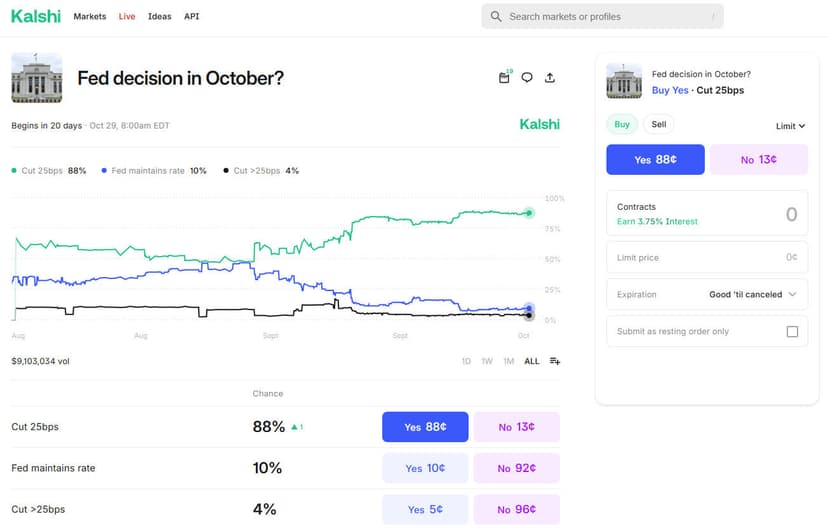
Sign up for a regulated prediction market platform like Kalshi (US-regulated, CFTC-approved) or Polymarket (crypto-based, broader market selection). For this walkthrough, we’ll use a $50 starting bankroll — small enough to learn without stress, large enough to execute meaningful trades.
Deposit your $50. Don’t add more until you’ve completed at least 20 trades. This constraint is intentional. It forces discipline.
Step 2: Browse Markets and Pick a Category You Understand
Scroll through available markets. You’ll see categories like economics (will the Fed raise rates?), weather (will a hurricane make landfall in Florida?), politics (will a bill pass the Senate?), and tech (will a company hit an earnings target?).
Pick a category where you already have above-average knowledge. A meteorology hobbyist has an edge in weather markets. A political junkie has an edge in election markets. Start where you’re already informed.
Step 3: Analyze the Contract
Let’s say you find a market: “Will US monthly CPI exceed 3.5% for March 2026?” The current YES price is $0.30, meaning the market implies a 30% probability.
Now do your homework:
- Check the latest CPI data and trend (has it been rising or falling?)
- Read the most recent Fed minutes and economic forecasts
- Look at consensus estimates from major economic surveys
- Check what related markets are pricing (Fed rate decision markets, inflation expectation markets)
After your research, suppose you estimate the true probability at 45%. The market says 30%. That 15-percentage-point gap is your perceived edge. If you want a deeper dive into how these prices translate to probabilities, read our guide on how prediction market odds work.
Step 4: Size Your Position and Execute
With a $50 bankroll and a beginner’s sizing rule (never risk more than 5% of your bankroll on a single trade), your maximum position is $2.50 in risk.
At $0.30 per YES contract, you can buy 8 contracts for $2.40. Here are the outcomes:
| Outcome | Revenue | Cost | Profit/Loss | Return |
|---|---|---|---|---|
| CPI exceeds 3.5% (YES wins) | $8.00 | $2.40 | +$5.60 | +233% |
| CPI does not exceed 3.5% (NO wins) | $0.00 | $2.40 | -$2.40 | -100% |
If your 45% probability estimate is correct, your expected value is: (0.45 x $5.60) – (0.55 x $2.40) = $2.52 – $1.32 = +$1.20 expected profit per trade. That’s a positive expectation bet. Place the trade.
Step 5: Monitor and Learn
After placing the trade, track how the market moves as new information emerges. Did the price move toward your estimate? Did you miss information others caught? Win or lose, document what happened and what you’d do differently. This trade journal becomes your most valuable asset.
5 Beginner Strategies That Actually Work
These aren’t theoretical frameworks you’ll read and forget. Each strategy includes when to use it, how it works mechanically, and what to watch out for.
Strategy 1: Value Buying on Overlooked Markets
High-profile markets (presidential elections, major economic indicators) attract the most attention and are usually priced efficiently. The edge lives in markets that fewer people are watching.
Look for:
- Niche regulatory decisions (FDA approvals, FCC rulings)
- State-level political outcomes
- Specific weather events in less-covered regions
- Tech product launches or milestone dates
These markets have thinner participation. When you bring genuine research to a thin market, your edge is larger. A contract priced at $0.50 that you’ve researched to a 70% true probability is a gift.
Strategy 2: Trading the Reaction (Fade the Crowd)
When major news breaks, prediction market prices whipsaw. The crowd overreacts. This creates opportunities to fade the emotional move.
Here’s the workflow: a news event drops that’s tangentially related to a market. The price spikes from $0.40 to $0.70 in minutes. You assess whether the news actually changes the fundamental probability by that much. If your analysis says the true probability only moved to $0.55, you sell (or buy NO) at $0.70 and wait for the reversion.
This strategy requires quick analysis and a cool head. It works best during high-volatility moments when emotional traders are most active.
Strategy 3: Niche Specialization
Instead of trading across every category, pick one domain and go deep. Become the person who knows more about FDA drug approval timelines than anyone else on the platform. Or the person who tracks NOAA weather models religiously.
Specialization creates compounding advantages:
- You build a mental database of base rates over time
- You learn which information sources move prices first
- You develop intuition for when prices are miscalibrated in your niche
- Your research gets faster because you already have the context
Most profitable prediction market traders are specialists, not generalists. Pick your lane early.
Strategy 4: Portfolio Diversification Across Uncorrelated Events
Don’t put all your capital into one market. Spread it across events that have no connection to each other. A weather contract in the Pacific, a Senate vote outcome, and a tech earnings market have essentially zero correlation.
Why this matters: even with a genuine edge, individual trades lose frequently. A strategy with 60% accuracy still loses 40% of the time. Diversification smooths your equity curve and reduces the emotional toll of individual losses. Aim for 5-10 active positions across at least 3 different categories at any given time. Managing that many concurrent positions is where traders start to benefit from a forex VPS running automated price alerts around the clock.
Strategy 5: Early Exit Discipline
You don’t have to hold every contract to expiration. This is one of the most underutilized prediction market trading tips for beginners.
Say you bought YES at $0.30 and the price has moved to $0.65. You could hold for the potential $1.00 payout, or you could sell now and lock in $0.35 per contract — a 117% return. If the remaining upside doesn’t justify the risk, take the profit.
Rules for early exits:
- If a position has doubled in value and your edge has narrowed, take at least half off the table
- If new information makes your original thesis weaker, exit regardless of profit or loss
- If a better opportunity appears and you need the capital, redeploy without hesitation
Pro tip: Track your early exits separately. After 50+ trades, compare the returns from early exits vs. holds-to-expiration. The data will tell you whether you’re exiting too early, too late, or at the right time.
Bankroll Management: The Rules That Keep You in the Game
Every profitable prediction market trader has a bankroll management system. Every blown-up account didn’t. These aren’t suggestions. They’re survival rules.
The 5% Rule
Never risk more than 5% of your total bankroll on a single position. With a $50 bankroll, that’s $2.50 max per trade. With a $500 bankroll, it’s $25. This ensures no single loss can meaningfully damage your ability to keep trading.
The Scaling Ladder
Your position sizes should grow only as your bankroll grows. Here’s a practical progression:
| Bankroll Size | Max Per Trade (5%) | Target Active Positions | Max Total Exposure |
|---|---|---|---|
| $50 (learning) | $2.50 | 5-8 | $20 (40%) |
| $200 (developing) | $10.00 | 8-12 | $100 (50%) |
| $500 (intermediate) | $25.00 | 10-15 | $300 (60%) |
| $2,000+ (experienced) | $100.00 | 15-25 | $1,400 (70%) |
Notice the max total exposure column. Even if you have 15 positions open, you shouldn’t have more than 60-70% of your bankroll deployed. Cash reserves let you jump on sudden opportunities without liquidating existing positions at unfavorable prices.
The Drawdown Circuit Breaker
If your bankroll drops 20% from its peak, stop trading for 48 hours. Review every losing trade. Identify whether you had bad luck (correct analysis, wrong outcome) or bad process (flawed analysis, predictable loss). Only resume trading after you’ve documented the review.
This circuit breaker prevents the most common account killer: tilt-driven revenge trading after a losing streak.
How to Find Your Edge: A Systematic Research Workflow
Finding mispriced contracts isn’t random. It’s a repeatable process. Here’s the workflow that turns prediction market trading from gambling into a structured operation.
Step 1: Daily Market Scan (10 Minutes)
Every morning, scan the available markets on your platform. Flag any contracts where the price surprises you — where your gut reaction is “that seems too high” or “that seems too low.” Don’t trade on gut reactions alone, but use them as a screening mechanism.
Step 2: Base Rate Research (15-20 Minutes per Flagged Market)
For each flagged market, find the historical base rate. If the market asks “Will X happen?”, find out how often X has happened in comparable past situations.
Examples:
- Weather market: Check the historical frequency of the specific weather event in that region during that time period. NOAA has decades of data.
- Economic market: Look at how often the specific economic indicator has exceeded the threshold in similar macroeconomic conditions.
- Political market: Find historical vote counts, polling data, and expert forecasts for similar legislative situations.
Base rates are your anchor. The market price should roughly align with the base rate plus adjustments for current circumstances. When it doesn’t, you’ve found a potential opportunity.
Step 3: Information Edge Assessment (5 Minutes)
Ask yourself three questions:
- Do I know something the market hasn’t priced in yet?
- Am I interpreting publicly available information differently (and more accurately) than the consensus?
- Is there a structural reason this market is mispriced (low liquidity, emotional crowd, stale pricing)?
If you can’t answer yes to at least one of these, skip the trade. No edge means no trade. Discipline here is what separates profitable traders from recreational gamblers.
Step 4: Document and Track
For every trade you take, record: the market, your probability estimate, the market price at entry, your reasoning, and the eventual outcome. After 50 trades, analyze your calibration. Are your 70% confidence trades winning roughly 70% of the time? If you’re consistently overconfident or underconfident, adjust your estimation process accordingly.
A simple spreadsheet works. The key is consistency. Every trade gets documented. No exceptions.
Common Beginner Mistakes and How to Avoid Them
Every prediction market beginner makes some of these errors. Knowing them in advance won’t prevent all of them, but it’ll reduce the damage.
Mistake 1: Confusing Conviction with Edge
Feeling strongly about an outcome is not the same as having an analytical edge. “I just know the Fed will cut rates” isn’t analysis. “Historical data shows the Fed has cut rates in 8 of 10 comparable situations, and the current market is pricing only a 40% chance” is analysis. Always quantify your reasoning.
Mistake 2: Ignoring Opportunity Cost
Capital locked in a mediocre trade can’t be deployed elsewhere. If a contract won’t resolve for 6 months and your expected return is 15%, your annualized return is far lower. Compare that to multiple shorter-duration trades that might each return 30-50% over weeks. Time is a factor. Always consider when a contract expires, not just what it pays.
Mistake 3: Overtrading
Not every market scan needs to produce a trade. Some days you won’t find an edge. That’s normal and healthy. Forcing trades when no edge exists is the fastest way to drain a bankroll. Quality over quantity. Ten well-researched trades per month will outperform fifty impulse trades.
Mistake 4: Anchoring to Your Entry Price
You bought at $0.40. The price drops to $0.25. New information suggests the true probability is now 20%. But you hold because “it’ll come back.” This is anchoring bias. Your entry price is irrelevant to the current expected value of the position. If the math says sell, sell. Cut losses based on updated analysis, not on what you paid.
Mistake 5: Neglecting Fees and Spreads
Platform fees, bid-ask spreads, and withdrawal costs eat into profits. A 5% edge on paper can become breakeven or negative after costs. Before entering any trade, calculate your expected profit after all fees. If the edge doesn’t survive the fee structure, skip it.
When to Level Up: From Manual Trading to Automation
Once you’ve completed 100+ trades, built a documented track record, and developed a consistent edge in at least one niche, you’ll start noticing a bottleneck: time. Manually scanning markets, executing trades, and monitoring positions doesn’t scale.
This is where automation enters the picture.
The Automation Progression
Don’t try to automate everything at once. Follow this progression:
- Automated alerts: Set up scripts that scan prediction market APIs and notify you when prices hit your target levels. This alone saves hours of manual monitoring.
- Automated data collection: Build scrapers that aggregate news, economic data, and market prices into a dashboard. Your research workflow gets faster when the data comes to you.
- Semi-automated execution: Create tools that pre-calculate position sizes, expected values, and place orders with one-click confirmation. You still make the decision, but execution is instant.
- Fully automated strategies: For well-tested, rule-based strategies (like buying when prices deviate from a base rate by X%), let the system execute without manual intervention.
Infrastructure Matters
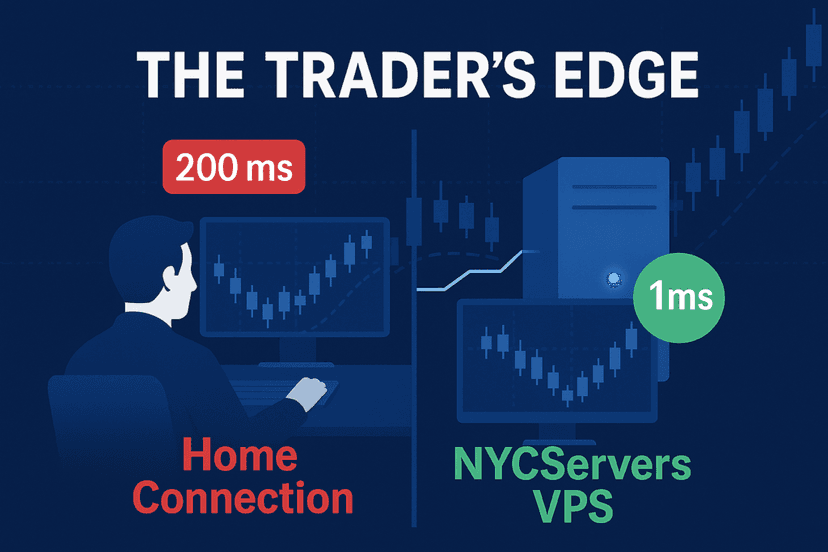
Automated prediction market tools need to run 24/7. Your laptop going to sleep or your home internet dropping out means missed opportunities. Serious traders run their monitoring scripts, alert systems, and execution tools on dedicated infrastructure that stays online around the clock.
A virtual private server gives you that always-on environment. Your scripts run continuously on a remote machine with guaranteed uptime, independent of your local setup. To ensure your trading setup never misses a beat, check out our prediction market VPS service.
The requirements are modest for prediction market automation — you don’t need heavy compute. But you need reliability. A monitoring script that goes offline for 4 hours during a market-moving event defeats the entire purpose of automation.
APIs and Tools to Know
Most prediction market platforms offer APIs that let you pull market data and place trades programmatically. Kalshi and Polymarket both have well-documented APIs. Python is the most common language for building trading tools, with libraries available for API interaction, data analysis, and scheduling.
Start small. A simple Python script that pulls current prices for your watched markets and compares them to your model’s estimated probabilities can surface opportunities you’d otherwise miss. Run it on a VPS, check the output each morning, and you’ve already gained an operational advantage over 90% of participants.
Building Your Prediction Market Playbook
The gap between reading about prediction market strategies and profiting from them is execution. Here’s how to bridge it in your first 30 days.
Week 1: Deposit $50. Make 3-5 small trades in your area of expertise. Focus on the process, not the outcome. Document everything.
Week 2: Implement the daily scan workflow. Flag 2-3 markets per day. Only trade the ones where your research gives you a clear probability edge of 10+ percentage points.
Week 3: Review your first 10-15 trades. Check your calibration. Are you overconfident? Underconfident? Adjust your estimation process based on the data.
Week 4: Specialize. Pick the one category where your win rate is highest and go deeper. Increase position sizes only if your bankroll has grown. Start exploring automation tools for your scanning workflow.
The traders who profit consistently in prediction markets aren’t smarter. They’re more systematic. They have a process for finding edge, rules for managing risk, and discipline to follow both. Everything in this guide gives you that foundation. Now it’s time to place that first trade.
Frequently Asked Questions
How much money do I need to start trading prediction markets?
You can start with as little as $50. Many platforms have no minimum deposit requirement, and individual contracts can cost as little as $0.01. Starting small lets you learn the mechanics, test your analysis process, and build a track record without risking meaningful capital. Scale up only after you’ve demonstrated a consistent edge over at least 50 trades.
Are prediction markets legal in the United States?
Yes, with caveats. Kalshi is a CFTC-regulated exchange that’s legal for US residents. Polymarket operates on a crypto-based model and has restrictions for US users. The regulatory landscape continues to evolve in 2026, so check the current status of any platform before depositing funds. Always use regulated platforms when available.
What’s the difference between prediction markets and sports betting?
The mechanics are similar — you’re wagering on outcomes — but the edge-finding process differs fundamentally. Sports betting markets are extremely efficient because of the volume of sharp bettors and modeling tools. Prediction markets cover events (economic data, political outcomes, weather) where far fewer participants do rigorous analysis. This means mispricings are more common and more exploitable for someone willing to do the research.
How do I know if I actually have an edge?
Track every trade in a spreadsheet with your estimated probability and the market price at entry. After 50+ trades, compare your estimated probabilities to actual outcomes. If you estimate events at 70% and they happen approximately 70% of the time, you’re well-calibrated. If your calibration is good and you’re consistently buying below your estimated probability, you have a genuine edge. If not, you need to refine your analysis process before scaling up.
Can I lose more than I invest on a prediction market trade?
No. Unlike leveraged forex or futures trading, prediction market contracts have a defined maximum loss. If you buy a YES contract at $0.40, the most you can lose is $0.40 per contract. There are no margin calls and no leverage-amplified losses. Your risk on any trade is always equal to the amount you paid for the contracts.
What are the best prediction market platforms for beginners in 2026?
Kalshi is the top choice for US-based beginners due to its regulatory status, clean interface, and straightforward deposit/withdrawal process. Polymarket offers a wider variety of markets and a more active community, though it requires crypto (USDC) for deposits. Both platforms have low minimum trade sizes and educational resources. Start with whichever platform aligns with your comfort level around crypto vs. traditional banking.
How much time does prediction market trading take per day?
For a manual approach, expect 30-45 minutes daily: 10 minutes for market scanning, 15-20 minutes for research on flagged opportunities, and 5-10 minutes for trade execution and journaling. As you automate parts of the workflow (alerts, data aggregation, price monitoring), the active time drops to 15-20 minutes of decision-making. The time investment is front-loaded — your first month will take more research time as you build your knowledge base.

About the author
Thomas Vasilyev
Writer & Full Time EA Developer
Tom is our associate writer, and has advanced knowledge with the technical side of things, like VPS management. Additionally Tom is a coder, and develops EAs and algorithms.
Areas of Expertise