
Prediction Market Arbitrage Guide: Strategies for 2026
Learn how traders extracted $40M+ in prediction market arbitrage profits. Complete guide to Polymarket and Kalshi arbitrage strategies, tools, and risks.
What Prediction Market Arbitrage Really Is
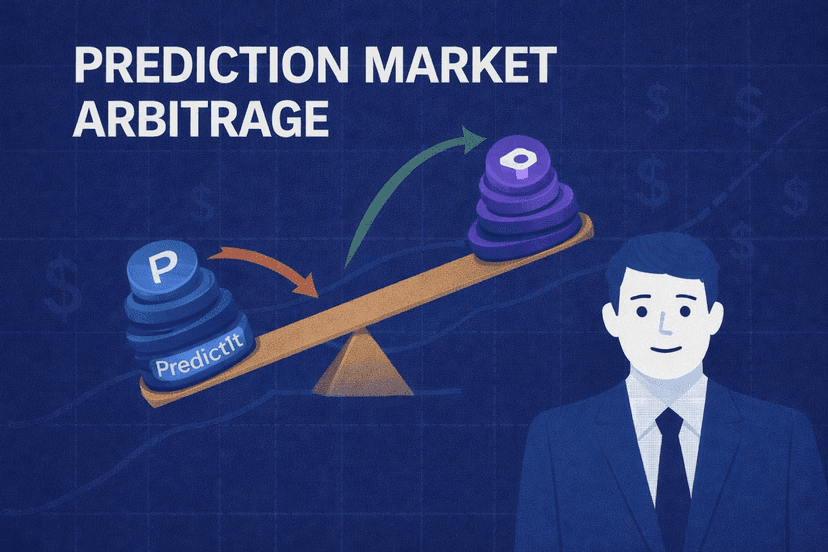
Prediction market arbitrage is the practice of locking in profit by exploiting price disagreements on binary event contracts. Every contract settles at $1.00 if its outcome happens and $0.00 if it does not, so a “Yes” trading at 79¢ is the market saying there is a 79% implied chance the event occurs. When a set of prices that must logically sum to $1.00 does not, a trader can buy the mispriced combination and collect the guaranteed dollar regardless of the result.
Academic work put hard numbers on this. The paper “Unravelling the Probabilistic Forest” from IMDEA Networks documented over $40 million in arbitrage profits extracted from Polymarket alone between April 2024 and April 2025, across 86 million bets and more than 7,000 markets with measurable mispricings. But the same study showed those profits went overwhelmingly to a handful of fast, automated wallets — the top three earned $4.2 million combined. This guide uses live prices captured during writing to show what these opportunities actually look like, and why most of them are thinner than the headlines suggest.
What You Need Before You Start
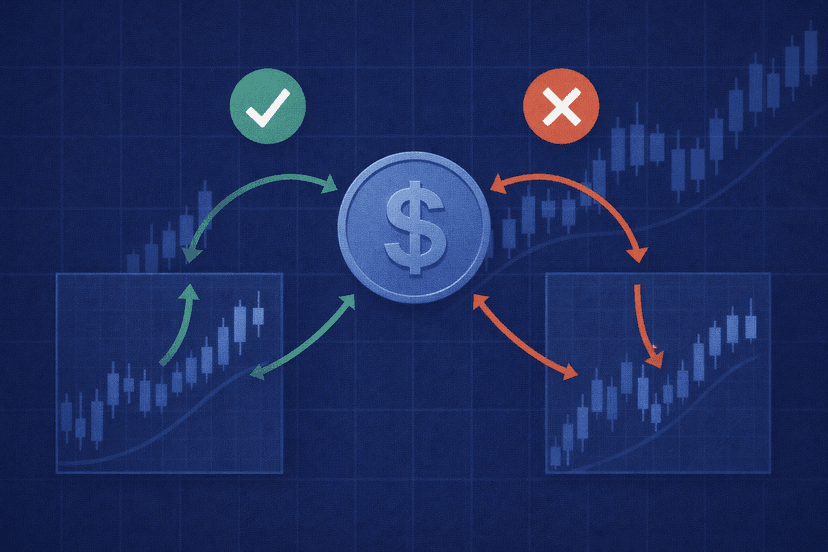
Before you start hunting spreads, get the prerequisites in place — arbitrage rewards preparation, not improvisation. You need funded, verified accounts on at least two venues, because most durable edges live between platforms. You need to understand how a price maps to a probability; if that is new, read our primer on how prediction market odds work first.
Here is the short checklist of what you need in hand:
- Capital on each platform you plan to trade — you cannot move funds between Polymarket and Kalshi mid-trade, so both legs must be pre-funded.
- A way to read both order books at once, ideally programmatically through each venue’s API.
- A spreadsheet or script that computes the true cost of a basket after fees, not just the headline prices.
- A written rule for maximum position size per opportunity (covered below).
If you are still learning the mechanics of the venues themselves, our beginner strategy walkthrough cover the groundwork this guide assumes.
Same-Market Arbitrage: A Live Polymarket Example
The simplest arbitrage lives inside a single event. Take Polymarket’s “Fed Decision in July?” market, priced live while writing this guide. It offers five mutually exclusive outcomes, and exactly one of them must resolve “Yes.” Here were the live “Buy Yes” prices:
| Outcome | Buy Yes price | Volume |
|---|---|---|
| No change | 79¢ | $11.0M |
| 25 bps increase | 18.4¢ | $10.7M |
| 25 bps decrease | 0.9¢ | $7.1M |
| 50+ bps increase | 0.4¢ | $8.0M |
| 50+ bps decrease | 0.2¢ | $7.8M |
Add every “Yes” leg together: 79 + 18.4 + 0.9 + 0.4 + 0.2 = 98.9¢. Because one outcome is guaranteed to pay $1.00, buying the complete basket for 98.9¢ looks like a locked 1.1¢ profit per dollar, a 1.1% gross edge. This is textbook same-market rebalancing arbitrage: the pieces of a certain event summed to less than a dollar.
Now apply the fees. Polymarket charges roughly 2% on the winning position, so the payout on the single winning leg is closer to 98¢ net. That turns the 1.1¢ gross edge into a net loss of about 0.9¢ per basket. The opportunity was real on paper and gone after fees — which is exactly why the IMDEA study found the profitable players were sub-second bots capturing rare, wider dislocations, not this kind of penny spread.
Cross-Platform Arbitrage: Polymarket vs Kalshi
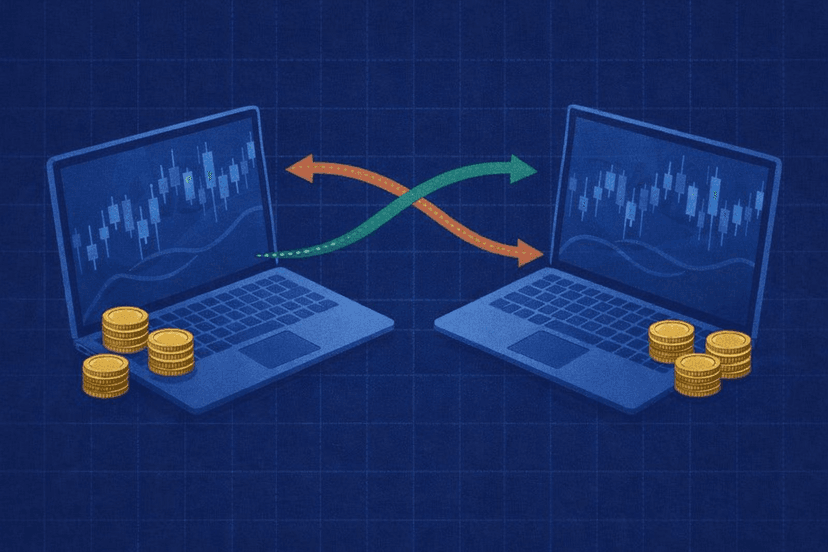
The more accessible edge sits between venues. During the same session, Polymarket priced “No change” at the July FOMC meeting at 79¢ — an implied 79% chance the Fed holds. Over on Kalshi, the matching rate ladder told a slightly different story. Kalshi’s “Above 3.50%” contract traded at a 98¢ Yes, while “Above 3.75%” traded at a 16–17¢ Yes. The gap between those two thresholds is the market’s implied probability the rate finishes exactly in the current band: roughly 0.98 − 0.16 = 82%.
So the same real-world question — does the Fed hold in July? — was priced at 79% on Polymarket and about 82% on Kalshi, a three-point disagreement. If the two contracts were identical, you would buy “hold” on the cheaper venue (Polymarket at 79¢) and “not hold” on the other (Kalshi’s implied 18¢), paying 97¢ for a guaranteed dollar and pocketing 3¢ before fees.
The catch is structural, and it is the whole lesson: the contracts are not identical. Polymarket prices the event as change buckets (no change, 25 bps, 50+ bps); Kalshi prices it as a rate-threshold ladder. Their “no change” and Kalshi’s “stays in band” can resolve differently on an edge case, so what looks like a locked 3¢ is really a directional bet with settlement risk once fees eat most of the spread.
Position Sizing: How Much to Stake
Finding an edge is half the job; sizing it correctly is what keeps you solvent. There are two cases, and they use different math.
Step 1 — size a locked (risk-free) basket. When both legs are genuinely guaranteed, the formula is mechanical:
Basket cost C = leg A price + leg B price. Edge e = $1.00 − C − fees. Contracts N = min(order-book depth, bankroll ÷ C). Guaranteed profit = N × e.
Using the Polymarket basket above with a $5,000 bankroll: C = 0.989, so bankroll ÷ C allows about 5,055 baskets — but the order book only supported a few hundred contracts at those prices. If depth caps you at 500 baskets and the post-fee edge is negative, N × e tells you to pass. The formula’s real job is to kill bad trades before you place them.
Step 2 — size a directional edge with fractional Kelly. When a “spread” is really a probability bet (like the cross-platform example), never stake the full Kelly fraction. Compute f* = (b×p − q) ÷ b, where b is the payout odds, p is your estimated probability, and q = 1 − p. Say you believe “hold” is truly 88% but Polymarket prices it at 79¢: b = (1 − 0.79) ÷ 0.79 = 0.27, giving a full-Kelly fraction near 43% of bankroll — far too aggressive for an event with settlement and execution uncertainty.
Finally, divide by four. Quarter-Kelly (f* ÷ 4) brings that to roughly 11%, or about $535 of a $5,000 bankroll — a stake you can survive being wrong on. The rule of thumb: locked baskets use the guaranteed-profit formula, everything else uses quarter-Kelly, and any trade whose edge disappears after fees gets zero.
One more discipline separates survivors from the roughly 2.9-to-1 majority who lose money on these venues: cap your total exposure across all open arbitrage pairs, not just each pair on its own. If five “locked” baskets all depend on the same platform staying solvent and honoring its resolution rules, they are not five independent bets — they are one concentrated bet on that venue. Size the correlated cluster as a single position, and keep dry powder for the wider dislocations that actually clear the fee hurdle.
Fees, Slippage, and Settlement Risk
Three forces turn paper profits into real losses, and every serious arbitrageur budgets for all three. Fees come first: Polymarket takes roughly 2% on winning positions and Kalshi charges up to a 3% taker fee, so a combined 5% drag means any spread under about 6% is dead on arrival. Slippage is second: order books are shallow on niche markets, so a displayed 3% edge on a $1,000 trade may only fill $100 at that price before the book moves against you. Settlement risk is third and most dangerous — the 2024 government-shutdown episode saw Polymarket and Kalshi resolve the “same” event in opposite directions because their rule wording differed, turning a hedged pair into a total loss.
Troubleshooting the common failures helps you fix them before they cost money:
- Edge vanishes on entry: your second leg filled at a worse price. Fix it with simultaneous limit orders and automation, never two manual clicks.
- Both legs lost: the venues used different resolution criteria. Fix it by reading both contracts’ settlement rules word-for-word before funding a pair.
- Can’t fill size: the book was thinner than the top-of-book quote. Fix it by sizing to real depth, not the displayed price.
These same asymmetries are what market makers harvest from the other side — our prediction market making guide shows how liquidity providers profit from the spreads that punish careless arbitrageurs. And because thin markets attract informed flow, review our notes on prediction market insider trading risks before you assume a suspiciously wide spread is free money.

Infrastructure: Low-Latency VPS for Prediction Market Arbitrage
Every example above shares one requirement: speed. The same-market basket closed in milliseconds, and the cross-platform gap moved every time either book updated. Capturing these fills by hand is essentially impossible, which is why the profitable wallets in the research ran automated bots on always-on, low-latency servers. A home connection adding 80–150ms of latency and a laptop that might sleep are liabilities when a spread lasts a few hundred milliseconds.
Active arbitrageurs solve this with a bot on a trading-optimized VPS positioned close to the venues where prediction market brokers how their servers. If you are building an arbitrage bot, our guide to why prediction-market bots need a VPS and our roundup of the best prediction market bots and tools cover the ground work for valuable information you need. NYCServers runs VPS plans from $25/month with 1ms latency to major prediction market infrastructure — the difference between catching a fleeting spread and watching it close. Just remember infrastructure sharpens a sound edge; it never creates one, and a fast server running a losing strategy only loses faster.
Frequently Asked Questions
Is prediction market arbitrage really risk-free?
Rarely. A same-market basket that sums under $1.00 is close to risk-free until fees erase it, but cross-platform trades carry settlement and execution risk because the two contracts are almost never worded identically. Treat “risk-free” as a spectrum, not a guarantee.
How much capital do I need to start?
Plan on at least $2,000–$5,000 split across platforms, because you must pre-fund both legs on separate venues. More capital helps you clear order-book depth, but start small while you learn how quickly real spreads close.
Can I do this manually without a bot?
Occasionally, but not profitably at scale. The live examples in this guide moved in milliseconds. Manual traders can catch rare wide dislocations, but the steady penny-and-nickel edges belong to automated systems with fast execution.
Why did my two legs both lose?
Almost always a settlement mismatch: the platforms resolved the same real-world event by different rules. This is the single biggest cross-platform risk, so read both contracts’ resolution criteria in full before funding a paired trade.
Do fees really matter that much?
Yes. With Polymarket near 2% and Kalshi up to 3%, a combined 5% drag means spreads under roughly 6% are unprofitable. Always compute the post-fee edge before sizing, not the headline price gap.

About the author
Thomas Vasilyev
Writer & Full Time EA Developer
Tom is our associate writer, and has advanced knowledge with the technical side of things, like VPS management. Additionally Tom is a coder, and develops EAs and algorithms.
Areas of Expertise