
Maven Trading Review 2026: Pricing, Rules & Verdict
Read our Maven Trading review for 2026, including pricing, rules, payouts, platforms, pros, cons, VPS setup, trader fit, and who should use it.
Maven Trading Review 2026 Verdict
Maven Trading is a low-cost prop firm that will appeal most to traders who want inexpensive access to funded-account style programs and are comfortable reading rules carefully before they trade. The headline attraction is price. Maven regularly shows challenge options that cost much less than many larger prop firms, and the official Maven Trading pricing page lists several paths, including one-step, two-step, three-step, OMO-style, and instant-style accounts.
The tradeoff is that Maven is not the simplest prop firm to evaluate from the outside. Its pricing changes by account size and program type, some rules are model-specific, and the exact drawdown, payout, refund, and consistency requirements can differ depending on which challenge you buy. That makes Maven more attractive to detail-oriented traders than to beginners who want one simple rulebook.
For 2026, the practical verdict is this: Maven Trading can be worth considering if you want a budget prop firm, you understand drawdown rules, and you can follow payout and trading restrictions without improvising. It is less attractive if you want the longest track record, the broadest regulatory comfort, or a challenge with rules that are easy to summarize in one paragraph.

What Is Maven Trading?
Maven Trading is a forex and CFD prop trading firm. Instead of giving every trader a live account immediately, Maven offers several evaluation-style programs where traders attempt to meet profit targets while staying inside drawdown and trading-rule limits. If a trader passes the evaluation and remains compliant, the trader can progress to a funded or simulated-funded account structure where profits are shared.
The basic appeal is familiar in the prop firm market: a trader pays a challenge fee, proves they can manage risk, and gets access to a larger notional account than they might trade personally. Maven competes heavily on affordability. The brand is often discussed as a budget prop firm because small accounts can start at relatively low prices, while larger accounts and instant-style options cost more.

Maven is not only a pricing story, though. Traders also need to understand the firm by rule type. A cheap challenge is not useful if the trader’s strategy conflicts with minimum hold times, daily drawdown calculations, news restrictions, maximum open risk limits, or payout caps. That is why this review focuses less on hype and more on the actual questions a trader should answer before buying.
Maven Trading Pricing And Challenge Types
Maven’s pricing is account-size dependent, so there is no single fee that represents the whole firm. The current official pricing page shows multiple account sizes and program types, with smaller accounts at the low end and larger or more direct funding-style accounts costing more. The important point is not just the entry price, but what that price buys.
Maven commonly presents several challenge structures. The one-step model is designed for traders who want one evaluation phase. The two-step model usually spreads the evaluation across two phases and can be more forgiving for traders who prefer proving consistency over a longer path. The three-step model uses smaller phase targets but adds more checkpoints. OMO-style and instant-style options add another layer, and these should be reviewed against Maven’s current rule language before purchase.
For traders comparing Maven with other firms, the closest internal comparison is our guide to instant funding prop firms. Instant funding can look attractive because it reduces or removes the evaluation path, but it usually comes with tighter rules, higher upfront fees, or more restrictive withdrawal terms. The best option depends on whether your edge is consistency, speed, or low starting cost.
One important pricing detail: Maven’s official pricing language may include coupon pricing and refund language. Do not assume a review page, screenshot, or cached search result is current. Before buying, verify the exact account size, platform, challenge type, discount code, refund timing, and payout rule directly on Maven’s checkout or pricing page.
Maven Trading Rules That Matter Most
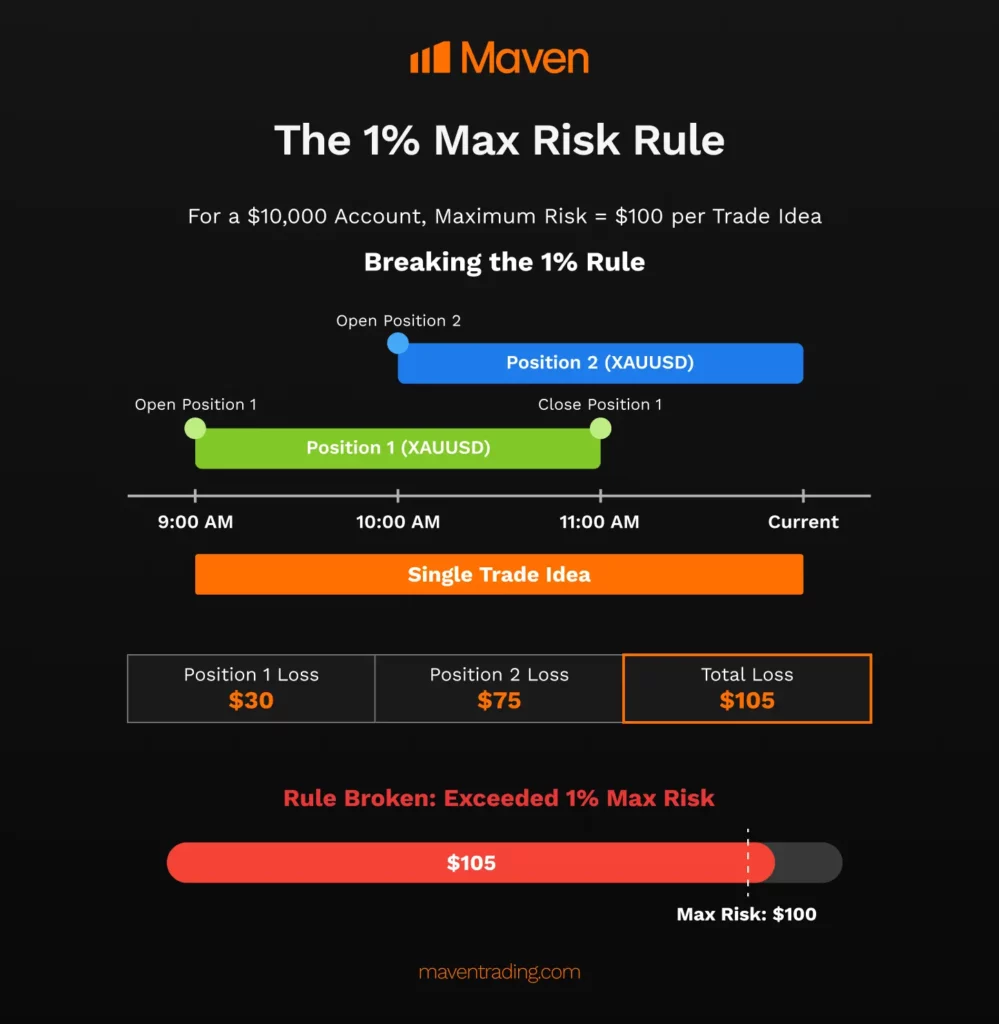
The main risk in any prop challenge is not the entry fee. It is misunderstanding a rule and losing the account after doing the hard part correctly. Maven’s official Maven Trading FAQ includes several rules that traders should read before purchasing.
Drawdown is the first rule category to study. Depending on the program, Maven may use daily drawdown, maximum drawdown, static drawdown, or trailing drawdown language. A static drawdown gives traders a clearer fixed floor from the starting balance, while a trailing drawdown can move as equity rises and leave less room after early profits. If you are not fully comfortable with this distinction, read our explainer on prop firm daily drawdown rules before choosing a challenge.
Strategy restrictions also matter. Maven’s FAQ language discusses prohibited behavior such as exploiting demo-trader inefficiencies, high-frequency or toxic order flow, certain arbitrage behavior, tick scalping, grid or gap trading, and copying trades from another individual. For most discretionary traders this may not be a problem, but it can matter a lot for automated systems, news scalpers, grid strategies, and copy-trading setups.
Some Maven programs also include minimum hold-time or profitable-day style requirements. These details can affect scalpers and high-frequency day traders more than swing traders. A trader who enters and exits quickly may find that profitable trades do not count if they fail a program-specific hold rule. That is exactly the kind of small rule that should be checked before paying for a challenge.
Payouts, Profit Splits, And Account Limits
Maven’s payout and profit-split terms vary by program, but the broad pattern is that traders should expect a profit split rather than keeping 100 percent of account profits. Some official Maven pricing blocks show 70 percent or 80 percent profit split language depending on the account type, with payout timing commonly framed around business-day cycles.
The key is to separate marketing language from operational rules. A payout may be available every set number of business days, but that does not mean every trader can withdraw any amount at any time. Minimum withdrawal thresholds, early payout caps, consistency requirements, profitable-day rules, and account review procedures can all affect the real experience.
Maven’s FAQ also discusses payout caps on early withdrawals for some structures. That does not automatically make the firm bad, but it changes expectations. A trader trying to pull a large amount out immediately after a strong first cycle may be frustrated if the account type has staged withdrawal limits. Before buying, map the expected payout path: first withdrawal, second withdrawal, refund timing, minimum profit requirement, and any cap or consistency threshold.
Consistency deserves special attention. Even when a firm does not call a rule a standard consistency rule, the practical effect can be similar if payout eligibility depends on profitable days, capped single-event profits, or limits on how much one trade or one news event can contribute. Our guide to prop firm consistency rules is useful background before evaluating Maven’s account types.
Platforms, Markets, And Execution Setup
Maven generally positions itself around popular prop trading platforms and broad CFD-style market access. Depending on account type and current availability, traders may see platform options such as MetaTrader-style workflows, Match-Trader-style workflows, or other prop-firm execution environments. Always confirm the platform at checkout because supported platforms can change and may vary by region or program.
Platform choice matters because it affects how you trade day to day. Manual traders may care most about chart layout and order execution. Automated traders care about uptime, latency, platform stability, and whether expert advisors or trade copiers are allowed under the specific account rules. Copy traders need to be especially cautious because many prop firms distinguish between copying your own trades across your own accounts and copying another trader’s signals.
Maven can be a reasonable fit for traders who already have a clean process. If you know your strategy, understand your average holding period, and have a journaled risk model, the main job is matching that process to the right Maven account. If your strategy relies on ultra-fast exits, grid recovery, news volatility spikes, or multi-account hedging, Maven’s restrictions deserve closer scrutiny.

Maven Trading VPS Setup Considerations
A VPS does not make a trader profitable, but it can make the execution environment more stable. That matters for prop firm traders because platform downtime, local internet outages, forced computer restarts, or delayed copier execution can all create avoidable risk. If you plan to run Maven accounts with MetaTrader, copy-trading software, or a platform that needs to stay online, a dedicated Maven Trading VPS can be useful.
The strongest VPS use cases are automated trading, trade copying, multi-account monitoring, and traders who cannot keep a home computer online during market hours. A VPS is less important for a purely manual trader who logs in occasionally and does not use automation. Even then, a stable hosted environment can help reduce missed platform alerts or execution interruptions.
The most important setup rule is compliance. Do not use a VPS to hide prohibited activity, copy trades in a way the rules do not allow, or run strategies that violate account terms. Use it to improve reliability, not to bypass restrictions. If Maven’s rules change, update your platform setup to match the account agreement.

Maven Trading Pros And Cons
Maven’s biggest advantage is accessibility. Low entry prices make it easier for traders to test a prop firm model without committing a large amount upfront. The range of challenge types also gives traders a choice between faster, cheaper, and more staged paths. Traders who like comparing account structures may appreciate that flexibility.
The second advantage is that Maven’s rules are specific enough for disciplined traders to plan around them. If you know the drawdown model, profit target, payout timing, and prohibited strategies before you start, you can choose a program that fits your actual trading behavior instead of forcing your strategy into the wrong challenge.
The downsides are mostly complexity and trust calibration. Maven’s low pricing does not remove the need to study rules. In fact, it makes rule review more important because account types can differ. Traders also need to remember that prop firm reviews are not guarantees. Payout experiences, account reviews, platform quality, and support responsiveness can vary by trader and by account type.
The main pros are low starting costs, several account paths, familiar prop-firm challenge structures, and a useful fit for disciplined traders with defined risk. The main cons are changing account-specific details, rule complexity, model-specific restrictions, and the need to verify official terms immediately before purchase.
Who Should Use Maven Trading?
Maven Trading is most likely to fit traders who want a budget path into prop firm trading and already understand risk management. A trader who can keep position sizes consistent, avoid revenge trading, and trade within daily drawdown limits may find Maven’s low-cost accounts useful for testing execution discipline.
It can also fit traders comparing account models. If you want to evaluate whether a one-step, two-step, or three-step structure suits your personality, Maven’s range of options gives you room to compare. Traders who already use a platform workflow that Maven supports may have an easier transition.
Maven is also relevant for traders who use hosted setups. If your strategy depends on uptime, VPS-based platform access, or copy management across accounts you control, the Maven review process should include infrastructure planning. The firm choice and the execution setup should be evaluated together.
Who Should Avoid Maven Trading?
Avoid Maven if you do not want to read detailed rules. The firm can be affordable, but affordability does not make a challenge simple. If you are unsure how daily drawdown, maximum loss, trailing loss, payout caps, or minimum hold times work, pause before buying.
Maven may also be a poor fit for traders who depend on prohibited or borderline strategies. Grid recovery, gap trading, ultra-short scalping, high-frequency execution, arbitrage-style behavior, and copying another person’s trades can create serious compliance issues. If your strategy sits near those lines, get clarity first.
Finally, Maven is not the obvious choice for traders who prioritize the longest operating history, the most conservative trust profile, or the simplest brand reputation. In that case, compare Maven with larger or more established firms and make the decision based on risk tolerance, not just price.
Maven Trading Alternatives
Maven’s closest alternatives depend on what you care about. If the goal is the lowest possible entry cost, compare Maven against other budget prop firms and instant funding offers. If the goal is platform choice, compare firms by MT5, cTrader, TradeLocker, Match-Trader, or futures platform availability. If the goal is trust and longevity, compare the operating history, public review depth, payout reputation, and rule clarity of each firm.
For forex traders, the broader comparison should include challenge structure, drawdown model, payout timing, account scaling, and platform compatibility. Our guide to the best prop firms for forex trading can help place Maven in a wider context if you are not already committed to one provider.
The bottom line is not that Maven is always better or worse than alternatives. It is that Maven is a budget-friendly, rule-sensitive option. Choose it if the account rules fit your trading behavior. Skip it if the low price is the only part of the offer you understand.
Maven Trading Review FAQ
Is Maven Trading legit?
Maven Trading appears to be an operating prop trading firm with a live official site, pricing page, account programs, and public trader discussion. That does not mean every trader will have a good experience or that payouts are guaranteed. Treat Maven as a real but rule-sensitive prop firm, and verify current terms before buying.
How much does Maven Trading cost?
Maven’s cost depends on account size, challenge type, platform, and current discounts. Small accounts can be inexpensive, while larger accounts and instant-style options cost more. Check Maven’s official pricing page immediately before purchase because review articles and screenshots can become outdated quickly.
What are the main Maven Trading rules?
The most important rules involve daily drawdown, maximum loss, profit targets, payout timing, prohibited strategies, and account-specific restrictions. Some structures may also include profitable-day, minimum hold-time, news-profit, or withdrawal-cap language. Read the FAQ and checkout terms for the exact account you plan to buy.
Does Maven Trading allow EAs or trade copiers?
Rules can depend on the exact strategy and account setup. Automated trading is not the same as compliant automated trading. Before using an EA, copier, or multi-account setup, confirm that the strategy does not violate Maven’s restrictions on copying another trader, arbitrage-style behavior, high-frequency execution, grid/gap trading, or other prohibited practices.
Is Maven Trading good for beginners?
Maven can be affordable for beginners, but that does not automatically make it beginner-friendly. New traders should first understand drawdown math, position sizing, payout rules, and strategy restrictions. A cheap challenge can still be wasted if the trader breaks a rule they did not understand.
Should Maven traders use a VPS?
A VPS is useful if you need stable platform uptime for MetaTrader, trade copying, account monitoring, or automation. It is less important for purely manual traders. The key is to use the VPS for reliability and not for any strategy that conflicts with Maven’s rules.

About the author
Matthew Hinkle
Lead Writer & Full Time Retail Trader
Matthew is NYCServers' lead writer. In addition to being passionate about forex trading, he is also an active trader himself. Matt has advanced knowledge of useful indicators, trading systems, and analysis.
Areas of Expertise