
How Prediction Market Odds Work: A Complete Guide
Understand how prediction market odds translate to probabilities, how prices move, and how traders profit. Covers order books, resolution, and betting strategy.

The Price-to-Probability Connection
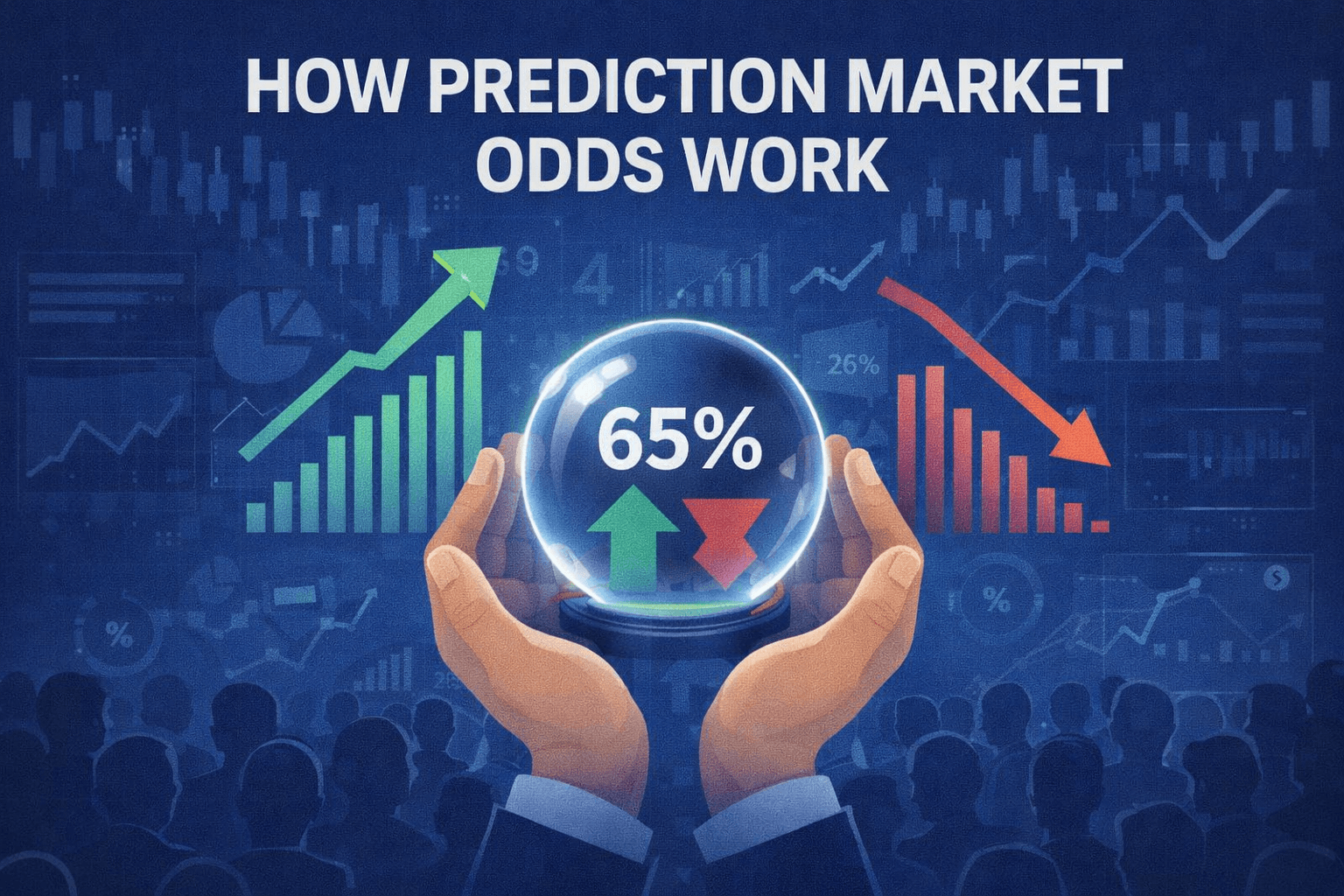
In prediction markets, price equals probability. A contract trading at $0.65 implies a 65% chance of that outcome occurring. This direct relationship makes prediction markets intuitive once you grasp the basic structure.
Most prediction market contracts are binary—they settle at $1.00 if the event happens, $0.00 if it doesn’t. When you buy a YES contract at $0.40, you’re paying $0.40 for something worth either $1.00 or $0.00. The market is pricing in a 40% probability of that outcome.
Your potential profit is $0.60 per contract if you’re right (the $1.00 payout minus your $0.40 cost). Your maximum loss is $0.40 per contract if you’re wrong. The risk-reward ratio is determined entirely by the price at which you enter.
This structure differs from traditional betting where odds are expressed as ratios or implied margins. Prediction market pricing is transparent—you can always see the exact probability the market assigns to any outcome.
How Prices Move
Prediction market prices adjust continuously as traders buy and sell based on their views. The mechanism is straightforward: when more people think an event is likely, they buy YES contracts, pushing the price up. When sentiment shifts bearish, selling pressure drives prices down.
Order Book Mechanics
Most prediction markets use order books similar to stock exchanges. Buyers post bids (the price they’re willing to pay), sellers post asks (the price they’re willing to accept). When a bid matches an ask, a trade executes.
The spread between the highest bid and lowest ask indicates market liquidity. Tight spreads (say, $0.64 bid / $0.65 ask) mean you can enter and exit positions cheaply. Wide spreads ($0.60 bid / $0.70 ask) signal thin liquidity and higher transaction costs.
Liquid markets—typically those covering major events like elections or high-profile sports—offer tight spreads and deep order books. Niche markets often have wider spreads and less depth, making large positions harder to establish without moving the price.

Price Discovery in Action
When new information hits, prediction market prices respond almost instantly. During a debate or breaking news event, you’ll see prices swing in real-time as traders incorporate the new data.
This responsiveness is one reason prediction markets often outperform traditional polling. Polls take days to conduct and publish. Markets update in seconds. During the 2024 US election, prediction markets showed different odds than polls and proved more accurate.
The efficiency comes from financial incentives. If you believe a market is mispriced, you can profit by trading against it. This profit motive drives sophisticated traders to constantly search for mispricings, which in turn keeps prices accurate.
Types of Prediction Markets
Not all prediction markets work the same way. Understanding the different structures helps you navigate various platforms and opportunities.
Binary Markets
The most common type. Will X happen? YES or NO. The market resolves to $1.00 or $0.00. Examples include election outcomes, whether a company hits an earnings target, or if a sports team wins a championship.
Binary markets are the easiest to understand and trade. The price directly tells you the probability. If you think the true probability differs from the market price, you have a trading opportunity.
Multi-Outcome Markets
Some events have more than two possible outcomes. Who will win the election? (multiple candidates). What will GDP growth be? (range of values). How will a fight end? (knockout, decision, submission).
In multi-outcome markets, you can buy contracts on different outcomes. The sum of all outcome prices should theoretically equal $1.00. If they don’t, arbitrage opportunities exist.
These markets are more complex to analyze since you need to assess relative probabilities across multiple outcomes, not just a single yes/no question.
Scalar Markets
Scalar markets let you bet on a range of values rather than discrete outcomes. What will Bitcoin’s price be on a specific date? What will inflation be this quarter?
Your payout depends on how close the actual outcome is to your prediction. These markets use more sophisticated pricing mechanisms like the Logarithmic Market Scoring Rule (LMSR) developed by economist Robin Hanson.
Scalar markets are less common than binary markets but offer ways to express views on magnitude, not just direction.
How Markets Resolve
After an event occurs, prediction markets must determine the outcome and settle contracts. Different platforms handle this differently, and understanding resolution mechanics matters for your trading.
Centralized Resolution
Kalshi, as a CFTC-regulated exchange, uses trusted data sources for resolution. Election results come from official certifications. Economic data comes from government releases. The platform defines resolution criteria upfront, and outcomes are determined by those predefined sources.
This approach is straightforward and fast. Once the data source publishes the result, markets resolve and payouts happen automatically. Disputes are rare because the criteria are clear.
Decentralized Resolution
Polymarket uses UMA’s optimistic oracle system—a more complex but decentralized approach.
Here’s how it works: After an event, someone proposes a resolution by posting a bond (typically $750 in USDC). There’s a two-hour challenge window where anyone can dispute the proposed outcome by posting their own bond.
If no one disputes, the market resolves as proposed. If disputed, the case escalates to UMA token holders who vote on the correct outcome. The winning side keeps their bond; the losing side forfeits theirs.
This system is designed to be dispute-resistant. Most resolutions go unchallenged because the outcome is obvious. The bond requirement and voting mechanism discourage frivolous disputes.
However, the oracle system has shown vulnerabilities. In March 2025, a whale with significant UMA token holdings manipulated a $7 million market outcome. Polymarket has since tightened its oracle access to address this risk.

Understanding Odds vs. Sportsbook Odds
If you’ve used traditional sportsbooks, prediction market odds might feel different. The two systems express probabilities differently, and understanding the conversion helps if you’re transitioning between them.
Prediction Market Format
Prediction markets price contracts between $0.01 and $0.99 (or expressed as 1% to 99%). A $0.65 contract means 65% implied probability. The price IS the probability.
Your potential profit on a winning $0.65 contract is $0.35 ($1.00 payout minus $0.65 cost). Your risk is $0.65. The odds in traditional format would be approximately -186 (American odds) or 1.54 (decimal odds).
No House Edge
Traditional sportsbooks build a margin (vig) into their odds. If the true probability of an event is 50%, a sportsbook might offer -110 on both sides, meaning you risk $110 to win $100. That margin is how they profit.
Prediction markets don’t have a built-in house edge. You’re trading peer-to-peer, paying only trading fees (typically under 1%). The market price reflects collective trader sentiment, not a bookmaker’s margin.
This makes prediction markets potentially more efficient for skilled traders. Without a house edge to overcome, a genuine information advantage translates directly to profit.
Converting Between Formats
To convert prediction market prices to American odds:
- For prices above $0.50: American odds = -(price × 100) / (1 – price)
- For prices below $0.50: American odds = (100 – (price × 100)) / price
For example, a $0.75 contract equals -300 American odds. A $0.25 contract equals +300 American odds. Many algorithmic trading strategies used in financial markets can be adapted to exploit these pricing dynamics.

Market Efficiency and Arbitrage
Prediction markets aren’t always perfectly efficient. Mispricings occur, creating opportunities for traders who can identify and exploit them.
Same-Market Arbitrage
In binary markets, YES + NO should always equal $1.00. If YES is trading at $0.45 and NO is trading at $0.52, the total is only $0.97. You could buy both sides for $0.97 and guarantee receiving $1.00 at resolution—a risk-free 3% return.
These opportunities are rare in liquid markets and disappear quickly. Automated traders constantly monitor for such discrepancies. But in less liquid markets or during fast-moving events, temporary mispricings do occur.
Cross-Platform Arbitrage
Different platforms sometimes price the same event differently. If Polymarket shows 55% odds and Kalshi shows 60% for the same outcome, you could potentially buy the cheaper side and sell the more expensive side across platforms.
Cross-platform arbitrage is more complex due to different fee structures, settlement timing, and capital requirements on each platform. Academic research documented over $40 million in arbitrage profits extracted from prediction markets between April 2024 and April 2025.
Why Markets Aren’t Always Efficient
Several factors create persistent inefficiencies:
- Geographic restrictions: Kalshi is US-only while Polymarket has international access. Traders can’t always arbitrage across both.
- Capital constraints: Tying up capital across platforms limits how much arbitrage traders can execute.
- Settlement risk: Different platforms might resolve the same event differently, especially for edge cases.
- Fee structures: Fees vary by platform and can eat into arbitrage profits.
Optimal Betting Strategy
How much should you bet when you’ve identified an edge? This question has a mathematically rigorous answer: the Kelly Criterion.
The Kelly Criterion
Developed by Bell Labs researcher John Kelly in 1956, the Kelly Criterion tells you the optimal fraction of your bankroll to bet given your edge and the odds.
The formula: f* = (bp – q) / b
Where:
- f* = fraction of bankroll to bet
- b = odds received (profit per dollar wagered)
- p = probability of winning (your estimate)
- q = probability of losing (1 – p)
For example, if a contract trades at $0.40 (market implies 40% probability) but you believe the true probability is 50%:
- b = 1.50 (you profit $0.60 on a $0.40 bet)
- p = 0.50 (your probability estimate)
- q = 0.50
- f* = (1.50 × 0.50 – 0.50) / 1.50 = 0.167
Kelly says bet 16.7% of your bankroll. This maximizes long-term growth while avoiding ruin.
Fractional Kelly
Most experienced traders use fractional Kelly—betting a fraction (often 25-50%) of the Kelly-optimal amount. This reduces variance and provides a buffer for estimation errors.
Your probability estimates are rarely perfect. Fractional Kelly acknowledges this uncertainty and sacrifices some expected growth for reduced volatility and lower risk of large drawdowns.

Platform-Specific Considerations
Each prediction market platform has quirks that affect how odds work in practice.
Polymarket
Polymarket operates on the Polygon blockchain using USDC stablecoin. The platform uses a Central Limit Order Book (CLOB) for most liquid markets, enabling professional market makers to provide tight spreads.
International traders pay minimal fees (around 0.01%). US traders accessing through regulated channels may face different fee structures. Settlement happens on-chain after oracle resolution.
Kalshi
Kalshi operates as a traditional exchange with CFTC oversight. Trading uses US dollars, and the interface feels familiar to anyone who’s traded stocks or futures.
Kalshi’s fee structure varies by contract price—roughly 1.2% on average. The platform offers both REST API and WebSocket connections for programmatic trading, plus FIX protocol for institutional participants.
Infrastructure Matters
Both platforms operate 24/7. Events can resolve at any hour. If you’re running automated strategies or monitoring multiple markets, reliable infrastructure becomes critical.
A trading VPS ensures your bots run continuously without depending on your home internet or computer uptime. The same infrastructure that powers forex automation works equally well for prediction market strategies.
Practical Tips for Reading Odds
Here’s how experienced traders approach prediction market odds:
Don’t chase low-probability events: A $0.05 contract offers a 20x return but only a 5% chance of paying off. The math might work, but you need a large sample size and careful bankroll management to profit from low-probability bets.
Watch for liquidity: Check the order book depth before trading. If you can only buy $100 worth at the current price before moving the market, factor that into your strategy.
Understand resolution criteria: Read exactly how the market will be resolved. Edge cases cause disputes. Know what you’re betting on.
Track your calibration: Are your probability estimates accurate? If you estimate 60% probability and those events happen 60% of the time, you’re well-calibrated. If they happen 50% of the time, you’re overconfident and losing money.
Consider opportunity cost: Capital tied up in prediction markets can’t be used elsewhere. Factor in time to resolution when sizing positions.
Run Prediction Market Strategies with Reliable Infrastructure
Whether you’re monitoring odds across platforms, running arbitrage bots, or executing algorithmic strategies, stable infrastructure makes a difference. Markets operate around the clock, and opportunities don’t wait for business hours.
NYCServers provides the foundation serious traders need—1ms latency to major financial hubs, 100% uptime during trading hours, and 24/7 support. Our Forex VPS solutions starting at $25/month give you the same infrastructure edge that powers professional trading operations.
Frequently Asked Questions
What does a $0.75 prediction market price mean?
A $0.75 price means the market assigns a 75% probability to that outcome occurring. If you buy at $0.75 and the event happens, you receive $1.00 (profit of $0.25). If it doesn’t happen, you lose your $0.75.
How accurate are prediction market probabilities?
Studies show prediction markets are generally well-calibrated. Events priced at 70% tend to occur about 70% of the time. They often outperform polls and expert forecasts, particularly for high-profile events with liquid markets.
Can prediction market prices exceed $1.00 or go negative?
No. Prices are bounded between $0.00 and $1.00 (or 0% and 100%). If a price somehow exceeded these bounds, arbitrage would immediately correct it.
Why do YES and NO prices sometimes not add up to exactly $1.00?
The slight difference reflects the bid-ask spread and liquidity. If YES bid is $0.45 and NO bid is $0.52, the midpoints might add to more than $1.00. This isn’t true arbitrage because you’d be paying the ask prices, which would bring the total back near $1.00.
How do fees affect prediction market odds?
Fees reduce your net profit but don’t change the underlying probability interpretation. A $0.60 contract still implies 60% probability regardless of fees. However, fees matter for your expected value calculation and position sizing.
What’s the difference between Polymarket and Kalshi odds?
Both express odds as contract prices representing probabilities. The main differences are fee structures, settlement mechanisms, and geographic availability. Prices for the same event may differ slightly between platforms due to these factors and differences in trader populations.
Should I always bet Kelly optimal amounts?
Most experienced traders use fractional Kelly (25-50% of optimal) to reduce variance and account for uncertainty in probability estimates. Full Kelly maximizes expected growth but can lead to significant drawdowns if your estimates are imperfect.

About the author
Thomas Vasilyev
Writer & Full Time EA Developer
Tom is our associate writer, and has advanced knowledge with the technical side of things, like VPS management. Additionally Tom is a coder, and develops EAs and algorithms.
Areas of Expertise