
Gold (XAUUSD) Trading Strategy: Guide for Forex Traders
Learn proven gold trading strategies for XAUUSD including scalping, price action, and session-based setups. Includes prop firm rules and risk management.
Why Trade Gold (XAUUSD)?
Gold is the single most popular instrument among retail forex traders in 2026, and for good reason. XAUUSD consistently delivers daily ranges of 200 to 500+ pips, dwarfing the movement you’ll see on EUR/USD or GBP/USD. That volatility translates directly into opportunity, whether you’re scalping five-minute charts or riding multi-day swings.
But volatility alone doesn’t make an instrument worth trading. Gold brings several structural advantages that set it apart from currency pairs.
Liquidity and Tight Spreads
XAUUSD is one of the most liquid instruments available to retail traders. During the London and New York sessions, spreads on major brokers typically sit between 10 and 25 cents (1.0 to 2.5 pips). That tight spread, combined with deep order books, means you can enter and exit positions without excessive slippage on standard lot sizes.
Safe Haven Dynamics
Gold behaves differently from currency pairs during market stress. When geopolitical tensions spike or equity markets sell off, capital flows into gold. This “flight to safety” dynamic gives you a tradable edge during events that would be unpredictable on most forex pairs. You’re not just reading charts; you’re trading a macro narrative.
Inverse USD Correlation
Gold is priced in US dollars, which creates a reliable inverse relationship with the Dollar Index (DXY). When the dollar weakens, gold tends to rise, and vice versa. This correlation isn’t perfect, but it gives you a secondary confirmation tool for every XAUUSD setup. If your gold chart says long and the DXY is rolling over, that’s confluence.
Works Across All Timeframes
Whether you trade the 1-minute chart or the weekly, gold delivers clean price action. The high average daily range means scalpers find plenty of intraday movement, while swing traders get well-defined trends that can run for weeks. This flexibility makes a solid gold trading strategy valuable regardless of your style. Traders who run EAs or need 24/7 uptime often pair their approach with forex VPS hosting to keep their platform connected around the clock.
Understanding Gold Price Drivers
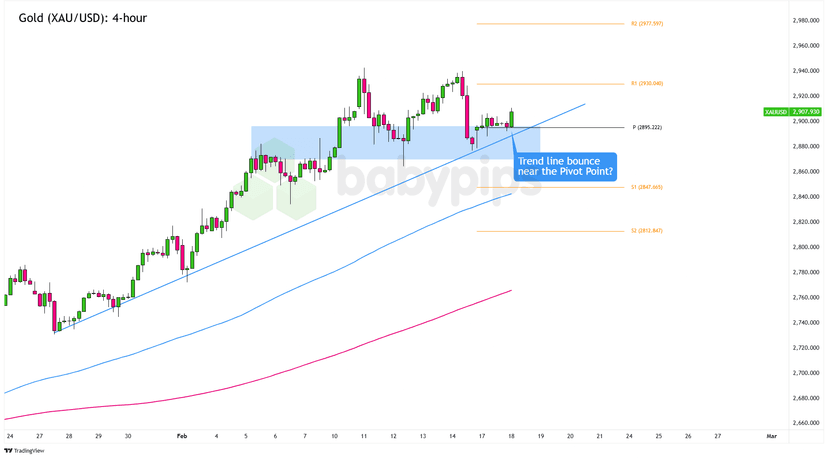
Before you open a single trade, you need to understand what moves gold. Technical setups work better when they align with the fundamental forces actually driving price. Here are the primary catalysts you should track.
Interest Rates and the Federal Reserve
This is the dominant driver. Gold pays no yield, so when real interest rates (nominal rates minus inflation) rise, gold becomes less attractive relative to bonds and savings. When real rates fall, gold benefits. Every FOMC decision, every shift in rate expectations, directly impacts XAUUSD.
In practice, watch the US 10-year Treasury yield and the CME FedWatch tool. If the market starts pricing in rate cuts, gold is likely to catch a bid. If rate hike expectations increase, expect selling pressure.
Inflation Data
Gold is traditionally viewed as an inflation hedge. When CPI data comes in hot, gold often rallies on the expectation that the purchasing power of fiat currencies is eroding. However, the relationship is nuanced. If inflation spikes but the Fed responds aggressively with rate hikes, the rate effect can overpower the inflation hedge narrative.
The key numbers to watch are US CPI (Consumer Price Index), PCE (Personal Consumption Expenditures, the Fed’s preferred measure), and PPI (Producer Price Index).
Geopolitical Risk
Wars, trade conflicts, sanctions, political instability. As the World Gold Council regularly documents, gold spikes on fear. The challenge is that geopolitical moves are often fast and unpredictable. You rarely get a clean entry. The more practical approach is to monitor gold’s reaction to ongoing geopolitical situations rather than trying to front-run headlines.
US Dollar Strength (DXY)
As mentioned, gold and the dollar have an inverse correlation. Track the DXY alongside your XAUUSD chart. When the DXY breaks a key support level, it often coincides with a gold breakout to the upside. This isn’t a strategy on its own, but it’s a powerful filter.
Pro tip: Don’t trade gold in a vacuum. Spend five minutes each morning checking the DXY, the US 10-year yield, and any major news events on the economic calendar. This context will save you from taking technically clean setups that run straight into a fundamental brick wall.
Best Gold Trading Strategies for 2026
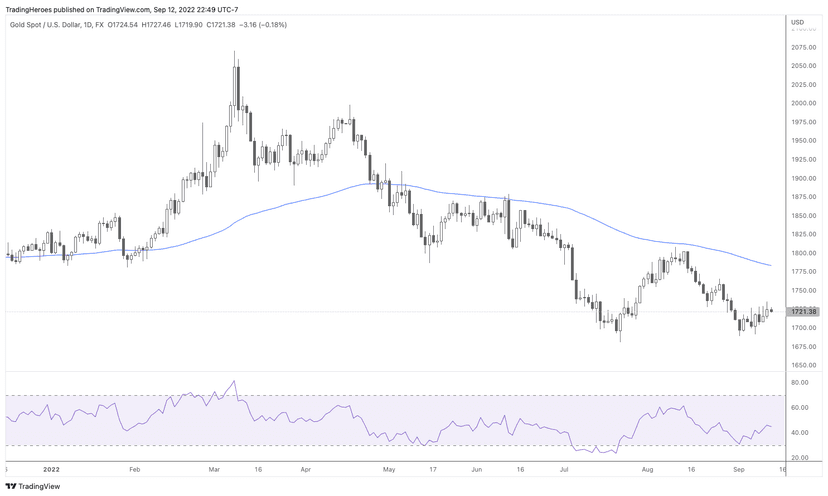
There’s no single “best” XAUUSD trading strategy. The right approach depends on your timeframe, risk tolerance, and whether you’re trading a personal account or a prop firm challenge. Below are five proven strategies, each with specific rules and examples.
Strategy 1: Trend Following with Moving Averages
This is the most straightforward approach and arguably the most reliable for traders who don’t want to sit at their screens all day. Gold trends well. When it moves, it tends to move in extended, directional runs. A moving average system helps you ride those trends and stay out during chop.
Setup:
- Timeframe: H1 or H4
- Indicators: 50 EMA and 200 EMA
- Bias: Trade only in the direction of the 200 EMA slope
Entry rules:
- Long: Price is above the 200 EMA. Wait for a pullback to the 50 EMA. Enter when a bullish candle closes above the 50 EMA after touching or wicking below it.
- Short: Price is below the 200 EMA. Wait for a rally to the 50 EMA. Enter when a bearish candle closes below the 50 EMA after touching or wicking above it.
Stop loss: Place your stop 150-250 pips below the 50 EMA (for longs) or above it (for shorts). On gold, this roughly translates to $1.50 to $2.50 on a standard price chart.
Take profit: Use a 1:2 or 1:3 risk-to-reward ratio, or trail your stop using the 50 EMA as a dynamic trailing level.
Example: Gold is trading at $2,320 with the 200 EMA at $2,280 (sloping up) and the 50 EMA at $2,310. Price pulls back to $2,308, wicks below the 50 EMA, then closes at $2,315 with a bullish engulfing candle. You enter long at $2,315 with a stop at $2,295 (200 pips risk). Your target is $2,355 for a 1:2 reward.
Strategy 2: Price Action at Key Support and Resistance
Gold respects round numbers and historical levels with almost uncanny precision. The $50 and $100 round numbers on gold (e.g., $2,300, $2,350, $2,400) act as psychological magnets. Combine these with horizontal support/resistance drawn from recent swing highs and lows, and you have a gold price action strategy that requires zero indicators. If you need a refresher on identifying and trading these levels, read our guide to support and resistance trading.
Setup:
- Timeframe: H1 or H4 for level identification, M15 for entry
- Tools: Horizontal lines at swing highs/lows, round numbers
- Confirmation: Candlestick patterns (pin bars, engulfing candles, inside bars)
Entry rules:
- Identify a key level where price has previously reversed at least twice
- Wait for price to return to that level
- Switch to M15 and look for a rejection candlestick pattern
- Enter on the close of the confirmation candle
Stop loss: Place your stop 50-100 pips beyond the key level. If you’re buying at support at $2,300, your stop goes at $2,295 or $2,290.
Example: Gold has bounced off $2,350 three times in the past week. Price drops back to $2,352 and forms a pin bar on the M15 chart with a long lower wick touching $2,349. You enter long at $2,353 with a stop at $2,344 (90 pips risk) and target $2,380 (270 pips, 1:3 RR).
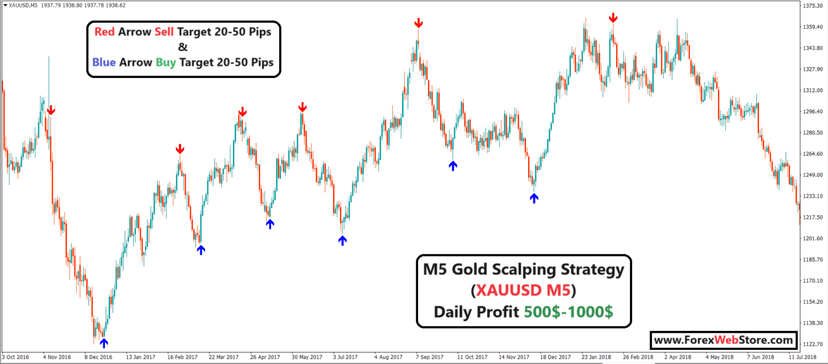
Strategy 3: Gold Scalping Strategy (1-5 Minute Charts)
Gold’s volatility makes it one of the best instruments for scalping. A single clean move on the M1 or M5 chart can deliver 50 to 150 pips in minutes. But scalping gold is unforgiving. Slippage, spread widening, and slow execution will destroy your edge faster than on any currency pair.
Setup:
- Timeframe: M1 or M5
- Indicators: 9 EMA and 21 EMA, RSI (14)
- Session: London open or New York open only (highest volume)
Entry rules:
- Long: 9 EMA crosses above 21 EMA, RSI is above 50 but below 70. Enter on the close of the crossover candle.
- Short: 9 EMA crosses below 21 EMA, RSI is below 50 but above 30. Enter on the close of the crossover candle.
Stop loss: 50-80 pips (tight). For scalping gold, you need fast execution and minimal spread to make this work.
Take profit: 100-200 pips, or close when the 9 EMA crosses back against your position.
Why execution speed matters here: At 50 pips of risk, even 10 pips of slippage eats 20% of your stop. This is where your infrastructure becomes part of your strategy. Running your scalping EA or manual platform on a VPS with sub-millisecond broker connectivity eliminates the variable of home internet latency. We’ll cover this in more detail later.
Strategy 4: News Trading Gold (NFP, FOMC, CPI)
Gold reacts violently to US economic data. Non-Farm Payrolls (NFP), FOMC rate decisions, and CPI releases routinely move XAUUSD by 300 to 1,000+ pips within hours. News trading gold is high-risk and high-reward, but it can be systematic.
Setup:
- Timeframe: M5 or M15
- Calendar: Track NFP (first Friday of each month), FOMC (8 times per year), CPI (monthly)
- Pre-news positioning: None. Wait for the release.
Entry rules (post-release fade):
- Wait 5 minutes after the data release for the initial spike to complete
- Identify the spike high and spike low
- If price reverses and closes back inside the pre-news range, enter in the reversal direction
- This “fade the spike” approach works because the initial reaction is often an overreaction
Stop loss: Beyond the spike extreme. If gold spiked to $2,380 and you’re shorting the fade, your stop is at $2,383.
Important warning: Spreads on gold can widen to 50+ pips during major news releases. Factor this into your position sizing. Many experienced news traders reduce their lot size by 50% on gold compared to normal conditions.
Strategy 5: Session-Based Trading (London/NY Overlap)
This is a time-based XAUUSD trading strategy that exploits the predictable volatility spike that occurs when the London and New York sessions overlap, roughly between 12:00 and 16:00 GMT. Gold volume peaks during this window, and the moves tend to be directional rather than choppy.
Setup:
- Timeframe: M15 or M30
- Session: 12:00 to 16:00 GMT
- Pre-session analysis: Identify the Asian session range (the high and low from 00:00 to 07:00 GMT)
Entry rules:
- Mark the Asian session high and low on your chart
- If price breaks above the Asian high during the London/NY overlap, enter long
- If price breaks below the Asian low, enter short
- Wait for a candle to close beyond the level, not just wick through it
Stop loss: Place your stop at the opposite end of the Asian range, or use a fixed 200-pip stop if the range is exceptionally wide.
Take profit: The average breakout from the Asian range during the London/NY overlap runs 300 to 600 pips. Target 1.5x to 2x the Asian range width.
| Strategy | Timeframe | Avg. Risk (pips) | Avg. Reward (pips) | Best For |
|---|---|---|---|---|
| Trend Following (MA) | H1 / H4 | 150-250 | 300-750 | Swing traders |
| Price Action S/R | H1 (M15 entry) | 50-100 | 150-300 | All styles |
| Scalping (EMA Cross) | M1 / M5 | 50-80 | 100-200 | Active traders |
| News Trading | M5 / M15 | 100-300 | 300-1000 | Event traders |
| Session Breakout | M15 / M30 | 150-200 | 300-600 | Part-time traders |
Best Time to Trade Gold (XAUUSD)
Not all hours are created equal when it comes to gold. The instrument trades nearly 24 hours on weekdays, but volume and volatility vary dramatically by session. Trading at the wrong time can turn a winning strategy into a slow bleed of losses from choppy, directionless price action.
Session-by-Session Breakdown
Asian Session (00:00 – 07:00 GMT): The quietest period for gold. Average range is typically 100 to 200 pips. This session builds the range that London and New York traders will eventually break. Not ideal for trend-following strategies, but range traders and session breakout strategy users need to mark these levels.
London Session (07:00 – 16:00 GMT): Volatility picks up significantly at the London open. Institutional traders in the world’s largest forex hub begin positioning, and gold typically makes its first major directional move of the day. Average volatility is roughly 2 to 3 times the Asian session.
New York Session (12:00 – 21:00 GMT): The most important session for gold trading. US economic data releases land during this window, and the London/NY overlap (12:00 to 16:00 GMT) is where the highest volume and the largest moves occur. If you can only trade one session per day, this is it.
London/NY Overlap (12:00 – 16:00 GMT): This four-hour window is prime time. Gold’s daily high or low is established during this period roughly 70% of the time. Spreads are tightest, liquidity is deepest, and directional moves are cleanest.
Key takeaway: The best time to trade gold XAUUSD is during the London/New York overlap between 12:00 and 16:00 GMT. If you’re in the US Eastern time zone, that’s 8:00 AM to 12:00 PM. Structure your trading day around this window.
Days to Watch (and Avoid)
Mondays tend to be ranging days for gold as the market digests weekend developments. Tuesdays through Thursdays deliver the best trending behavior. Fridays can be strong in the morning but thin out after the New York lunch hour as traders square positions ahead of the weekend.
The first Friday of each month (NFP Friday) and any day with a scheduled FOMC decision are your highest-volatility opportunities. Plan your position sizing accordingly.
Gold Trading for Prop Firms
XAUUSD is arguably the most popular instrument among prop firm traders. The volatility means you can hit profit targets faster, but the same volatility can blow through drawdown limits in minutes if you’re not careful. Here’s how to trade gold for prop firms without destroying your account.
Why Prop Firms and Gold Are a Natural Fit
Most prop firm challenges require you to hit a profit target of 8% to 10% within 30 days. On a currency pair like EUR/USD, which moves 50 to 80 pips per day, you need to capture a significant chunk of that daily range. Gold’s 200 to 500+ pip daily range gives you far more room to find setups and hit targets even with conservative position sizing.
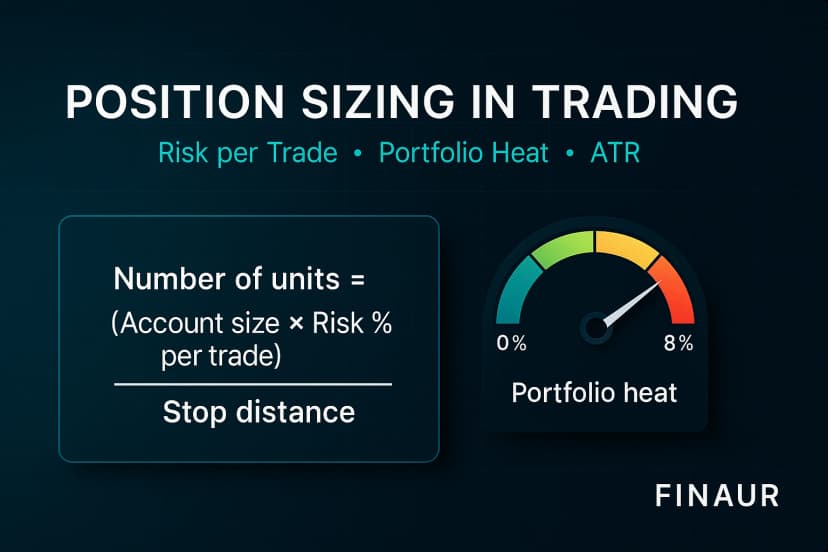
Position Sizing for Prop Firm Gold Trading
This is where most traders fail. Gold’s pip value is $10 per pip per standard lot, $1 per pip per mini lot, and $0.10 per pip per micro lot. A 200-pip stop on a standard lot is a $2,000 risk. On a $100,000 prop firm account with a 5% maximum drawdown ($5,000), that single trade eats 40% of your total allowed loss.
The math that works:
- $100K account, 5% max drawdown ($5,000): Risk 1% per trade ($1,000). With a 200-pip stop, you can trade 0.50 lots. With a 100-pip stop, you can trade 1.0 lot.
- $50K account, 5% max drawdown ($2,500): Risk 1% per trade ($500). With a 200-pip stop, you can trade 0.25 lots. With a 100-pip stop, you can trade 0.50 lots.
- $200K account, 5% max drawdown ($10,000): Risk 1% per trade ($2,000). With a 200-pip stop, you can trade 1.0 lot. With a 100-pip stop, you can trade 2.0 lots.
Managing Daily Drawdown Limits
Many prop firms impose a daily drawdown limit of 4% to 5% in addition to the overall maximum drawdown. With gold’s volatility, one bad session can breach this limit if you’re overexposed. Two practical rules that help:
- Two-loss rule: If you take two consecutive losing trades on gold, stop trading for the day. Two losses at 1% risk each means you’re down 2%, leaving buffer before the daily limit.
- Session limit: Only trade gold during one session per day. If you traded the London open and broke even, don’t come back for the New York session looking to “make up” for missed opportunities. Overtrading gold on a prop firm account is the fastest route to failing a challenge.
Strategies That Work Best for Prop Firms
From the strategies above, the session breakout and the price action support/resistance approaches tend to perform best for prop firm challenges. They offer defined risk, clean entries, and manageable drawdowns. Scalping gold on a prop firm is risky because the high frequency of trades amplifies the chance of hitting a daily drawdown limit.
News trading on prop firm accounts is a gray area. Some firms explicitly ban trading within 2 minutes before and after high-impact news. Others allow it but widen their simulated spreads to punish the approach. Check your prop firm’s specific rules before deploying a news trading strategy on gold.
| Prop Firm Consideration | Recommendation |
|---|---|
| Max risk per trade | 0.5% to 1% of account balance |
| Max daily trades on gold | 2 to 3 trades |
| Preferred strategies | Session breakout, price action S/R |
| Avoid on prop firm accounts | High-frequency scalping, news straddles |
| Stop loss minimum | 50 pips (to avoid noise-triggered stops) |
| Best sessions for consistency | London open, London/NY overlap |
XAUUSD Risk Management
Risk management on gold requires a different mindset than what you’d use on currency pairs. The numbers are bigger, the moves are faster, and the consequences of poor sizing are brutal. Here’s what you need to know.
Understanding Gold Pip Values
On most brokers, 1 pip on XAUUSD equals $0.01 in price movement (e.g., from $2,300.00 to $2,300.01). The pip value per lot size:
- Micro lot (0.01): $0.10 per pip
- Mini lot (0.10): $1.00 per pip
- Standard lot (1.00): $10.00 per pip
When gold drops from $2,350 to $2,345, that’s a 500-pip move. On a standard lot, that’s $5,000. Make sure your lot size reflects your account’s ability to absorb that kind of swing.
Stop Loss Strategies for Gold
Fixed pip stops work, but they need to be wider than what you’d use on forex pairs. Here are three approaches:
1. ATR-based stops: Use the Average True Range (14-period) on your trading timeframe. Set your stop at 1.5x the ATR value. If the H1 ATR is 120 pips, your stop is 180 pips. This adapts automatically to current volatility conditions.
2. Structure-based stops: Place your stop beyond the nearest swing high or low. This is the most logical approach because it invalidates your trade idea. If you’re long and the previous swing low is 150 pips below your entry, that’s your stop level.
3. Fixed percentage stops: Calculate your dollar risk first (e.g., 1% of a $10,000 account = $100), then determine your lot size based on the pip distance to your stop. If your stop is 200 pips away and you want to risk $100, you’d trade 0.05 lots ($0.50 per pip x 200 pips = $100 risk).
The Overleveraging Trap
Gold’s high pip value catches many traders off guard. A trader who comfortably trades 1.0 lots on EUR/USD (where a 30-pip stop equals $300 risk) might use the same lot size on gold with a 200-pip stop. That’s suddenly $2,000 at risk. Always calculate your risk in dollars before placing a gold trade, never in lot sizes.
Risk management rule for gold: Calculate your dollar risk first. Then work backward to determine lot size. Never start with lot size and assume the risk is acceptable. This single habit separates profitable gold traders from blown accounts.
Why Execution Speed Matters for Gold Trading
Gold’s volatility is a double-edged sword. The same fast-moving price action that creates opportunities also means that slow execution can cost you real money. This section isn’t theoretical; it’s about the practical impact of latency on your gold trading results.
The Slippage Problem
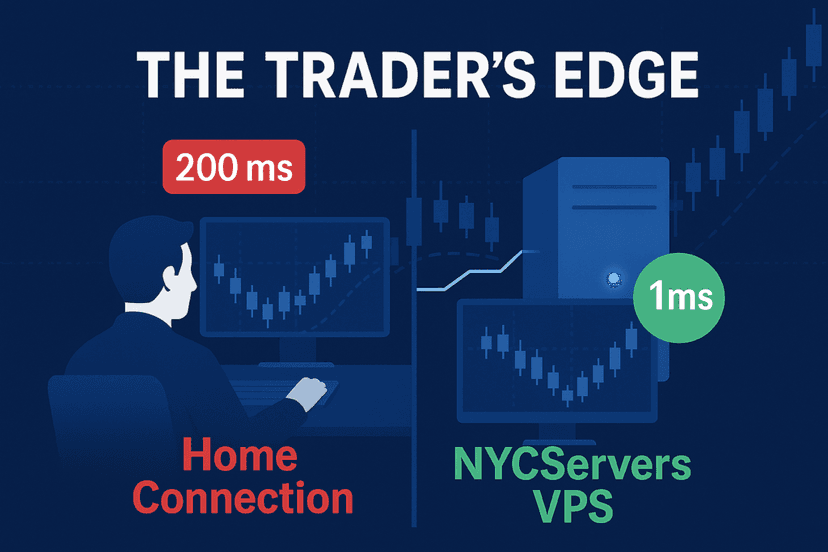
During high-volatility periods, gold can move 10 to 30 pips per second. If your order takes 200 milliseconds to reach your broker instead of 1 millisecond, price may have moved 5 to 15 pips against you before your order fills. On a scalping strategy with 50 pips of risk, that’s 10% to 30% of your entire stop distance lost to slippage alone.
Over 100 trades, even 5 pips of average slippage costs you 500 pips. At $10 per pip on a standard lot, that’s $5,000 in hidden costs that won’t show up in your backtesting results.
Home Internet vs. VPS Execution
Trading gold from a home computer introduces several variables you can’t control: WiFi dropouts, ISP routing inefficiencies, distance from your broker’s server, and operating system background processes competing for resources. Any of these can add 50 to 300+ milliseconds of latency.
A forex VPS located in the same data center as your broker eliminates most of these variables. When your MT4, MT5, or cTrader platform sits on a server with sub-1ms connectivity to your broker, orders execute at the speed the market demands. You can check your broker’s latency to see exactly how much difference server proximity makes.
This matters most for:
- Gold scalpers: Where every pip of slippage directly reduces your already thin profit margin
- EA traders: Automated systems that fire orders at specific price levels lose their edge when execution is delayed
- News traders: The 5-second window after a data release is when milliseconds determine whether you catch the move or chase it
- Prop firm traders: Where slippage can mean the difference between passing and failing a challenge by fractions of a percent
Choosing the Right Server Location
If your broker’s matching engine is in New York (common for many major brokers and prop firms), your VPS should be in New York. If your broker is in London, choose a London server. The goal is physical proximity. A VPS in Tokyo won’t help you if your broker’s server is in Equinix NY4.
Check your broker’s server location before selecting a VPS. Most brokers publish this information, and you can verify it by pinging the broker’s server address from different VPS locations. At NYCServers, we offer locations in New York, London, and Tokyo to cover the major financial hubs where brokers typically host their infrastructure.
Building Your Gold Trading Plan
Having strategies is one thing. Having a plan is another. Your gold trading plan should answer these questions before you risk a single dollar.
Define Your Parameters
- Which strategy? Pick one or two from this guide. Don’t try to trade all five simultaneously.
- Which session? Commit to a specific time window. Trading gold 24 hours a day leads to overtrading and burnout.
- Max daily risk? Set a hard limit. For most traders, 2% to 3% of account balance per day is sustainable.
- Max trades per day? On gold, two to three well-selected trades are enough. Quality over quantity.
- Lot size formula? Use the fixed percentage method. Decide your risk per trade, measure the stop distance, and calculate the lot size. Every single time.
Backtesting Before Live Trading
Every strategy in this guide should be backtested on at least six months of XAUUSD data before you trade it live. Pay special attention to performance during high-impact news events, as gold’s behavior around NFP and FOMC is fundamentally different from normal price action.
When backtesting, account for realistic spreads (15 to 25 pips during normal hours, up to 60 pips during news) and realistic slippage (3 to 10 pips during normal hours, potentially much more during news). A strategy that looks profitable with zero slippage may break even or lose money in real conditions.
Demo to Live Transition
After backtesting, run your strategy on a demo account for at least two weeks during live market hours. This validates that your execution environment (platform, broker, connectivity) can actually deliver the fills your backtest assumes. If you’re scalping gold, this step is mandatory because demo execution is often faster than live execution.
Frequently Asked Questions
What is the best gold trading strategy for beginners?
The trend-following strategy using the 50 and 200 EMA on the H4 timeframe is the most beginner-friendly approach. It generates fewer signals, gives you more time to analyze setups, and keeps you aligned with the dominant trend. Avoid scalping gold until you have at least six months of profitable results on higher timeframes.
How many pips does gold move per day?
XAUUSD typically moves 200 to 500+ pips per day, measured from the daily high to the daily low. On major news days (NFP, FOMC, CPI), the range can exceed 1,000 pips. By comparison, EUR/USD averages 50 to 80 pips per day. This volatility is what makes gold attractive, but it demands wider stops and careful position sizing.
What is the best time to trade gold?
The London/New York session overlap between 12:00 and 16:00 GMT is the optimal trading window. This period consistently delivers the highest volume, tightest spreads, and most directional price movement. The London open (07:00 to 08:00 GMT) is also a strong period for initial session moves.
Can you trade XAUUSD on a prop firm account?
Yes, and it’s one of the most popular instruments for prop firm challenges. The key is strict position sizing. Risk no more than 1% per trade, limit yourself to two or three trades per day, and avoid trading within news blackout windows if your prop firm enforces them. The session breakout and price action strategies tend to produce the most consistent results for prop firm challenges.
How much margin do you need to trade 1 lot of gold?
Margin requirements vary by broker and leverage. At 1:100 leverage, one standard lot of XAUUSD at $2,350 requires approximately $2,350 in margin. At 1:500 leverage, the same position requires roughly $470. However, margin requirements and maximum risk are different concepts. Always size your position based on your stop loss distance and acceptable dollar risk, not based on how much margin you have available.
Do I need a VPS for gold trading?
If you’re scalping gold or running EAs that trade XAUUSD, a VPS with low-latency broker connectivity significantly improves execution quality. Gold’s fast-moving price action means that home internet latency can result in measurable slippage over time. For swing trading on H4 or daily charts, a VPS is less critical but still offers the benefit of keeping your platform running 24/7 without interruption.
What lot size should I use for gold on a $10,000 account?
It depends entirely on your stop loss distance. If you risk 1% per trade ($100) and your stop loss is 200 pips, you’d trade 0.05 lots ($0.50 per pip x 200 pips = $100). If your stop is 100 pips, you’d trade 0.10 lots ($1.00 per pip x 100 pips = $100). Always calculate lot size from your dollar risk and stop distance, never the other way around.
Start Trading Gold With a Solid Foundation
Gold trading rewards preparation and punishes impulse. The strategies in this guide work, but only when paired with proper risk management, session awareness, and consistent execution. Pick one strategy, master it on one timeframe, and build from there.

About the author
Matthew Hinkle
Lead Writer & Full Time Retail Trader
Matthew is NYCServers' lead writer. In addition to being passionate about forex trading, he is also an active trader himself. Matt has advanced knowledge of useful indicators, trading systems, and analysis.
Areas of Expertise