

What is a Forex Introducing Broker? 2026 Guide
Learn what a Forex Introducing Broker is, how IB programs work, commission structures, and how to become one. Beginner friendly guide.

What Is a Forex Introducing Broker?
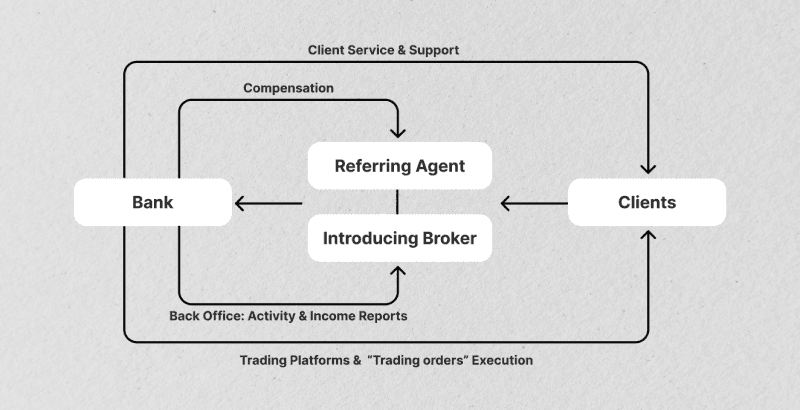
A Forex Introducing Broker, commonly called an IB, is an individual or company that introduces new clients to a Forex broker in exchange for commissions. Think of an IB as a middleman who connects traders with brokerage firms. When someone opens a trading account through an IB’s referral link and starts trading, the IB earns a portion of the spreads or commissions that the broker collects.
The IB model has become one of the most popular ways to earn passive income in the Forex industry. Unlike traditional sales roles, IBs do not need to handle client funds, provide trading advice, or manage complex regulatory requirements. Their primary responsibility is marketing and client acquisition.
Forex IBs operate under a partnership agreement with brokers. This agreement outlines commission rates, payment schedules, and the terms of the relationship. Most brokers offer tiered commission structures, meaning the more clients an IB brings in, the higher their earning potential becomes. Successful IBs often recommend essential trading infrastructure to help their clients achieve better trade execution and reliability.
How Do Forex IB Programs Work?
Forex IB programs function on a simple principle: brokers pay commissions to individuals or entities that bring them new, active traders. The process begins when an IB registers with a broker’s partnership program. Upon approval, the IB receives unique tracking links and marketing materials to promote the broker’s services.
When a potential trader clicks on an IB’s referral link and opens an account, the broker’s system tags that account to the IB. From that point forward, every trade the client makes generates revenue for the IB. This revenue typically comes in one of three forms: spread rebates, commission sharing, or a combination of both.
The beauty of the IB model lies in its recurring nature. Unlike one-time affiliate payments, IB commissions continue as long as the referred client keeps trading. This creates a sustainable income stream that can grow significantly over time as an IB builds their client base. Many successful IBs recommend a reliable forex VPS to their clients to ensure consistent trade execution and minimal downtime.
Understanding IB Commission Structures
Forex IB commission structures vary widely between brokers, but they generally fall into three main categories. Understanding these structures is crucial for anyone considering becoming an IB. Each commission model has its own advantages and disadvantages, and the best choice depends on your client base, their trading style, and your long-term business goals.
Before diving into specific commission types, it is important to understand how brokers calculate and track IB earnings. Most brokers provide dedicated IB portals where you can monitor client activity, track commissions in real-time, and access detailed reports. These tools help you optimize your marketing efforts and identify your most valuable client relationships. Some brokers also offer multi-tier IB programs, where you can earn additional commissions by recruiting sub-IBs who bring in their own clients.
Revenue Share Model: Under this arrangement, the IB receives a percentage of the revenue the broker generates from the referred client’s trading activity. For example, if a broker offers a 30% revenue share and earns $1,000 from a client’s spreads in a month, the IB receives $300. Revenue share percentages typically range from 20% to 50%, depending on the broker and the IB’s performance.
Per Lot Rebates: This structure pays the IB a fixed amount for every standard lot traded by their referred clients. Common rebate rates range from $2 to $10 per lot, though some brokers offer higher rates for high-volume IBs. If an IB has clients trading 100 lots per month at a $5 rebate rate, they earn $500.
Hybrid Models: Many brokers combine both approaches, offering a base revenue share plus additional per-lot bonuses for high-volume traders. Hybrid models often provide the best of both worlds, ensuring IBs earn from all client activity while rewarding those who bring in serious traders.

IB Commission Structure Examples
To understand the earning potential, let us look at realistic commission scenarios. These examples assume an IB has built a modest client base over several months.
Scenario 1: Small IB with 10 Active Clients
An IB refers 10 retail traders who each trade 5 lots per month. At a $6 per lot rebate rate, the monthly calculation is: 10 clients × 5 lots × $6 = $300 per month. Annually, this generates $3,600 in passive income.
Scenario 2: Medium IB with 50 Active Clients
An IB with 50 active clients trading an average of 10 lots each per month at a 35% revenue share. If the broker earns an average of $15 per lot in spreads, the monthly revenue per client is $150. The IB earns 35% of $150 = $52.50 per client. With 50 clients: 50 × $52.50 = $2,625 per month, or $31,500 annually.
Scenario 3: Large IB with 200 Active Clients
A well-established IB with 200 active traders on a hybrid model earning $8 per lot plus 25% revenue share. If clients average 15 lots per month: 200 × 15 × $8 = $24,000 from rebates alone. Plus revenue share on high-volume traders could add another $5,000-$10,000 monthly. Total potential: $29,000-$34,000 per month.
These examples demonstrate why the IB business model attracts entrepreneurs and marketing professionals. The scalability is virtually unlimited, and successful IBs can build seven-figure annual incomes.
Forex IB vs Affiliate: Understanding the Key Differences
Many newcomers confuse Forex IBs with affiliates, but these roles have distinct differences that affect earning potential, responsibilities, and business relationships. Understanding these distinctions helps you choose the right path for your goals.
The primary difference lies in the relationship with clients. An affiliate simply drives traffic to a broker’s website and earns a one-time payment when someone signs up and deposits. Once the conversion happens, the affiliate’s involvement ends. In contrast, an IB maintains an ongoing relationship with referred clients and earns recurring commissions based on their trading activity.
Payment structures also differ significantly. Affiliates typically receive CPA (Cost Per Acquisition) payments ranging from $200 to $800 per qualified client. This is a single payment regardless of how much the client trades. IBs, however, earn smaller amounts per trade but continue earning as long as the client remains active. Over time, an IB can earn far more from a single active trader than an affiliate earns from a one-time CPA.
Another key distinction involves support and value-add services. Successful IBs often provide additional services to their clients, such as trading education, market analysis, or technical support. These value-added services help retain clients and increase trading volumes, directly benefiting the IB’s bottom line. Affiliates generally do not provide ongoing support.
From a regulatory standpoint, IBs may face different requirements depending on their jurisdiction. Some regions require IBs to register with financial authorities or obtain specific licenses. Affiliates typically face fewer regulatory obligations since they do not maintain ongoing client relationships.
Finally, the marketing approach differs. Affiliates focus on high-volume traffic generation through SEO, paid advertising, and content marketing. IBs focus on building trust and long-term relationships, often through personal networks, trading communities, and educational content.
How to Become a Forex Introducing Broker
Becoming a Forex IB requires careful planning and execution. While the barrier to entry is relatively low compared to other financial services businesses, success depends on following the right steps and choosing appropriate partners.
Step 1: Research and Select Broker Partners
Your choice of broker partner significantly impacts your success as an IB. Start by researching brokers with established IB programs, competitive commission structures, and strong reputations in the industry. Look for brokers regulated by reputable authorities such as the FCA, ASIC, or CySEC.
Evaluate the broker’s trading conditions, platform offerings, and customer support quality. For traders focused on high-frequency strategies, consider reviewing the best forex brokers for scalping to ensure your clients get the tightest spreads and fastest execution. Most brokers support popular platforms like MetaTrader 4, MetaTrader 5, and cTrader. Remember, you are recommending this broker to your network, so their reputation becomes your reputation. Request detailed information about their IB program, including commission rates, payment schedules, and marketing support.
Consider starting with two or three broker partners to diversify your income streams. This approach also allows you to offer clients choices based on their specific trading needs and preferences.
Step 2: Understand Forex Introducing Broker Requirements
Forex IB requirements vary by broker and jurisdiction. At minimum, most brokers require IBs to be of legal age and have a valid identification document. Some brokers require proof of marketing experience or an existing audience in the trading space.
Regulatory requirements depend on your location. In the United States, IBs must register with the Commodity Futures Trading Commission (CFTC) and become members of the National Futures Association (NFA). European IBs may need to comply with MiFID II regulations. Asian jurisdictions have their own specific requirements.
Many brokers accept IBs from most countries, but some restrict partnerships based on regulatory considerations. Always verify that you can legally operate as an IB in your jurisdiction before investing time and resources into building your business.
Step 3: Set Up Your Business Infrastructure
Professional IBs treat their operation as a business from day one. This means establishing proper business structures, creating professional marketing materials, and setting up systems to track clients and commissions.
Create a professional website or landing page that explains your services and provides value to potential traders. Your online presence should include educational content, market analysis, or trading tools that demonstrate your expertise and build trust with prospects.
Set up accounting systems to track income and expenses. IB commissions are taxable income in most jurisdictions, so consult with a tax professional to understand your obligations. Consider forming a business entity such as an LLC or corporation to protect personal assets and optimize tax treatment.
Step 4: Develop Your Marketing Strategy
Successful IBs employ diverse marketing strategies to attract traders. Content marketing through blogs, YouTube channels, and social media helps establish authority and attract organic traffic. Educational webinars and trading courses can build email lists of engaged prospects.
Consider your target audience carefully. Are you focusing on beginner traders who need extensive education, or experienced traders looking for better trading conditions? Your marketing message should align with your audience’s needs and pain points.
Networking within trading communities, both online and offline, provides valuable opportunities to connect with potential clients. Attend trading expos, participate in forum discussions, and build relationships with influencers in the Forex space.
Step 5: Provide Ongoing Value and Support
The most successful IBs differentiate themselves by providing exceptional value to their clients. This might include regular market analysis, trading signals, educational resources, or technical support. The more value you provide, the more likely clients are to remain active and refer others.
Consider offering additional services that complement your IB business. Many successful IBs also provide VPS hosting recommendations for their clients, helping them achieve better trade execution. This creates an additional revenue stream while solving a real problem for traders.
Regular communication with your client base keeps them engaged and informed. Email newsletters, Telegram groups, or Discord communities help maintain relationships and provide ongoing touchpoints for your business.

Why Forex IBs Need VPS for Their Clients
As an Introducing Broker, your clients’ trading success directly impacts your income. One often-overlooked factor in trading performance is the quality of their internet connection and trade execution. This is where Virtual Private Server (VPS) hosting becomes crucial. Learn more about what a Forex VPS is and how it optimizes trading strategies.
A Forex VPS provides traders with a dedicated virtual server located near their broker’s data center. This proximity reduces latency, ensuring faster order execution and fewer slippage issues. For scalpers and high-frequency traders, even milliseconds of delay can significantly impact profitability.
IBs who educate their clients about VPS benefits demonstrate expertise and genuine concern for their success. When clients experience improved execution speeds and more reliable trading, they tend to trade more actively and remain loyal longer. This directly translates to higher IB commissions.
Furthermore, recommending a quality VPS service creates an additional touchpoint with clients. You become their trusted advisor not just for broker selection but for their entire trading infrastructure. This strengthens relationships and increases the lifetime value of each referred client.
Many successful IBs partner with quality VPS providers to offer their clients special discounts or bundled packages. This creates a win-win situation: clients receive better trading conditions at competitive prices, and the IB earns additional referral income beyond their broker commissions.
When discussing VPS with clients, emphasize the practical benefits: 24/7 uptime, protection from local internet outages, ability to run automated trading systems continuously, and improved security compared to home computers. These tangible advantages help clients understand why VPS investment pays for itself through better trading results.
Maximizing Your IB Rebate Forex Income
Once you have established your IB business, focus on strategies to maximize your rebate income. The most successful IBs treat their operation as a scalable business rather than a side hustle.
Client retention should be your top priority. Acquiring new clients costs significantly more than retaining existing ones. Provide exceptional support, regular market insights, and educational resources to keep your clients engaged and trading actively. Happy clients also refer friends and colleagues, creating organic growth.
Diversify your client base across different trader types. Some clients may be scalpers generating high volume but small profits per trade. Others might be swing traders with lower frequency but larger position sizes. A mix of trading styles creates more stable income and reduces dependence on any single client.
Negotiate better rates as your volume grows. Most brokers offer tiered commission structures that reward high-performing IBs. Do not hesitate to request improved terms once you have demonstrated consistent client acquisition and retention. Even small percentage increases compound significantly at scale.
Track your metrics meticulously. Monitor client acquisition costs, lifetime value, churn rates, and average revenue per client. This data helps you identify which marketing channels and client segments provide the best return on investment.
Stay current with industry trends and broker offerings. The Forex industry evolves rapidly, and brokers frequently update their IB programs. Regular evaluation of your partnerships ensures you are always offering clients competitive conditions while maximizing your own earnings.
Common Challenges for New Forex IBs
Starting any business involves challenges, and the Forex IB model is no exception. Understanding common obstacles helps you prepare and develop strategies to overcome them.
Building Initial Trust: New IBs often struggle to establish credibility without a track record. Overcome this by providing exceptional value through free educational content, transparent communication, and honest broker recommendations. Consider partnering with established trading educators or communities to leverage their existing trust.
Client Acquisition Costs: Marketing to traders can be expensive, especially in competitive niches. Focus on organic growth strategies like content marketing and community building before investing heavily in paid advertising. Test small campaigns and scale only what proves profitable.
Regulatory Complexity: Navigating financial regulations intimidates many potential IBs. Consult with legal professionals in your jurisdiction and choose brokers with strong compliance departments. Many brokers provide regulatory guidance to their IB partners.
Client Retention: The Forex industry has high trader turnover. Combat this by setting realistic expectations, providing ongoing education, and helping clients develop sustainable trading strategies. Clients who approach trading as a business rather than gambling tend to last longer.
Payment Delays: Some brokers have lengthy payment terms or minimum payout thresholds. Clarify payment schedules before partnering and maintain cash reserves to manage cash flow. Diversifying across multiple brokers also reduces dependence on any single payment schedule.

Future Trends in Forex IB Programs
The Forex IB landscape continues evolving as technology advances and regulations change. Staying ahead of these trends positions you for long-term success.
Cryptocurrency and digital asset trading represents a major growth area. Many traditional Forex brokers now offer crypto pairs, and specialized crypto exchanges have introduced IB programs. Diversifying into digital assets expands your potential client base and revenue streams.
Social trading and copy trading platforms create new IB opportunities. These platforms allow less experienced traders to automatically copy successful traders’ positions. IBs can build businesses around identifying and promoting top-performing strategy providers.
Artificial intelligence and automation tools are transforming how IBs operate. AI-powered content creation, chatbots for client support, and automated marketing systems allow small IBs to compete with larger operations. Embracing these technologies improves efficiency and scalability.
Regulatory changes continue shaping the industry. Increased transparency requirements and stricter marketing rules affect how IBs can promote broker services. Staying compliant while maintaining effective marketing requires ongoing education and adaptation.
The rise of mobile trading changes how IBs reach potential clients. Mobile-optimized content, apps, and communication channels become increasingly important as more traders manage their accounts primarily through smartphones.
Ready to Start Your Forex IB Journey?
Becoming a successful Forex Introducing Broker offers an exciting opportunity to build a scalable business in the financial markets. With low startup costs, recurring revenue potential, and the ability to work from anywhere, the IB model attracts entrepreneurs worldwide.
Success requires dedication, ethical business practices, and a genuine commitment to helping your clients succeed. Focus on providing value, building trust, and maintaining long-term relationships rather than chasing quick commissions.
If you are serious about becoming a Forex IB, start by researching broker partners and understanding the requirements in your jurisdiction. Create a business plan that includes marketing strategies, financial projections, and growth milestones. Treat your IB business as a professional venture from day one.
Remember that your clients’ success directly impacts your income. By helping them access better trading conditions, reliable technology like VPS hosting for forex trading, and quality education, you build a sustainable business that benefits everyone involved.
The Forex IB industry continues growing as more traders enter the markets and brokers expand their partnership programs. There has never been a better time to start building your IB business and claiming your share of this lucrative market. Contact NYCServers today to provide your clients with the low-latency infrastructure they need for successful trading.
Frequently Asked Questions
What is a Forex IB in simple terms?
A Forex IB (Introducing Broker) is someone who refers traders to Forex brokers and earns commissions based on their trading activity. Think of it as being a referral partner who gets paid when the people you introduce trade with that broker. Unlike a one-time referral fee, IBs earn ongoing commissions as long as their referred clients keep trading.
How much money can I make as a Forex IB?
Income varies widely based on your client base and their trading activity. A small IB with 10 active clients might earn $300-$500 monthly, while established IBs with hundreds of clients can earn $20,000+ per month. The key is building a loyal client base that trades consistently. Most successful IBs start part-time and transition to full-time as their income grows.
Do I need a license to become a Forex IB?
Requirements depend on your location. In the United States, IBs must register with the CFTC and NFA. European IBs may need to comply with local financial regulations. Many other jurisdictions have minimal requirements. Always check with a legal professional in your country and verify broker-specific requirements before starting.
What is the difference between IB rebate and revenue share?
IB rebate pays a fixed amount per lot traded, typically $2-$10 per standard lot. Revenue share pays a percentage of the broker’s earnings from your clients, usually 20%-50%. Rebates provide predictable income based on volume, while revenue share can be more lucrative if your clients trade frequently or with larger positions. Many brokers offer hybrid models combining both structures.
Can I be an IB for multiple brokers?
Yes, most IBs work with multiple brokers to offer clients choices and diversify their income. Different brokers excel in different areas: some offer better conditions for scalpers, others for swing traders, and some specialize in specific markets. Having multiple partnerships allows you to match clients with the best broker for their needs.
How do I find clients as a new IB?
Start with your existing network of traders and expand through content marketing, social media, and trading communities. Create valuable educational content that demonstrates your expertise. Participate in trading forums and social media groups where potential clients gather. Consider hosting webinars or creating YouTube content. Building trust takes time, so focus on providing value before asking for business.
What makes a successful Forex IB?
Successful IBs combine marketing skills with genuine care for their clients’ success. They provide ongoing education, responsive support, and honest broker recommendations. They understand that their income depends on clients’ long-term trading activity, so they focus on retention rather than quick signups. Successful IBs also stay current with industry trends and continuously improve their marketing strategies.

About the author
Thomas Vasilyev
Writer & Full Time EA Developer
Tom is our associate writer, and has advanced knowledge with the technical side of things, like VPS management. Additionally Tom is a coder, and develops EAs and algorithms.
Areas of Expertise