
Forex Correlation Pairs: How to Trade Correlated Currencies
Learn how forex correlation pairs work, which currencies move together or opposite, and practical strategies for trading correlated currencies on MT4/MT5.
What Are Forex Correlation Pairs?
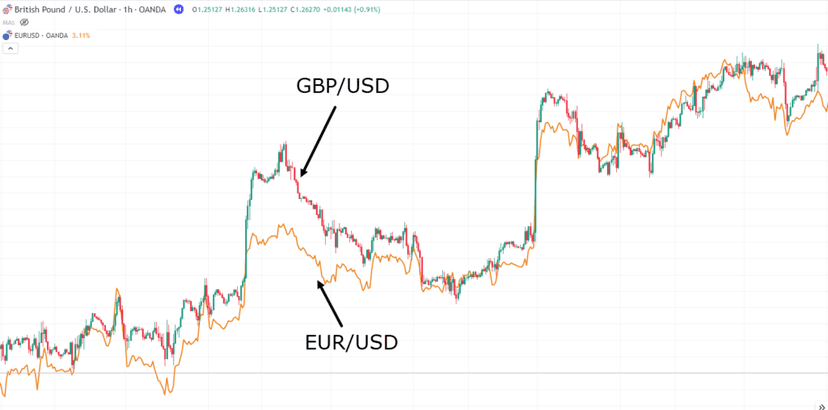
Forex correlation pairs are currency pairs that tend to move in sync or in opposite directions based on shared economic factors. When you open EUR/USD and GBP/USD charts side by side, you’ll notice their price action often mirrors each other. That’s correlation at work.
Understanding these relationships isn’t just academic. Correlation directly impacts your risk exposure, trade confirmation process, and ability to hedge positions. Traders who ignore correlation often end up doubling down on the same directional bet without realizing it.
The correlation between two currency pairs is measured using a correlation coefficient, a value that ranges from -1.0 to +1.0. A reading of +1.0 means two pairs move in perfect lockstep. A reading of -1.0 means they move in exactly opposite directions. Zero means no statistical relationship exists.
How the Correlation Coefficient Works
The Pearson correlation coefficient is the standard measurement tool in forex. It calculates the strength and direction of a linear relationship between two currency pairs over a specific time period.
Here’s what the numbers actually mean in practice:
| Coefficient Range | Interpretation | Trading Implication |
|---|---|---|
| +0.70 to +1.00 | Strong positive correlation | Pairs move together. Avoid doubling exposure. |
| +0.40 to +0.69 | Moderate positive correlation | Some overlap in movement. Monitor but manageable. |
| -0.39 to +0.39 | Weak or no correlation | Independent movement. Good for diversification. |
| -0.40 to -0.69 | Moderate negative correlation | Useful for partial hedging. |
| -0.70 to -1.00 | Strong negative correlation | Pairs move opposite. Good for hedging or confirmation. |
Anything above +0.70 or below -0.70 is considered a strong correlation. These are the readings that should influence your trading decisions most.
One critical detail: correlation is time-frame dependent. A pair showing +0.90 correlation on daily charts might only show +0.55 on 1-hour charts. Always match your correlation analysis to the time frame you’re actually trading.
Most Correlated Forex Pairs in 2026
Certain currency pairs consistently show strong correlations because the underlying economies share structural connections. Here are the major relationships every trader should know.
Strong Positive Correlations
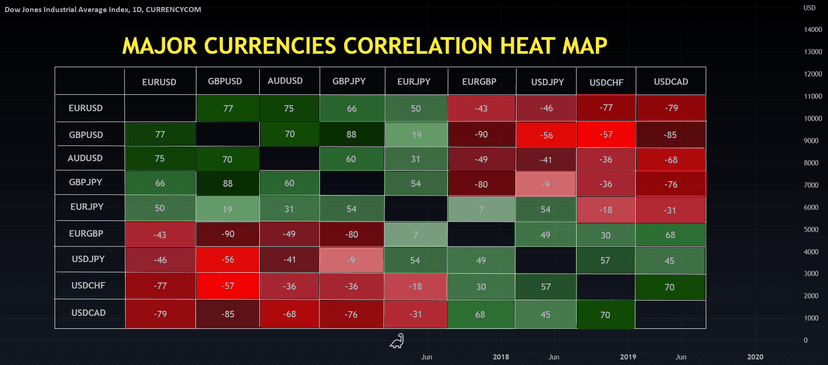
EUR/USD and GBP/USD: This is the most well-known positive correlation in forex. Both pairs have USD as the quote currency, and the European and British economies are tightly linked through trade. Their correlation typically ranges between +0.80 and +0.95 on daily charts.
AUD/USD and NZD/USD: Australia and New Zealand share similar commodity-driven economies and geographic proximity. This correlation often sits between +0.85 and +0.95, making it one of the strongest in the market.
EUR/USD and AUD/USD: While not as tight as the pairs above, EUR/USD and AUD/USD frequently show positive correlation in the +0.60 to +0.80 range. Both move inversely to USD strength.
Strong Negative Correlations
EUR/USD and USD/CHF: This is the textbook negative correlation, often between -0.85 and -0.98. The Swiss franc tracks closely with the euro due to Switzerland’s deep economic ties to the EU, so when EUR/USD rises, USD/CHF almost always falls.
GBP/USD and USD/JPY: This pair shows moderate to strong negative correlation, typically around -0.50 to -0.75. It’s less consistent than EUR/USD vs USD/CHF but still tradable during risk-on/risk-off cycles.
AUD/USD and USD/CAD: Both the Australian and Canadian dollars are commodity currencies, but their correlation with the US dollar creates a negative relationship when you compare AUD/USD to USD/CAD. Readings often fall between -0.60 and -0.80.
Commodity Correlations Worth Watching
Currency correlations extend beyond pair-to-pair relationships. Some of the most tradable correlations involve commodities:
- AUD/USD and Gold (XAU/USD): Australia is a major gold producer. When gold prices rise, AUD/USD tends to follow. Correlation typically ranges from +0.60 to +0.80. For a deeper dive into this relationship, read our gold trading strategy guide.
- USD/CAD and Crude Oil (WTI): Canada exports massive amounts of oil. When WTI rises, CAD strengthens, pushing USD/CAD lower. This creates a negative correlation between USD/CAD and oil prices.
- USD/NOK and Brent Crude: Norway’s economy is heavily oil-dependent. Brent crude price movements directly influence the Norwegian krone.
Why Correlations Change Over Time
Forex correlations are not fixed. They shift based on macroeconomic conditions, central bank policy divergence, and market sentiment. Treating correlations as permanent is a common mistake. Traders who rely on a low-latency VPS for 24/7 monitoring have an edge because their correlation indicators never go offline.
Several factors cause correlations to break down or strengthen:
- Central bank divergence: When two central banks move in opposite policy directions (one hiking, one cutting), historically correlated pairs can decouple. This happened repeatedly during 2023-2025 when the Fed, ECB, and BOE moved at different speeds.
- Risk sentiment shifts: During market panic, correlations between risk-on pairs tend to spike toward +1.0 as traders flee to USD and JPY simultaneously. Normal diversification benefits evaporate.
- Commodity price shocks: A sudden move in oil or gold can temporarily break the typical AUD/NZD positive correlation if only one country’s commodity exports are affected.
- Geopolitical events: Brexit is a textbook case. GBP/USD decoupled from its usual correlation with EUR/USD for extended periods during negotiations.
Pro tip: Check your correlation assumptions at least weekly. A correlation that held at +0.90 for three months can drop to +0.50 within a single week during central bank meetings or economic data releases.

Five Practical Strategies for Trading Correlated Currencies
Now that you understand what correlation is and which pairs are correlated, here’s how to actually use this information in your trading.
Strategy 1: Trade Confirmation Using Correlated Pairs
This is the simplest and most widely used correlation strategy. Before entering a trade on EUR/USD, check what GBP/USD is doing. If both pairs are giving you the same signal (bullish breakout, support bounce, bearish reversal), your confidence level goes up.
If EUR/USD is signaling a buy but GBP/USD is showing no momentum or is bearish, that’s a red flag. The divergence suggests your EUR/USD signal may be weak or a false breakout.
This works best with strongly correlated pairs (+0.80 or higher). Don’t waste time cross-referencing pairs with weak correlation.
Strategy 2: Hedging with Negatively Correlated Pairs
If you have a long position on EUR/USD and want to reduce your USD exposure without closing the trade, you can open a long position on USD/CHF. Because these pairs are strongly negatively correlated, gains on one tend to offset losses on the other.
This isn’t a perfect hedge. Correlations fluctuate, and execution costs eat into any gains. But during high-uncertainty events like NFP releases or FOMC meetings, partial hedging through negatively correlated pairs can protect your account from a sudden directional move.
Strategy 3: Divergence Trading
When two historically correlated pairs suddenly diverge, it creates a trading opportunity. If EUR/USD is rallying but GBP/USD is flat or falling, one of them is “wrong.” This often means:
- The lagging pair will catch up (trade in the direction of the leader)
- The leading pair has overextended (trade a reversal on the leader)
To trade divergence effectively, you need to determine which pair is driven by a fundamental catalyst and which is simply reacting to flows. The pair with the fundamental backing is usually the leader.
Strategy 4: Diversification Through Low-Correlation Pairs
If you’re running multiple positions simultaneously, correlation tells you whether you’re actually diversified or just concentrated in one directional bet. Running longs on EUR/USD, GBP/USD, and AUD/USD simultaneously is essentially a triple-sized short USD position.
True diversification means pairing positions across low-correlation pairs. For example:
- EUR/GBP (European cross, not USD-driven)
- AUD/JPY (commodity/risk pair)
- USD/CAD (commodity/USD pair)
These three positions have low correlation to each other, meaning a bad move on one doesn’t wipe out all three.
Strategy 5: Correlation Breakout Detection
When a historically strong correlation breaks down sharply, it often signals a regime change in the market. Monitor your correlation matrix for sudden drops (e.g., EUR/USD and GBP/USD falling from +0.90 to +0.50 within a week).
A correlation breakdown usually means one of the two currencies is being hit by a country-specific event. Identifying which currency is driving the divergence can put you ahead of the move before other traders catch on.
How Correlations Shift Across Trading Sessions
Not all trading hours are equal when it comes to correlation. The relationship between two pairs can vary significantly depending on which session is active.
London Session (08:00-17:00 GMT)
European pairs like EUR/USD and GBP/USD tend to show their strongest positive correlation during London hours. High liquidity and overlapping economic data releases from the Eurozone and the UK drive both pairs in similar directions. This is the best window for correlation-based confirmation trades.
New York Session (13:00-22:00 GMT)
During the London-New York overlap (13:00-17:00 GMT), correlations between USD-denominated pairs tighten further. This four-hour window typically produces the strongest and most reliable correlation readings of the entire trading day. The overlap also carries the highest volume, which reduces noise and makes correlation signals more dependable.
Asian Session (00:00-09:00 GMT)
Correlations often weaken during Asian hours. EUR/USD and GBP/USD may decouple because European currencies see thin liquidity while JPY crosses dominate volume. If your strategy depends on European pair correlation, avoid the Asian session or widen your signal thresholds.
For traders running automated correlation strategies, session-awareness is critical. Your EA needs to know which session is active and adjust its correlation parameters accordingly. Static thresholds that ignore session differences produce inconsistent results.
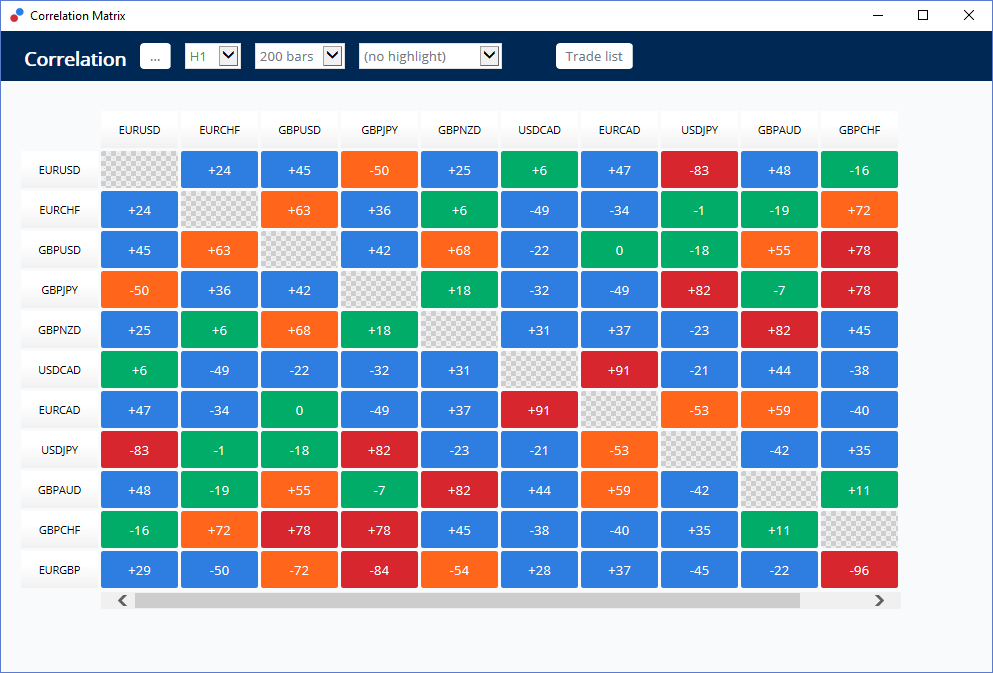
How to Build and Use a Correlation Matrix
A correlation matrix displays the correlation coefficients between multiple currency pairs in a single table. It’s the most efficient way to see all your correlation relationships at a glance.
Free Correlation Tools
Several platforms provide real-time or near-real-time correlation data:
- Myfxbook Correlation Tool: Offers real-time correlation data across multiple time frames. You can sort by most or least correlated pairs.
- Investing.com Correlation Calculator: Covers major, minor, and exotic pairs with customizable time periods.
- BabyPips Currency Correlation Calculator: Simple interface showing daily, weekly, and monthly correlation coefficients for all major pairs.
MT4/MT5 Correlation Indicators
If you prefer monitoring correlation directly on your trading platform, several free indicators are available for MetaTrader:
- Correlation Table Indicator: Displays a matrix of correlation values directly on your chart. Updates with each new bar.
- Overlay Chart Indicator: Places two currency pair charts on top of each other so you can visually compare price action.
- Correlation Heatmap: Color-coded correlation display that makes it easy to spot strong positive (green) and negative (red) correlations at a glance.
Running these indicators alongside your regular chart analysis adds a valuable layer of confirmation without switching between platforms.
Correlation-Aware Risk Management
Ignoring correlation in your risk management is one of the fastest ways to blow an account. Here’s how correlation should factor into your position sizing and exposure calculations.
Avoid Stacking Correlated Positions
If you risk 2% per trade and open three positions on highly correlated pairs (all long EUR/USD, GBP/USD, AUD/USD), your actual risk isn’t 6%. It’s closer to 6% on a single directional bet, because all three will likely move against you simultaneously.
A practical rule: when holding positions on pairs with correlation above +0.70, reduce your per-trade risk to account for the overlap. If you’d normally risk 2% per trade, cut it to 1% on each correlated position.
Calculate Effective Exposure
Before entering a new trade, scan your open positions for correlation overlap. A quick formula:
- If two positions have +0.80 correlation, treat them as roughly 1.8 positions of effective exposure (not 2.0)
- If two positions have -0.80 correlation, treat them as roughly 0.2 positions of effective exposure (they mostly cancel out)
- If two positions have zero correlation, they remain 2.0 independent positions
This isn’t mathematically precise, but it gives you a practical read on your actual risk at any moment.
Stress-Test During Volatility Spikes
During high-impact news events, correlations between risk-on pairs tend to spike toward +1.0. Your normally diversified portfolio may suddenly behave like a single concentrated position. Account for this by reducing overall exposure ahead of known volatility events like NFP, CPI, and central bank decisions.

Running Correlation Analysis Around the Clock
Correlations shift throughout the trading day as different sessions open and close. The EUR/USD and GBP/USD correlation tends to be strongest during the London-New York overlap and weakest during the Asian session.
If you’re running EAs or automated strategies that rely on correlation data, you need uninterrupted monitoring. A home PC that sleeps, restarts for updates, or loses internet connection means gaps in your correlation analysis exactly when markets are moving.
This is where running your trading setup on a dedicated VPS makes a measurable difference. A forex VPS keeps your MT4/MT5 platform, correlation indicators, and EAs running 24/5 with sub-millisecond latency to your broker. You can verify your connection speed using our broker latency checker. No disconnections during session overlaps. No missed divergence signals at 3 AM.
Check our forex VPS plans to ensure your correlation-based strategies never miss a beat.
Correlation and Prop Firm Trading
If you’re trading a prop firm challenge or managing a funded account, correlation awareness is non-negotiable. Prop firms monitor your drawdown in real time, and stacking correlated positions is one of the fastest ways to breach daily drawdown limits.
Consider this scenario: you open three long positions on EUR/USD, GBP/USD, and AUD/USD with 1% risk each. If the US dollar strengthens on unexpected CPI data, all three positions hit their stops almost simultaneously. That’s a 3% drawdown in minutes, and many prop firms set daily limits between 3% and 5%.
Smart prop firm traders run a correlation check before every new position. If your existing exposure is already USD-short through one pair, adding another correlated USD-short position should either be skipped or sized down significantly.
Common Correlation Trading Mistakes
Even experienced traders fall into these traps when using correlation data:
- Treating correlation as causation: Two pairs moving together doesn’t mean one causes the other to move. Both might be reacting to the same underlying factor (like USD strength). This matters for timing entries.
- Using stale correlation data: A correlation table from last month may not reflect this week’s market conditions. Refresh your data at minimum weekly.
- Ignoring time-frame mismatches: A strong daily correlation doesn’t guarantee intraday correlation. Always match your correlation data to your trading time frame.
- Over-hedging: Opening equal-sized positions on negatively correlated pairs results in a net-zero position after accounting for spreads. You’re paying trading costs to go nowhere.
- Assuming stable correlations during news: Correlations break down most during the moments you most need them to hold. Major economic releases can temporarily invert established relationships.
Frequently Asked Questions
What is the most correlated forex pair?
EUR/USD and GBP/USD consistently show the strongest positive correlation among major pairs, typically between +0.80 and +0.95 on daily charts. For negative correlation, EUR/USD and USD/CHF are the strongest, usually between -0.85 and -0.98.
Can you trade two correlated pairs at the same time?
Yes, but you need to adjust your position sizing. Trading two strongly correlated pairs with full-size positions doubles your effective directional exposure. Reduce your risk per trade proportionally or choose one pair and sit out the other.
How often do forex correlations change?
Correlations shift continuously. Short-term correlations (hourly, daily) can change rapidly during news events or central bank meetings. Long-term correlations (weekly, monthly) are more stable but still evolve over months as economic fundamentals shift. Check your correlation data at least weekly.
What time frame should I use for correlation analysis?
Match your correlation time frame to your trading time frame. If you’re a swing trader holding positions for days, use daily or weekly correlation data. Scalpers and day traders should monitor hourly or 4-hour correlations. Using daily correlation data for scalping trades leads to unreliable signals.
Is forex correlation the same as currency strength?
No. Currency strength measures how one currency performs against a basket of others. Correlation measures how two specific pairs move relative to each other. A currency can be strong (rising against most pairs) without the pairs being correlated. Both tools are useful but measure different things.
Do forex correlations work with crypto pairs?
Bitcoin and major crypto pairs show varying correlation with forex markets. BTC/USD has shown periods of positive correlation with risk-on forex pairs like AUD/USD, but the relationship is inconsistent and less reliable than traditional forex correlations. Crypto-specific factors like halving events and regulatory news frequently override any forex correlation patterns.
What tools can I use to track forex correlations?
Free browser-based tools include the Myfxbook Correlation Tool, BabyPips Currency Correlation Calculator, and Investing.com’s Correlation Calculator. For platform-based monitoring, MT4 and MT5 both support free correlation indicator plugins that display real-time data directly on your charts.

About the author
Matthew Hinkle
Lead Writer & Full Time Retail Trader
Matthew is NYCServers' lead writer. In addition to being passionate about forex trading, he is also an active trader himself. Matt has advanced knowledge of useful indicators, trading systems, and analysis.
Areas of Expertise