
Crypto Prediction Markets Explained: On-Chain Guide
How do on-chain crypto prediction markets actually work? This guide covers smart contracts, oracles, outcome tokens, Polymarket, Drift BET, and Azuro.
What Makes Prediction Markets “On-Chain”
A prediction market lets you put money behind your view of a future event. Will BTC break $150K by July? Who wins the next presidential election? Will the Fed cut rates? In traditional finance, you’d express these opinions through derivatives or structured bets. In crypto, you mint tokens that represent outcomes and trade them on open markets.
The “on-chain” distinction matters. Centralized prediction platforms (Kalshi, for example) operate with a traditional order book on company servers. Your funds sit in custodial accounts. Settlement depends on the platform operator declaring the outcome. You’re trusting a single entity with your money and the resolution process.
On-chain prediction markets flip this model. Every trade, every token mint, every resolution step happens through smart contracts deployed on a public blockchain. Your funds remain in your wallet until a trade executes. Outcome tokens live on-chain as transferable assets. And market resolution runs through decentralized oracle systems rather than a company’s internal process.
This architecture introduces real tradeoffs. You get censorship resistance, transparency, and self-custody. You also inherit blockchain-specific risks: smart contract bugs, oracle failures, gas costs, and bridge exploits. Understanding the DeFi stack underneath these markets is what separates informed traders from those who are just clicking buttons.
The DeFi Stack: Smart Contracts, Outcome Tokens, and the Conditional Token Framework
Every on-chain prediction market is built on three core layers: a smart contract that manages collateral and minting, a token standard that represents outcomes, and a pricing mechanism that keeps markets efficient. Here’s how they fit together.
Conditional Tokens and ERC-1155
Most major prediction markets use the Gnosis Conditional Token Framework (CTF). This is a set of smart contracts that turns real-world questions into tradeable positions using the ERC-1155 multi-token standard.
Here’s the basic flow. A market creator calls prepareCondition() on the CTF contract, specifying an oracle address, a unique question ID, and the number of possible outcomes. For a simple yes/no market, that’s two outcome slots.
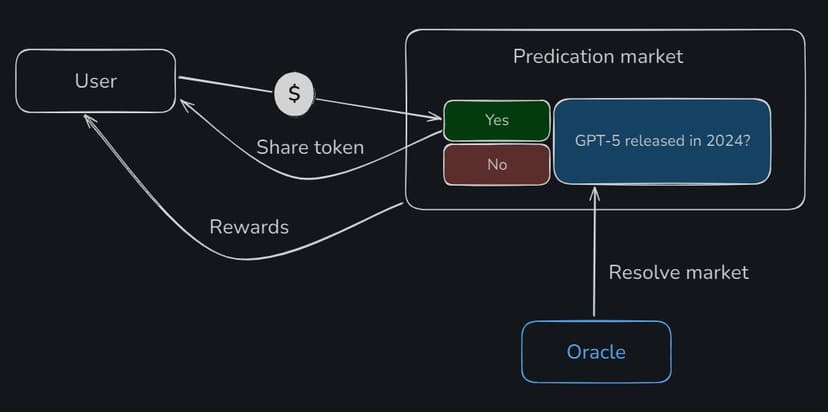
Once the condition exists, any user can deposit collateral (typically USDC) into the contract. The contract mints a complete set of outcome tokens in return. Lock in $1 of USDC and you receive one YES token and one NO token. Each token is a claim on $1.00 if that outcome is correct when the market resolves.
Why ERC-1155? Prediction markets can have thousands of active conditions simultaneously. ERC-1155 allows a single smart contract to manage all of those outcome tokens efficiently, rather than deploying a new ERC-20 contract for each token. Each token is indexed by a unique
positionIdderived from the condition, the outcome slot, and the collateral type.
Price Discovery and Market Mechanics
The price of an outcome token directly reflects the market’s implied probability. If a YES token trades at $0.60, the market is pricing a 60% chance of that outcome occurring. Two primary pricing mechanisms drive this discovery:
- LMSR (Logarithmic Market Scoring Rule): Adjusts prices logarithmically as more shares are purchased for a given outcome. Used in earlier prediction market designs to provide automated liquidity with bounded market-maker losses.
- CPMM (Constant Product Market Maker): Maintains a constant product between outcome token inventories. As one side gets bought up, its price increases relative to the other. Similar to how Uniswap prices assets in traditional DeFi liquidity pools.
- CLOB (Central Limit Order Book): The model Polymarket uses. Off-chain order matching with on-chain settlement. This gives you limit orders, market orders, and real depth data, far closer to a traditional trading experience.
Regardless of the pricing model, arbitrage enforces a critical invariant: the prices of all outcome tokens in a market always sum to approximately $1.00. If YES + NO drifts above $1, arbitrageurs sell both and pocket the difference. If it drops below $1, they buy both and redeem for the full collateral. This self-correcting loop keeps markets honest. For a deeper look at how traders exploit these inefficiencies, see our prediction market arbitrage guide.

How Oracle Resolution Works
Smart contracts can’t Google who won an election. They need external data feeds to know what happened in the real world. That’s the oracle’s job: bridge the gap between off-chain events and on-chain settlement. Two oracle systems dominate the prediction market space, and they work in fundamentally different ways.
UMA Optimistic Oracle
Polymarket relies on UMA’s Optimistic Oracle for market resolution. The system operates on a simple principle: proposed outcomes are assumed correct unless someone challenges them. Here’s the lifecycle:
- Proposal: When a market’s event concludes, a proposer submits the outcome along with a financial bond (denominated in USDC.e). This bond is at risk if the proposal is wrong.
- Challenge Window: The proposal enters a dispute period (typically 2 hours on Polymarket). During this window, anyone can challenge the proposed outcome by posting their own bond.
- Dispute Resolution: If challenged, the dispute escalates to UMA’s Data Verification Mechanism (DVM). UMA token holders vote on the correct outcome. Voters aligned with the consensus earn rewards; those on the losing side get slashed.
- Settlement: Once the outcome is confirmed, a
reportPayoutscall stores the result on-chain. Winners callredeemPositions()to burn their tokens and claim collateral.
In practice, disputes are rare. The economic incentives are structured so that proposing incorrect outcomes is always a losing trade. UMA’s protocol handles around 7,000 proposals monthly, and the vast majority settle without dispute.
A recent upgrade, UMIP 183, introduced the MULTIPLE_VALUES price identifier. This lets a single oracle request return up to seven values, reducing gas costs and simplifying resolution for multi-outcome markets. UMA is also integrating LLMs to propose and verify data at roughly $0.005 per request.
Chainlink Data Feeds and Data Streams
Chainlink takes a different approach. Instead of the optimistic model, Chainlink uses a Decentralized Oracle Network (DON) where independent node operators fetch data from multiple sources, aggregate it off-chain, and deliver a single verified update on-chain.
For prediction markets, two Chainlink products matter most:
- Data Streams: Low-latency, high-frequency price updates designed for derivatives trading. Sub-second data delivery enables real-time prediction markets around asset pricing.
- Automation: Triggers on-chain settlement automatically when conditions are met, enabling near-instantaneous resolution without manual intervention.
Polymarket actually uses both oracle systems. UMA handles subjective, event-based markets (elections, news events). Chainlink powers deterministic, price-based markets (will BTC hit $X by Y date). The Chainlink-powered crypto markets on Polymarket have already exceeded $3.4 billion in trading volume.
| Feature | UMA Optimistic Oracle | Chainlink Data Feeds |
|---|---|---|
| Resolution model | Propose-dispute (optimistic) | Aggregated node consensus |
| Best for | Subjective/event outcomes | Deterministic price data |
| Dispute mechanism | DVM token holder vote | Node operator consensus |
| Latency | 2-hour challenge window | Sub-second (Data Streams) |
| Cost per resolution | ~$0.005 (with LLM integration) | Varies by feed |
| Market share | Dominant for event markets | 70%+ overall oracle market |
Platform Deep-Dives: Polymarket, Drift BET, and Azuro
Three platforms define the on-chain prediction market landscape in 2026, each with a distinct architecture and target audience.

Polymarket (Polygon)
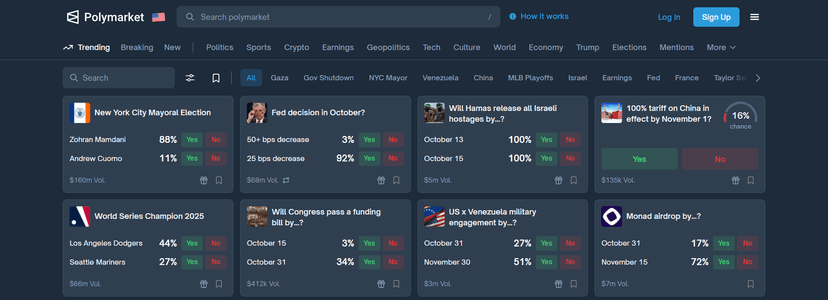
Polymarket remains the dominant platform by volume and market breadth. Its hybrid architecture pairs an off-chain Central Limit Order Book (CLOB) with on-chain settlement through the Conditional Token Framework on Polygon PoS.
The technical setup works like this: you sign orders off-chain with your wallet. The CLOB operator matches buyers and sellers. When a match occurs, the CTF Exchange contract on Polygon executes an atomic swap: USDC moves from the buyer, outcome tokens move from the seller (or get minted from collateral). Everything settles non-custodially.
This CLOB model gives Polymarket a significant UX advantage over pure AMM-based markets. You get limit orders, market orders, and real order-book depth. It feels like trading on a centralized exchange but with on-chain settlement guarantees.
Polygon’s infrastructure handles the load well. Transaction costs hover around $0.002, throughput sits at roughly 110 TPS, and the network has processed over 6.4 billion total transactions. For prediction markets where users might make many small trades, these economics matter.
Polymarket currently hosts over 5,300 active markets spanning crypto, politics, sports, science, and pop culture. Monthly volumes reached $27 billion in January 2026, with sports betting alone driving over $1 billion in daily volume during Super Bowl LIX.
Drift BET (Solana)
Drift BET, short for “Bullish on Everything,” takes a radically different approach. Instead of building a standalone prediction market, Drift integrated BET directly into its existing perpetual futures exchange on Solana.
The key differentiator is capital efficiency. Because BET sits on top of Drift’s existing infrastructure, it taps into a $500 million liquidity pool shared across perpetuals, spot, and prediction markets. You can use over 30 different crypto assets as collateral, not just stablecoins.
This integration enables features that pure prediction platforms can’t match:
- Cross-collateral trading: Use your existing Drift positions as margin for prediction bets
- Structured bets: Go long on a prediction market outcome while simultaneously shorting BTC as a hedge
- Yield on idle collateral: Your deposited assets earn yield even when not actively deployed in a bet
- FUEL token incentives: Traders earn FUEL rewards for placing bets and staking DRIFT
Solana’s infrastructure gives Drift BET a raw speed advantage. Transaction fees run under $0.01, and the Drift v3 upgrade (rolling out in 2026) targets filling 85% of market orders in under 400ms with slippage around 0.02% on large trades. That’s approaching centralized exchange performance.
The platform is still growing its market catalog. Current categories focus on crypto prices, elections, and altcoin milestones, with sports and pop culture markets in development.
Azuro Protocol (Multi-Chain)
Azuro isn’t a prediction market you trade on. It’s the infrastructure layer that prediction market apps are built on top of. Think of it as the “Stripe for prediction markets” — a protocol that handles liquidity, odds, and settlement so that frontend developers can focus on user experience.
The technical architecture differs significantly from Polymarket and Drift BET:
- vAMM (Virtual AMM): Instead of a CLOB or traditional AMM, Azuro uses a virtual AMM that doesn’t require liquidity bootstrapping for individual markets. Each market inherits liquidity from a single, protocol-wide pool.
- LiquidityTree: A segment tree data structure that tracks deposits and withdrawals across multiple levels. Each deposit is a “leaf” node, and parent nodes aggregate liquidity. This ensures all markets share deep liquidity without fragmentation.
- Data Providers: External providers push real-time odds through the vAMM. Buy-side bettors trade against these odds. The two-step process keeps pricing dynamic and responsive to real-world developments.
Azuro operates on Polygon, Gnosis Chain, and Chiliz, with additional chain deployments planned. Over 30 applications have been built on the protocol, collectively processing more than $400 million in cumulative betting volume. The primary focus has been sports, which provides steady, recurring market creation tied to the global sporting calendar.
For developers: Azuro’s modular design means you can spin up a prediction market frontend without building your own liquidity infrastructure, oracle integrations, or settlement logic. The protocol handles all of that. Your app just needs a UI and a user base.
Chain Comparison: Polygon vs. Solana vs. Gnosis Chain
The blockchain underneath a prediction market determines its speed, cost, and composability. Each chain makes different tradeoffs.
| Metric | Polygon PoS | Solana | Gnosis Chain |
|---|---|---|---|
| Avg. transaction cost | ~$0.002 | <$0.01 | ~$0.001 |
| Throughput (TPS) | ~110 | ~4,000+ | ~70 |
| Block finality | ~2 seconds | ~400ms | ~5 seconds |
| EVM compatible | Yes | No (SVM) | Yes |
| Key prediction platform | Polymarket, Azuro | Drift BET | Omen, Azuro |
| Ecosystem maturity | Very high | High | Moderate |
| Oracle support | UMA + Chainlink | Pyth + Switchboard | Chainlink + Reality.eth |
Polygon is the default choice for prediction markets. Its EVM compatibility makes it easy to deploy Gnosis CTF contracts. Low fees and decent throughput handle prediction market volumes well. Polymarket’s success has proven the chain can support billions in monthly volume.
Solana wins on raw speed. Sub-second finality and rock-bottom fees make it ideal for high-frequency prediction trading and bot-driven strategies. The tradeoff is that Solana uses its own virtual machine (SVM), so Ethereum-native tooling and contracts don’t port directly.
Gnosis Chain has deep roots in prediction markets (Gnosis literally invented the Conditional Token Framework). Its February 2026 “Kickoff” upgrade cut settlement latency to under two minutes for live events. Fees are the lowest of the three, but throughput is also the most limited. It’s a solid choice for smaller, community-driven markets.
How to Place Your First On-Chain Prediction Trade
Here’s a step-by-step walkthrough using Polymarket, the most accessible on-chain prediction platform. The concepts apply broadly to other platforms with minor differences.
Step 1: Set Up Your Wallet
You need a Web3 wallet that supports Polygon. MetaMask, Rabby, or Coinbase Wallet all work. Make sure you have USDC on Polygon. If your USDC is on Ethereum mainnet, you’ll need to bridge it, or buy USDC directly on Polygon through an exchange that supports direct withdrawals to the network.
Step 2: Connect and Deposit
Navigate to Polymarket and connect your wallet. You can deposit USDC directly or use Polymarket’s onramp options if you’re starting from fiat. Your USDC stays in your wallet until you execute a trade.
Step 3: Find a Market
Browse active markets by category: crypto, politics, sports, science, or culture. Each market displays the current YES/NO prices (implied probabilities), total volume, and time until resolution.
Step 4: Place Your Trade
Select the outcome you want to bet on. Choose your order type:
- Market order: Executes immediately at the current best price
- Limit order: Sets a maximum price you’re willing to pay; executes only when the market reaches your price
Enter your stake amount. The interface shows your potential payout if correct (each winning token redeems for $1.00).
Step 5: Sign and Execute
Sign the order with your wallet. The CLOB matches your order against existing liquidity. Settlement happens on-chain through the CTF Exchange contract. Your outcome tokens appear in your wallet as ERC-1155 assets.
Step 6: Monitor and Exit
You don’t have to hold until resolution. Outcome tokens trade freely. If the market moves in your favor, you can sell your tokens before the event concludes and lock in profit. When the market resolves, winning tokens can be redeemed for $1.00 each through the CTF contract.
Providing Liquidity on Prediction Markets
You don’t have to pick a side. Liquidity provision is another way to participate in prediction markets, and the approach varies significantly by platform.
Polymarket Liquidity (CLOB Market Making)
Polymarket uses a CLOB, so providing liquidity means acting as a market maker. You post both buy and sell orders on the order book, earning the bid-ask spread on matched trades. This requires active management and a solid understanding of how probability pricing works. Most retail traders won’t do this; it’s the domain of algorithmic market makers running bots on a forex VPS or dedicated server for consistent uptime.
Azuro Liquidity (Peer-to-Pool)
Azuro’s model is more accessible. You deposit tokens into the protocol’s unified liquidity pool and earn APY from the pool’s performance across all markets. You don’t choose specific markets to fund. The LiquidityTree mechanism distributes your capital across active events automatically. The tradeoff is that pool performance depends on the overall win/loss ratio of bettors across the protocol.
Drift BET Liquidity
Drift’s shared liquidity architecture means that liquidity providers to the broader Drift protocol also back prediction market activity. If you’re already an LP on Drift for perpetuals or spot trading, your capital is also serving BET markets. This makes Drift BET arguably the most capital-efficient platform for liquidity providers who are already active in Solana DeFi.

On-Chain Risks You Need to Understand
On-chain prediction markets carry risks beyond just being wrong about an outcome. The DeFi infrastructure itself introduces attack surfaces that don’t exist in centralized alternatives.
Smart Contract Vulnerabilities
The CTF contracts, exchange contracts, and oracle integration code are all potential attack vectors. While major platforms undergo regular audits (Polymarket’s CTF contracts have been audited by ChainSecurity, among others), no audit guarantees zero bugs. A vulnerability in the CTF Exchange contract could theoretically allow outcome token manipulation or collateral theft.
Oracle Failures and Manipulation
The entire settlement layer depends on oracles reporting correct outcomes. With UMA’s optimistic model, a coordinated attack would require controlling a majority of UMA tokens to influence DVM votes — expensive but not theoretically impossible. Chainlink’s DON model distributes trust across many operators but still has a finite set of nodes. In either case, oracle downtime could delay market resolution.
Bridge and Cross-Chain Risks
If you’re moving USDC from Ethereum to Polygon for Polymarket, you’re trusting the Polygon bridge infrastructure. Bridge exploits have historically been some of the largest hacks in DeFi. Similarly, moving assets to Gnosis Chain or between Solana and EVM chains introduces bridge risk.
Liquidity and Slippage
Not all markets are created equal. Smaller, niche markets can have thin order books or low pool depth. Trying to enter or exit a large position in an illiquid market means significant slippage. Always check the order book depth or pool size before placing a substantial trade.
Regulatory Uncertainty
The legal landscape for on-chain prediction markets remains fluid in 2026. While regulated platforms like Kalshi have gained significant U.S. market share (capturing roughly 66% of volume), fully decentralized platforms operate in a legal gray area in many jurisdictions. Access restrictions, KYC requirements, and potential enforcement actions are all real considerations.

Infrastructure for Serious On-Chain Traders
If you’re running bots on prediction markets, providing liquidity algorithmically, or executing high-frequency strategies, your local machine isn’t going to cut it. The infrastructure layer between your strategy and the blockchain determines whether you capture alpha or watch it evaporate.
Why VPS Matters for On-Chain Trading
Prediction market bots need to react fast. When new information hits, the window to trade before markets reprice is measured in seconds. A bot running on your home internet connection, subject to ISP routing, Wi-Fi hiccups, and your laptop going to sleep, will consistently lose to a bot running on dedicated infrastructure close to RPC nodes.
A VPS gives you:
- 100% uptime: Your bot runs continuously, even when you’re offline
- Low-latency RPC access: Proximity to blockchain RPC endpoints means faster transaction submission
- Consistent performance: Dedicated CPU and RAM that aren’t competing with your browser tabs
- Redundant connectivity: Data-center-grade networking with multiple uplinks
RPC Node Proximity
For Polygon-based trading (Polymarket), an East Coast U.S. server location puts you closest to Polygon’s primary RPC infrastructure and Polymarket’s CLOB operators. For Solana-based trading (Drift BET), the same region works well given Solana validator distribution.
At NYCServers, our Equinix NY4 data center in Secaucus, NJ gives you direct fiber access to the same facilities where major crypto infrastructure runs. The same sub-millisecond latency that serves forex traders running EAs on MT4 and MT5 also benefits on-chain trading bots that need fast RPC communication.
Bot Hosting Considerations
Most prediction market bots run Python or Node.js scripts interacting with blockchain RPC endpoints. You’ll want:
- At least 2 CPU cores and 4GB RAM for running a single bot with RPC calls and order management
- NVMe storage for fast logging and data persistence
- Windows or Linux: Most on-chain bots run on Linux, but if you’re combining crypto bots with forex EAs, a Windows VPS lets you run both from a single server

Frequently Asked Questions
How do on-chain prediction markets work?
On-chain prediction markets use smart contracts to create tradeable tokens representing outcomes of future events. Users deposit collateral (usually USDC) and receive outcome tokens (YES/NO) that trade based on the market’s implied probability. When the event concludes, a decentralized oracle reports the result, and winning token holders redeem their tokens for the full collateral value ($1.00 per winning token).
What is the Conditional Token Framework used by Polymarket?
The Conditional Token Framework (CTF) is a set of smart contracts originally developed by Gnosis that uses the ERC-1155 multi-token standard to create and manage outcome tokens. It allows a single contract to handle thousands of unique prediction markets simultaneously. Users lock collateral to mint complete sets of outcome tokens, and the framework enforces that all outcome token prices sum to the collateral value through arbitrage incentives.
What is the difference between UMA and Chainlink oracles for prediction markets?
UMA uses an optimistic model where proposed outcomes are assumed correct unless disputed within a challenge window. If disputes arise, UMA token holders vote on the correct answer. Chainlink uses a decentralized node network that aggregates data from multiple sources and delivers verified updates on-chain. Polymarket uses UMA for subjective event markets and Chainlink for deterministic price-based markets. Each approach optimizes for different types of questions.
Is Drift BET better than Polymarket?
They serve different niches. Polymarket has far more market variety and liquidity, making it the better choice for most traders. Drift BET offers superior capital efficiency because it shares liquidity with Drift’s perpetual futures exchange, supports 30+ collateral types, and runs on Solana with sub-second finality. If you’re already active in Solana DeFi, Drift BET lets you trade predictions without moving capital. For the widest market selection, Polymarket remains the leader.
Can I provide liquidity on prediction markets without picking a side?
Yes. Azuro’s peer-to-pool model lets you deposit into a unified liquidity pool that automatically backs all markets on the protocol. You earn APY based on the pool’s overall performance. On Polymarket, liquidity provision means acting as a market maker on the CLOB, posting both buy and sell orders. On Drift, LP positions for the broader protocol also serve prediction market trades. Each model has different risk and reward profiles.
What are the main risks of on-chain prediction markets?
The primary risks include smart contract vulnerabilities (bugs in the CTF or exchange contracts), oracle failures or manipulation (incorrect outcome reporting), bridge exploits (when moving funds between chains), liquidity risk (thin markets causing slippage), and regulatory uncertainty (legal status varies by jurisdiction). Always verify a platform’s audit history and understand the specific oracle mechanism before committing significant capital.
Do I need a VPS to trade on prediction markets?
For manual trading, no. A standard browser and Web3 wallet are sufficient. However, if you’re running automated strategies, providing algorithmic liquidity, or need to react to market-moving events faster than other participants, a VPS gives you significant advantages. Consistent uptime, low-latency RPC access, and dedicated resources ensure your bots don’t miss trades because of home internet issues or hardware limitations.

About the Author
Thomas Vasilyev
Writer & Full Time EA Developer
Tom is our associate writer, and has advanced knowledge with the technical side of things, like VPS management. Additionally Tom is a coder, and develops EAs and algorithms.