

Best 1-Minute Scalping Strategies for Forex Traders
Master 5 proven 1-minute scalping strategies for forex. EMA crossover, RSI divergence, Bollinger Band squeeze, and VWAP setups with exact entry and exit rules.

Why the 1-Minute Chart Attracts Scalpers
The 1-minute chart is the fastest standard timeframe available on MT4, MT5, and cTrader. It updates sixty times per hour, giving scalpers a constant stream of micro-opportunities that longer timeframes simply don’t reveal. Traders who work this timeframe aim for 3-10 pip gains per trade, stacking small wins across dozens of positions each session.
Speed is the defining factor here. Positions rarely last longer than five minutes. You’re not forecasting where price will be tomorrow or next week. You’re reacting to what price is doing right now, in the next few candles.
That speed demands the right tools. You need indicators that respond quickly without generating excessive noise. You need clear entry and exit rules you can execute without hesitation. And you need an execution environment where every millisecond counts, because on 1-minute charts, a slow fill or a lagging platform can turn a winner into a loser.
Below, we break down five proven 1-minute scalping strategies. Each one includes specific indicator settings, entry rules, exit rules, stop-loss placement, and the best currency pairs to trade it on. Pick the one that matches your style, test it on a demo account, and refine it before risking real capital.
Strategy 1: EMA Crossover Scalping
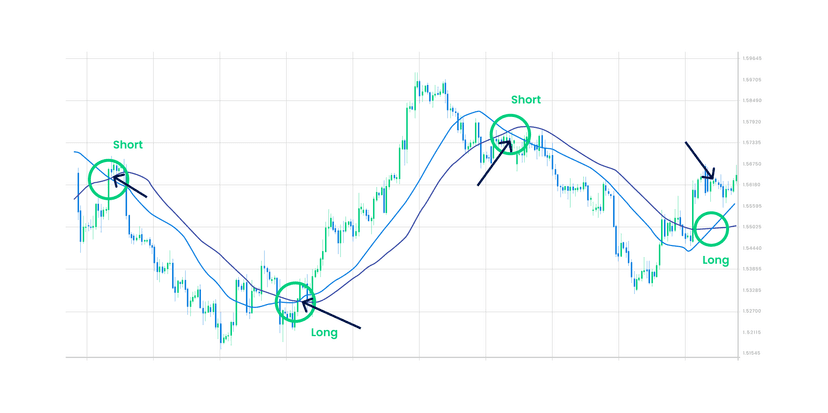
The EMA crossover is the most popular 1-minute scalping strategy for good reason. Exponential moving averages react faster than simple moving averages, making them ideal for the rapid pace of the 1-minute chart. This strategy identifies short-term trend shifts and lets you ride momentum for quick profits.
Indicator Setup
- EMA 9 (fast line) — tracks immediate price momentum
- EMA 21 (slow line) — represents the short-term trend
- EMA 50 (optional filter) — confirms the broader direction
Apply all three to your 1-minute chart. The 9 and 21 EMAs generate signals. The 50 EMA acts as a directional filter so you only trade with the prevailing micro-trend.
Entry Rules
Long entry: The 9 EMA crosses above the 21 EMA while price is above the 50 EMA. Enter on the close of the crossover candle or the first pullback to the 9 EMA after the cross.
Short entry: The 9 EMA crosses below the 21 EMA while price is below the 50 EMA. Enter on the close of the crossover candle or the first rally back to the 9 EMA after the cross.
Exit Rules
- Take profit: 5-8 pips from entry, or when the 9 EMA begins flattening against the direction of your trade
- Stop loss: 3-5 pips beyond the most recent swing high (for shorts) or swing low (for longs)
- Alternative exit: Close when the 9 EMA crosses back through the 21 EMA in the opposite direction
Best Pairs for EMA Crossover Scalping
EUR/USD and GBP/USD work best during the London and New York overlap (12:00-16:00 UTC). Both pairs offer tight spreads and consistent 1-minute price action. USD/JPY is another strong choice during the Tokyo-London overlap. Choosing the right broker is just as important as choosing the right pair, so check our breakdown of the best brokers for scalping if you haven’t locked that in yet.
Pro tip: Avoid trading the EMA crossover during the first five minutes after major news releases. The whipsaws will generate false crossovers that blow through your stops before the real move develops.
Strategy 2: RSI Divergence Scalping
RSI divergence on the 1-minute chart catches reversals at micro-exhaustion points. When price makes a new high but RSI doesn’t, momentum is fading. This strategy exploits those brief windows where overbought or oversold conditions snap back.
Indicator Setup
- RSI Period: 4 (shorter period for 1-minute sensitivity)
- Overbought level: 80
- Oversold level: 20
- Optional confirmation: 21 EMA for trend direction
A standard 14-period RSI is too slow for 1-minute scalping. The 4-period setting responds quickly enough to capture the micro-reversals you’re targeting.
Entry Rules
Bullish divergence (long): Price makes a lower low, but RSI makes a higher low. RSI must be at or near the 20 level. Enter when the RSI hooks back above 20 and a bullish candle closes.
Bearish divergence (short): Price makes a higher high, but RSI makes a lower high. RSI must be at or near the 80 level. Enter when the RSI hooks back below 80 and a bearish candle closes.
Exit Rules
- Take profit: 5-7 pips, or when RSI reaches the opposite extreme (80 for longs, 20 for shorts)
- Stop loss: 4-6 pips beyond the divergence swing point
- Time stop: Exit after 5 minutes if the trade hasn’t moved at least 2 pips in your direction
Best Pairs for RSI Divergence Scalping
This strategy works best on pairs that tend to mean-revert in quiet sessions. AUD/USD during the Asian session and EUR/USD during the early London session deliver the cleanest divergence signals. GBP/JPY offers larger moves but wider stops.
The key advantage of RSI divergence is that it catches turns before they happen. The downside is that divergence can persist, so the time stop is critical. If the reversal doesn’t kick in fast, get out.
Strategy 3: Bollinger Band Squeeze Scalping
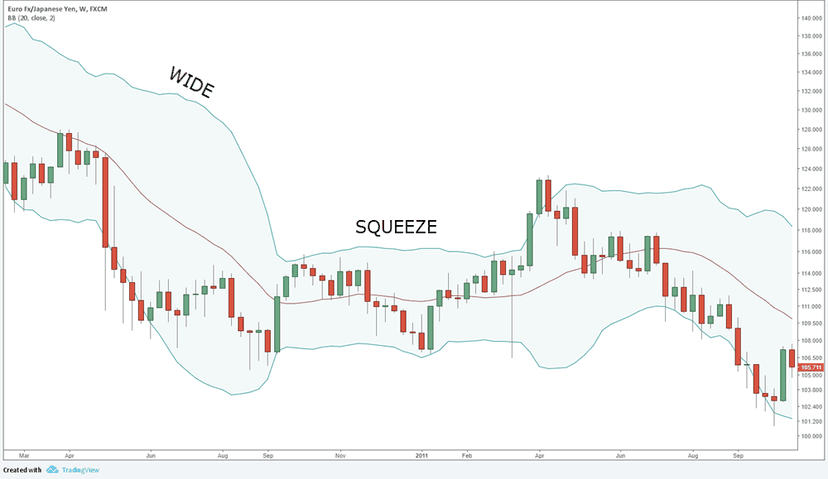
Bollinger Bands measure volatility. When the bands squeeze tight, a breakout is coming. This strategy waits for low-volatility compression on the 1-minute chart, then trades the explosion when price breaks out of the range.
Indicator Setup
- Bollinger Band period: 20
- Standard deviation: 2
- Optional: Bandwidth indicator to quantify the squeeze (Bollinger BandWidth below 0.001 signals extreme compression)
The standard 20-period Bollinger Band with 2 standard deviations works well on the 1-minute chart. You don’t need to adjust these settings.
Entry Rules
Long entry: Bands have been contracting for at least 5-10 candles. Price closes above the upper band with increasing volume. Enter on the breakout candle close.
Short entry: Bands have been contracting for at least 5-10 candles. Price closes below the lower band with increasing volume. Enter on the breakout candle close.
Confirmation: The candle that breaks the band should have a body at least 60% of its total range. Doji candles or candles with long wicks on the breakout side are rejection signals, not breakout signals.
Exit Rules
- Take profit: When price touches the opposite Bollinger Band, or after 6-10 pips of movement
- Stop loss: Place at the middle Bollinger Band (20 SMA), typically 3-5 pips from entry during a squeeze
- Trailing stop: After 4+ pips of profit, trail your stop to the middle band
Best Pairs for Bollinger Band Squeeze Scalping
EUR/USD and USD/CHF produce the cleanest squeezes during pre-session consolidation periods. Look for squeezes forming 30-60 minutes before the London or New York open, then trade the breakout as volume floods in.
Pro tip: The tighter the squeeze, the bigger the breakout. A Bollinger BandWidth reading below 0.0008 on the 1-minute chart often precedes a 10+ pip move. Be patient and wait for the narrowest compressions.
Strategy 4: VWAP Scalping
VWAP (Volume Weighted Average Price) is a favorite among institutional and day traders. It shows the average price weighted by volume, acting as a dynamic support and resistance level. On the 1-minute chart, VWAP anchors your directional bias and highlights mean-reversion opportunities.
Indicator Setup
- VWAP: Standard daily VWAP (resets each session)
- VWAP bands: +/- 1 and 2 standard deviations (if your platform supports them)
- MACD: 12, 26, 9 settings for momentum confirmation
VWAP is built into MT5 and cTrader. For MT4 users, you’ll need a custom VWAP indicator, which is freely available from the MQL5 community. Whichever platform you use, running it on a low-latency VPS keeps your VWAP data streaming without interruption.
Entry Rules
Long entry (mean reversion): Price pulls back to VWAP from above. The candle touches or slightly penetrates VWAP, then closes above it. MACD histogram shows decreasing bearish momentum or turns positive. Enter on the candle close.
Short entry (mean reversion): Price rallies to VWAP from below. The candle touches or slightly penetrates VWAP, then closes below it. MACD histogram shows decreasing bullish momentum or turns negative. Enter on the candle close.
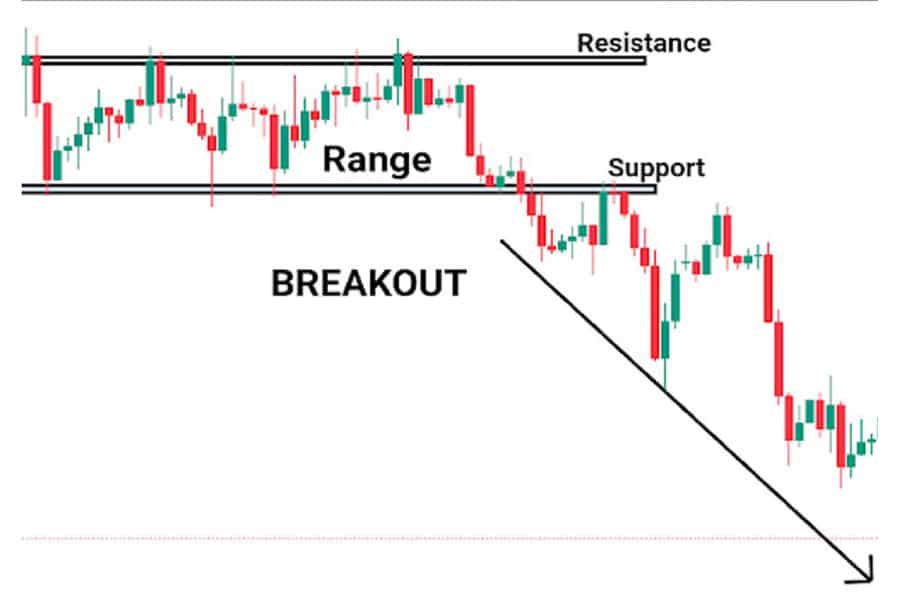
Breakout variant: If price has been consolidating near VWAP for 10+ candles, trade the first decisive close beyond the 1st standard deviation band in either direction.
Exit Rules
- Take profit: First target at the 1st VWAP deviation band (mean reversion trades). Second target at the 2nd deviation band for runners.
- Stop loss: 2-3 pips beyond VWAP on the opposite side of your entry
- Dynamic exit: Close if MACD crosses against your position direction
Best Pairs for VWAP Scalping
VWAP works best on high-volume pairs where institutional flow matters. EUR/USD during the New York session is the gold standard. GBP/USD and USD/JPY also produce reliable VWAP setups during their peak liquidity hours.
Note that VWAP loses its edge during low-volume periods. Avoid using it during the late New York or early Asian session when volume dries up and VWAP stops acting as a reliable anchor.
Strategy 5: Keltner Channel Breakout Scalping
Keltner Channels are similar to Bollinger Bands but use the Average True Range (ATR) instead of standard deviation to set the band width. This makes them smoother and less prone to false breakout signals on the 1-minute chart.
Indicator Setup
- Keltner Channel EMA: 20 period
- ATR multiplier: 1.5
- ATR period: 10
- RSI: Period 14, for momentum confirmation
The 1.5 ATR multiplier is key. A multiplier of 2 (the default on many platforms) filters too aggressively for the 1-minute timeframe and misses viable scalping entries.
Entry Rules
Long entry: Price closes above the upper Keltner Channel for two consecutive candles. RSI is above 50 and rising. Enter on the close of the second candle.
Short entry: Price closes below the lower Keltner Channel for two consecutive candles. RSI is below 50 and falling. Enter on the close of the second candle.
The two-candle confirmation is what separates this from a basic breakout strategy. Single-candle pokes above or below the channel often fail. Two consecutive closes show committed directional pressure.
Exit Rules
- Take profit: 5-8 pips, or when price closes back inside the Keltner Channel
- Stop loss: At the Keltner Channel midline (20 EMA), typically 4-6 pips from entry
- Re-entry: If stopped out but price immediately breaks back outside the channel, re-enter with the same rules
Best Pairs for Keltner Channel Scalping
GBP/USD thrives with Keltner Channels because of its natural volatility. EUR/GBP during the London session offers lower-volatility but higher-probability setups. USD/CAD around the oil inventory reports at 14:30 UTC on Wednesdays can produce explosive Keltner breakouts.
| Strategy | Best Pairs | Ideal Session | Target Pips | Stop Loss |
|---|---|---|---|---|
| EMA Crossover | EUR/USD, GBP/USD, USD/JPY | London-NY overlap | 5-8 | 3-5 pips |
| RSI Divergence | AUD/USD, EUR/USD, GBP/JPY | Asian, early London | 5-7 | 4-6 pips |
| Bollinger Squeeze | EUR/USD, USD/CHF | Pre-London, Pre-NY | 6-10 | 3-5 pips |
| VWAP | EUR/USD, GBP/USD, USD/JPY | NY session | 5-10 | 2-3 pips |
| Keltner Breakout | GBP/USD, EUR/GBP, USD/CAD | London, news events | 5-8 | 4-6 pips |
Risk Management for 1-Minute Scalping
Scalping generates high trade volume. Twenty to fifty trades per session is normal. That volume amplifies both gains and losses, making risk management the single most important factor in long-term profitability.
Position Sizing
Risk no more than 1% of your account per trade. For a $10,000 account with a 5-pip stop loss on EUR/USD, that means trading roughly 2 standard lots maximum. Most scalpers work with 0.5-1.0 lots to stay well within this threshold.
Reduce your position size during high-impact news events. Spreads widen, slippage increases, and your 5-pip stop can easily become a 10-pip loss.
Daily Loss Limits
Set a hard daily loss limit of 3% of your account. Once hit, stop trading for the day. No exceptions. Scalpers who blow accounts almost always do it in a single revenge-trading session, not from accumulated small losses.
The Spread Factor
Spreads matter more in scalping than any other style. A scalper targeting 5 pips of profit on a pair with a 1.5-pip spread is giving up 30% of each winning trade to costs. The same trade on a pair with a 0.5-pip spread loses only 10%.
This is why ECN or raw spread accounts are essential for scalping. Standard accounts with marked-up spreads destroy scalping profitability over hundreds of trades. You need all-in costs (spread plus commission) below 1 pip on your primary pairs.
Win Rate vs. Risk-Reward
Most successful 1-minute scalpers operate with a 55-65% win rate and a 1:1 to 1:1.5 risk-reward ratio. That math works because of volume. With 30 trades at a 60% win rate and 1:1 risk-reward, you net 6 winning-trade equivalents per session.
Chasing 1:3 risk-reward on the 1-minute chart is unrealistic. Price simply doesn’t trend far enough in the typical 2-5 minute scalping window. Accept smaller gains, focus on consistency, and let volume do the heavy lifting.
Execution Speed and Infrastructure
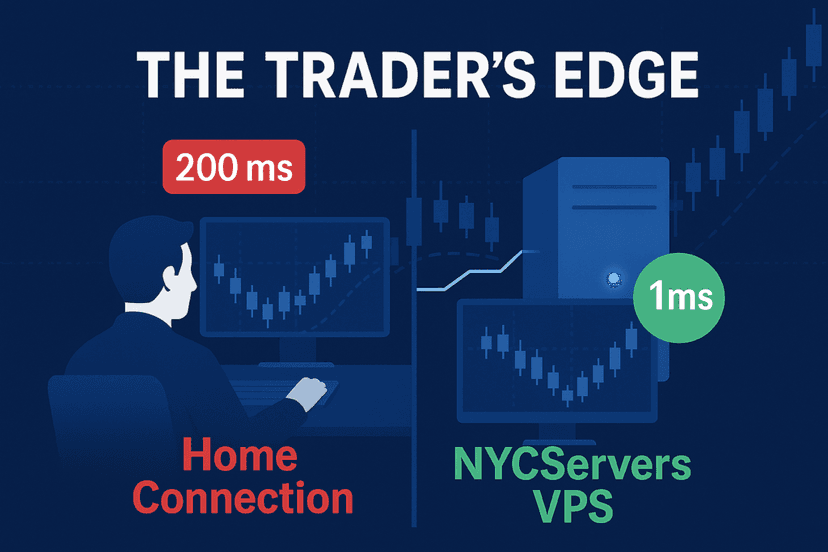
On longer timeframes, a few hundred milliseconds of latency is irrelevant. On the 1-minute chart, it changes outcomes. The difference between a 1ms fill and a 150ms fill on a fast-moving scalping setup can be 1-2 pips of slippage. Over 30 trades, that’s 30-60 pips of lost profit every session.
Why VPS Matters for Scalpers
Running your trading platform from a home internet connection introduces variable latency, potential disconnections, and ISP-level lag spikes that are invisible on a swing chart but devastating on the 1-minute timeframe. A trading VPS located in the same datacenter as your broker’s server eliminates these variables.
You get consistent sub-millisecond execution. Your Expert Advisors run 24/7 without depending on your home PC. And you avoid the single worst outcome for a scalper: being disconnected mid-trade with no stop loss active. Use our broker latency checker to see exact ping times from each datacenter to your broker.
Choosing the Right Setup
For manual scalping with 1-3 terminals open, a basic VPS with 2 CPU cores and 2GB RAM handles the workload. If you’re running automated scalping EAs across multiple pairs, you’ll want 4+ cores and 4-8GB RAM to prevent execution delays from resource contention.
Check our forex VPS plans to ensure your scalping setup never misses a beat.

Common Mistakes That Kill Scalping Accounts
Overtrading Without an Edge
Taking 50 trades per day means nothing if 30 of them are random entries. Every trade should match your strategy rules exactly. If the setup isn’t there, don’t trade. Boredom is not an entry signal.
Ignoring the Spread
Trading exotic pairs or illiquid timeframes on the 1-minute chart is a guaranteed way to lose money. Stick to major pairs during peak sessions. If your all-in cost exceeds 20% of your average win, the strategy is not viable on that pair.
No Pre-Session Routine
Check the economic calendar before every session. Know which news events are scheduled. Mark the times. High-impact releases like NFP, CPI, and rate decisions create volatility that looks like opportunity but is actually noise for most scalping strategies.
Moving Stops to Avoid Losses
If your stop loss is at 5 pips, it stays at 5 pips. Moving it wider on a losing trade is the fastest path to account destruction. The stop is there for a reason. Take the loss, move on, and trust the math of your edge over many trades.

Choosing the Right Strategy for Your Style
Not every strategy works for every trader. Your choice depends on your personality, risk tolerance, and the session you trade.
If you prefer trending markets: EMA crossover and Keltner Channel breakout strategies thrive when price is directional. Trade these during the London-New York overlap when trends are strongest.
If you prefer reversals: RSI divergence and Bollinger Band squeeze strategies excel at catching turns. These work best during ranging conditions in quieter sessions.
If you’re data-driven: VWAP scalping gives you an institutional-grade reference point. It’s objective, volume-based, and removes guesswork from directional bias.
Start with one strategy. Master it over at least 100 demo trades. Track your win rate, average gain, average loss, and profit factor using a tool like Myfxbook. Only add a second strategy once the first one is consistently profitable.
Frequently Asked Questions
What is the best indicator for 1-minute scalping?
There’s no single best indicator. The 9/21 EMA crossover is the most widely used because it balances speed and reliability. For confirmation, pair it with a 4-period RSI. The combination gives you trend direction from the EMAs and momentum confirmation from the RSI without cluttering your chart.
How many pips should I target on the 1-minute chart?
Most profitable scalpers target 5-8 pips per trade with a stop loss of 3-6 pips. Targeting more than 10 pips on the 1-minute timeframe is unrealistic for most pairs outside of news events. The math works through volume, not large individual gains.
What are the best currency pairs for 1-minute scalping?
EUR/USD is the top choice because of its tight spreads and consistent liquidity. GBP/USD offers more volatility and slightly larger moves. USD/JPY is reliable during the Tokyo and London sessions. Avoid exotic pairs entirely because their spreads will eat your profits.
Can I use automated EAs for 1-minute scalping?
Yes, and many scalpers prefer automation because it removes emotional decision-making and executes trades faster than manual entry. The catch is that your EA needs a stable, low-latency environment. Running an EA on your home PC over Wi-Fi is asking for disconnections and missed trades. A VPS in the same datacenter as your broker solves this problem.
What time of day is best for 1-minute scalping?
The London-New York overlap (12:00-16:00 UTC) offers the highest liquidity and tightest spreads. The London open (07:00-10:00 UTC) is the second-best window. Avoid scalping during the late New York session (after 20:00 UTC) and the early Asian session (after 22:00 UTC) when volume drops and spreads widen.
How much capital do I need to start scalping?
A minimum of $5,000 is recommended for scalping the 1-minute chart. Smaller accounts face disproportionately high spread costs relative to position sizes. With $5,000 and proper risk management (1% per trade), you can trade micro or mini lots comfortably while keeping risk contained.
Is 1-minute scalping profitable in 2026?
It can be, but profitability depends entirely on execution. You need tight spreads (ECN or raw spread accounts), fast execution (a VPS near your broker’s server), and disciplined risk management. The strategies haven’t changed much, but the traders who profit are the ones who control costs and stick to their rules across hundreds of trades per week.

About the author
Matthew Hinkle
Lead Writer & Full Time Retail Trader
Matthew is NYCServers' lead writer. In addition to being passionate about forex trading, he is also an active trader himself. Matt has advanced knowledge of useful indicators, trading systems, and analysis.
Areas of Expertise