

Best Brokers for High-Frequency Trading 2026 (HFT + VPS)
Compare the top brokers for high-frequency trading in 2026. Ultra-low latency, co-location, FIX API access, and institutional infrastructure — VPS required.

High-frequency trading isn’t about clicking buy and sell faster than other traders. It’s about infrastructure — sub-millisecond latency, direct FIX API connections, and servers co-located in the same data centers as your broker’s matching engine.
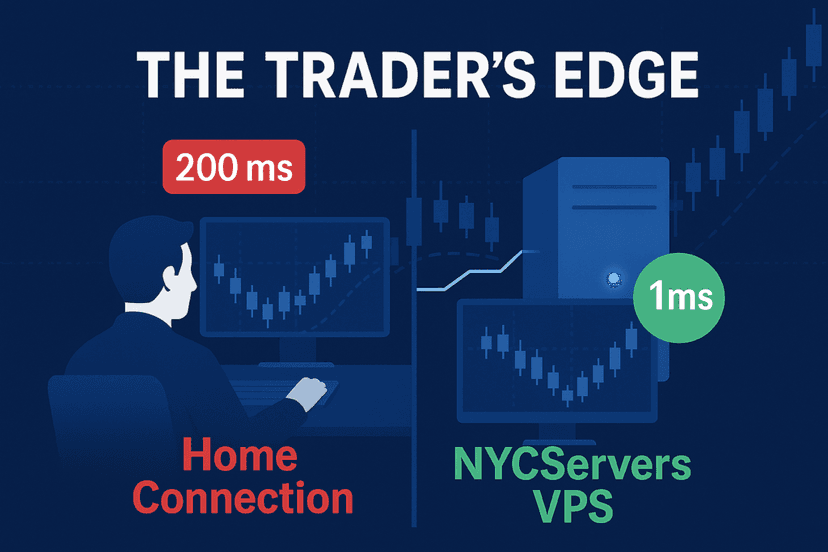
If you’re trading from home on MetaTrader with a 50ms connection, you’re not competing. Real HFT operates at speeds measured in microseconds, executing thousands of orders per second through automated systems that capitalize on price discrepancies before they vanish.
This article compares the top brokers for high-frequency trading in 2026, focusing on what matters: execution speed, co-location options, API access, FIX protocol support, and institutional-grade infrastructure. We’ll also cover why VPS or dedicated server hosting isn’t optional for HFT — it’s the foundation.
What High-Frequency Trading Actually Requires
Before comparing brokers, let’s establish what HFT demands from your infrastructure:
1. Ultra-Low Latency (Under 5ms)
Latency is the time between sending an order and receiving confirmation. Home internet connections average 50-100ms. HFT requires sub-5ms execution, with elite setups achieving under 1ms through co-location.
When HFT algorithms run on a properly configured VPS, they connect directly to broker servers through ultra-low latency network paths, reducing order transmission time to under 1 millisecond in optimal configurations. A VPS delivering steady 0.8ms latency outperforms one fluctuating between 0.3ms and 2.1ms because predictable timing enables better algorithm optimization.
2. Co-Location Infrastructure
Co-location places your trading server in the same data center as the broker’s matching engine. For example, IC Markets’ servers in Equinix NY4 can achieve 0.5ms execution when co-located, versus 15-100ms from a home connection.
One of the most effective ways to reduce latency is co-location, which involves placing trading servers in the same data center as the stock exchange’s matching engine. This minimizes the physical distance trade orders must travel, reducing transmission time to a few microseconds.
3. FIX API or Direct Market Access
The FIX (Financial Information Exchange) protocol lets you bypass the retail platform interface and connect directly to liquidity providers. While MT4/MT5 processes orders in 20-50ms, FIX API achieves execution in under 5ms.
Most brokers require $10,000-$50,000 minimum deposits for FIX access and charge $300-$1,500 monthly for connectivity.
4. ECN or STP Execution Model
HFT requires true ECN (Electronic Communication Network) or STP (Straight Through Processing) execution — no dealing desk, no requotes, no artificial delays. Your orders must route directly to liquidity providers with transparent pricing.
5. No Trading Restrictions
Many retail brokers prohibit latency arbitrage, impose minimum hold times, or limit messages per second. HFT-friendly brokers have no such restrictions and explicitly allow scalping and algorithmic strategies.
6. VPS or Dedicated Server
Trading from home is non-negotiable for HFT. You need a VPS or dedicated server positioned near your broker’s matching engine. At NYCServers, our infrastructure in Equinix NY4, LD4, and TY3 delivers sub-1ms latency to major brokers — check current latencies using our broker latency checker.

Best Brokers for High-Frequency Trading in 2026
We’ve ranked these brokers based on execution speed, infrastructure quality, API access, and suitability for institutional-grade HFT strategies. Note that Pepperstone, while popular for retail scalping, has notable limitations for true HFT and appears last in our rankings.
1. IC Markets — Best Overall for HFT Infrastructure
Execution Speed: Sub-20ms average (sub-1ms with co-location)
Co-Location: Equinix NY4, LD4, TY3
API Access: FIX API, cTrader API, MT4/MT5 API
Minimum Deposit: $200 (FIX API requires institutional account)
Commissions: From $3.50/lot (Raw account)
HFT-Friendly: Yes, with limitations (2,000 messages/day cap)
IC Markets operates servers in Equinix NY4, the world’s largest financial ecosystem housing over 600 institutions. Their MetaTrader 4 and 5 servers have average latency of less than 1 millisecond to major VPS providers co-located in NY4 or connected through dedicated lines to nearby data centers.
During independent HFT tests, IC Markets consistently delivered execution below 20ms on cTrader and MetaTrader with negligible slippage. With co-location, traders report execution under 1ms.
IC Markets supports FIX API for institutional clients, along with cTrader API and MT4/MT5 API integration. The broker uses True ECN execution with no dealing desk intervention, allowing orders to be placed between the spread with zero minimum order distance and freeze level.
Important limitation: IC Markets only allows 2,000 messages (including trades) per day on both demo and live accounts. Exceeding this limit results in account restrictions. For ultra-high-frequency strategies executing thousands of trades per hour, this may be restrictive.
Why you need VPS with IC Markets: IC Markets’ infrastructure lives in Equinix NY4. To capitalize on their sub-1ms latency, your trading system must be co-located in the same facility. NYCServers offers NY4 VPS hosting with direct connectivity to IC Markets’ servers — check your current latency on our latency checker.
2. LMAX Exchange — Best for Institutional HFT
Execution Speed: Average 3ms (sub-1ms with co-location)
Co-Location: New York, London, Tokyo, Singapore
API Access: FIX 4.4 API, REST API, Java/.NET client libraries
Minimum Deposit: $10,000
FIX API Cost: $300-$1,500/month
HFT-Friendly: Yes, purpose-built for institutional HFT
LMAX Exchange was built specifically for institutional and high-frequency traders. Unlike most over-the-counter venues, LMAX operates a centralized limit order book with no “last look” — all trades execute on strict price and time priority.
The platform’s proprietary technology delivers average execution speeds around 3 milliseconds, with co-located setups achieving sub-millisecond performance. LMAX’s infrastructure spans major financial centers including New York, London, Tokyo, and Singapore.
LMAX provides FIX 4.4 protocol support, REST API access, and customizable client libraries in Java and .NET. This enables seamless integration with custom HFT systems and allows direct access to the central limit order book with full market depth and real-time pricing.
The broker is regulated by the FCA in the UK, providing institutional-grade oversight and security. LMAX’s non-interventionist approach means no dealing desk interference and no requotes.
Cost consideration: Using FIX protocol with LMAX costs approximately $300-$1,500 per month depending on trading volume and initial deposit. The minimum deposit for FIX API access is $10,000.
VPS requirement: LMAX’s infrastructure requires co-location or VPS hosting in the same data centers to achieve competitive latency. Our forex VPS plans in NY4, LD4, and TY3 connect directly to LMAX’s servers with sub-2ms latency.
3. Dukascopy — Best Swiss-Regulated HFT Broker
Execution Speed: Sub-20ms average
Co-Location: Switzerland, Tokyo data centers
API Access: JForex API (Java), FIX API
Minimum Deposit: $1,000 (higher for API access)
Regulation: FINMA (Switzerland), FCMC (Latvia), JFSA (Japan)
HFT-Friendly: Yes
Dukascopy operates under FINMA regulation in Switzerland, offering institutional-grade infrastructure with Swiss banking integration. The broker’s proprietary SWFX platform connects to over 20 major banking institutions, providing deep ECN liquidity.
During independent testing, Dukascopy achieved execution speeds below 20ms with FIX and JForex API, placing it among the fastest brokers alongside Interactive Brokers and IC Markets. Execution speed is outstanding, supported by institutional-grade infrastructure and real-time order matching.
The JForex API provides full customization using Java programming, allowing traders to develop custom software applications that communicate directly with Dukascopy’s trade servers over secure Internet sessions. The platform also supports FIX API connectivity for institutional clients.
Dukascopy’s non-interventionist approach means no dealing desk interference and no requotes. Asian traders with algorithmic systems benefit from the broker’s Tokyo-based data centers for optimized latency.
Pricing advantage: Dukascopy uses a volume-centric commission model, rewarding high-volume traders with progressively reduced fees — ideal for HFT operations executing thousands of trades daily.
Why VPS matters: Dukascopy’s Tokyo servers serve Asian HFT traders, while European operations connect through Swiss infrastructure. NYCServers’ TKY3 VPS hosting provides optimized connectivity to Dukascopy’s Asian servers.
4. Saxo Bank — Best for Multi-Asset HFT
Execution Speed: Competitive (institutional-grade)
Co-Location: Equinix LD4, LD5
API Access: FIX API, SaxoOpenAPI (REST)
Minimum Deposit: Varies by jurisdiction (institutional accounts required for FIX)
Markets: Forex, stocks, futures, options, bonds, CFDs
HFT-Friendly: Yes (institutional clients)
Saxo Bank offers comprehensive API infrastructure for institutional traders requiring multi-asset HFT capabilities. Through FIX API, traders can gain market access through fast, flexible electronic infrastructure with tailored multi-asset liquidity.
Connection can be established via VPN or cross-connect in Equinix LD4 and LD5 data centers. The FIX session runs continuously from 5:00 AEST Monday to 17:00 EST/EDT Friday with no daily sequence number reset.
SaxoOpenAPI is a REST-like API on HTTP protocol with streaming support, providing access to all resources required to build high-performance trading platforms. The API supports streaming updates, instrument data, charts, quotes, client portfolio data, and order placement.
With over 20 years’ experience creating liquidity pools, Saxo constructs competitive solutions for institutional flows. Their connectivity to major technology providers ensures swift API implementation.
Saxo offers 8,600+ CFDs on stocks, indices, forex, and commodities, plus 250+ futures covering equity indices, energy, metals, and rates. Traders can access 120 global exchanges for stocks, ETFs, bonds, futures, and listed options.
Multi-asset advantage: Unlike forex-only brokers, Saxo enables HFT strategies across currencies, equities, futures, and options through a single API infrastructure.
Infrastructure requirement: Saxo’s FIX connectivity requires co-location in LD4 or LD5. Our LD4 forex VPS plans deliver direct connectivity to Saxo’s infrastructure.
5. FXPro — Best cTrader HFT Broker
Execution Speed: Sub-20ms on cTrader
Co-Location: Equinix data centers
API Access: cTrader Automate (C# API), MT4/MT5 API
Minimum Deposit: $100
Commissions: Effective spread ~1.3 pips EUR/USD (0.6 spread + 0.7 commission)
HFT-Friendly: Yes
FXPro delivers ECN-style trading through cTrader with Level II market depth and execution speeds under 20ms. The broker offers competitive infrastructure for HFT traders who prefer cTrader’s architecture over MetaTrader.
cTrader Automate allows traders to build algorithmic trading strategies using C# programming language, creating custom cBots with advanced optimization and backtesting capabilities. FXPro’s cTrader implementation provides direct access to real market liquidity with transparent pricing.
FXPro earned best-in-class honors for Algo Trading in 2025, with its cTrader account offering lower spreads than MetaTrader alternatives. The broker’s infrastructure includes VPS hosting through BeeksFX for running cBots 24/5 with reduced latency.
APIs can link traders’ automated HFT algorithms to FXPro’s platform for high-frequency execution. The broker supports MT4, MT5, and cTrader platforms, giving algorithmic traders flexibility in platform selection.
Platform advantage: cTrader’s native architecture often outperforms MetaTrader for HFT applications, with better handling of rapid order flow and more granular execution control.
VPS recommendation: FXPro’s cTrader servers benefit from sub-1ms connectivity when hosted in Equinix facilities. NYCServers’ cTrader VPS hosting is optimized for FXPro’s infrastructure.
6. Interactive Brokers — Best for US-Based HFT Traders
Execution Speed: Sub-10ms via Gateway API
Co-Location: Multiple global data centers
API Access: FIX API, Gateway API, REST API
Minimum Deposit: $0 (higher balances for better margin rates)
Markets: Forex, stocks, options, futures, bonds (multi-asset)
HFT-Friendly: Yes (with SEC compliance requirements)
Interactive Brokers is the best broker for high-frequency trading among US-regulated options, with execution speeds sub-10ms via Gateway API. The broker offers extensive global market access and institutional-grade infrastructure.
IBKR provides FIX API trading, REST API, and its proprietary Gateway API, delivering some of the fastest execution speeds in the industry. The broker’s multi-asset platform supports HFT across forex, equities, options, and futures.
As a US broker-dealer, IBKR complies with SEC Rule 15c3-5, implementing pre-trade risk limits and real-time monitoring. While this adds compliance overhead, it provides institutional-level risk management.
US regulation consideration: Interactive Brokers’ US regulatory framework means stricter compliance requirements but also provides enhanced trader protections unavailable from offshore brokers.
Infrastructure note: IBKR’s servers span multiple global data centers. For optimal HFT performance, choose VPS hosting nearest to your primary trading session — NY4 for US hours, LD4 for European sessions.
7. Pepperstone — Limited HFT Suitability
Execution Speed: 30-60ms average (0.35ms claimed, not independently verified)
Co-Location: Equinix servers (specific locations unclear)
API Access: MT4/MT5 API, cTrader API (no FIX API)
Minimum Deposit: $0
HFT-Friendly: Allowed but not optimized
Pepperstone markets itself as HFT-friendly and won awards for MetaTrader and Algo Trading in 2025. However, for true high-frequency trading, the broker has significant limitations compared to institutional-grade alternatives.
Latency concerns: While Pepperstone claims average speeds of 0.35ms, independent testing shows execution times of 30-60ms — considerably slower than IC Markets (sub-20ms), LMAX (3ms), or Dukascopy (sub-20ms). Most orders execute in under 30 milliseconds for Australian clients (Pepperstone Group Limited) and 60 milliseconds for UK/European clients (Pepperstone Limited).
No FIX API: Pepperstone lacks FIX protocol support, limiting traders to retail platform APIs (MetaTrader, cTrader). Without direct FIX connectivity, you can’t achieve the sub-5ms execution that defines true HFT.
Co-location ambiguity: While Pepperstone mentions Equinix server hosting, the specific data center locations aren’t clearly documented. IC Markets explicitly co-locates in NY4, LD4, and TY3. LMAX specifies New York, London, Tokyo, and Singapore. Pepperstone’s infrastructure documentation is vague by comparison.
Retail focus: Pepperstone excels at retail scalping and allows HFT strategies with no trading restrictions. However, the broker’s infrastructure targets retail algorithmic traders rather than institutional HFT operations. If you’re running latency arbitrage or strategies requiring sub-5ms execution, Pepperstone’s 30-60ms average latency makes it uncompetitive.
Better for: Retail scalpers, beginner algo traders, and strategies that can tolerate 30-60ms execution. Not suitable for institutional HFT, latency arbitrage, or strategies requiring FIX API access.
HFT Broker Comparison Table
| Broker | Execution Speed | Co-Location | API Access | Min Deposit | HFT Rating |
|---|---|---|---|---|---|
| IC Markets | Sub-20ms (sub-1ms co-located) | NY4, LD4, TY3 | FIX, cTrader, MT4/MT5 | $200 | 9.5/10 |
| LMAX Exchange | 3ms avg (sub-1ms co-located) | NY, London, Tokyo, Singapore | FIX 4.4, REST, Java/.NET | $10,000 | 9.5/10 |
| Dukascopy | Sub-20ms | Switzerland, Tokyo | JForex, FIX | $1,000 | 9/10 |
| Saxo Bank | Institutional-grade | LD4, LD5 | FIX, SaxoOpenAPI | Varies | 8.5/10 |
| FXPro | Sub-20ms (cTrader) | Equinix facilities | cTrader Automate, MT4/MT5 | $100 | 8/10 |
| Interactive Brokers | Sub-10ms (Gateway API) | Multiple global centers | FIX, Gateway, REST | $0 | 8.5/10 |
| Pepperstone | 30-60ms | Equinix (unclear) | MT4/MT5, cTrader (no FIX) | $0 | 6/10 |

Why VPS Infrastructure Is Non-Negotiable for HFT
You can’t run high-frequency trading from home. Let’s be clear about why.
The Latency Gap
Trading from home introduces latency of 50-100ms or more due to routing through residential ISPs, geographic distance from broker servers, and shared network infrastructure. HFT strategies become unprofitable when latency exceeds 10ms.
A properly configured VPS in an Equinix data center reduces latency to under 1ms by positioning your trading system in the same facility as your broker’s matching engine. When HFT algorithms run on a VPS, they connect directly to broker servers through ultra-low latency network paths, bypassing the routing delays inherent in standard internet connections.
Consistent Latency Matters More Than Minimum Latency
A VPS delivering steady 0.8ms latency outperforms one fluctuating between 0.3ms and 2.1ms. Predictable timing enables better algorithm optimization. Home internet connections experience unpredictable latency spikes during peak usage, ISP routing changes, or network congestion — any of which can destroy HFT profitability.
24/7 Uptime Requirement
HFT systems must monitor markets continuously and react to opportunities within milliseconds. Your home computer shuts down, restarts for updates, experiences power outages, and has ISP downtime. A trading VPS guarantees 100% uptime during market hours with redundant power and network connectivity.
Co-Location with Broker Infrastructure
IC Markets’ MetaTrader servers live in Equinix NY4. LMAX operates in NY, London, Tokyo, and Singapore. Dukascopy runs servers in Switzerland and Tokyo. If your trading system isn’t co-located in the same facility, you’re competing with traders who have 50-100x faster execution.
One trader reported that co-locating a trading server through an HFT broker in Chicago, near the CME, resulted in execution times dropping from 15 milliseconds to under 2 milliseconds. That’s the difference between profitable and unprofitable HFT.
NYCServers HFT Infrastructure
We operate trading VPS and dedicated servers in Equinix NY4 (New York), LD4 (London), and TY3 (Tokyo) — the same facilities hosting IC Markets, LMAX, and major liquidity providers.
Our NY4 VPS hosting delivers sub-1ms latency to IC Markets, LMAX, and brokers co-located in the same facility. Check your current latency to any broker using our broker latency checker.
HFT-Optimized VPS Plans:
- Standard VPS — $40/month, 2 CPU, 4GB RAM, 70GB storage — suitable for single-strategy HFT systems
- Professional VPS — $60/month, 4 CPU, 8GB RAM, 100GB storage — handles multiple strategies or instruments
- Dedicated Server — Starting at $125/month, fully customizable — for institutional HFT operations requiring maximum performance
All plans include Windows Server pre-installed, MT4/MT5/cTrader ready to deploy, 100% uptime guarantee during trading hours, and 24/7 support. Need help determining which infrastructure fits your HFT strategy? Our team can assess your requirements and recommend the optimal setup.
Common HFT Mistakes That Kill Profitability
1. Trading from Home
This is the most common mistake. If your trading system runs on your home computer, you’re operating at 50-100ms latency while your competition executes at under 1ms. You can’t compete.
2. Using the Wrong Data Center
If your broker operates servers in Equinix NY4 but your VPS is in a different facility, you’ve negated the latency advantage. Always co-locate in the same data center as your broker.
3. Choosing Brokers Without FIX API
Retail platform APIs (MetaTrader, cTrader) introduce 15-30ms latency overhead compared to FIX API. For true HFT, FIX protocol is non-negotiable.
4. Ignoring Message Rate Limits
IC Markets caps messages at 2,000 per day. Some strategies exceed this in minutes. Verify your broker’s message rate policies before deploying HFT systems.
5. Underestimating Infrastructure Costs
True HFT requires significant capital investment: VPS or dedicated server ($40-$5,000/month), FIX API access ($300-$1,500/month), sufficient trading capital ($10,000-$50,000 minimum), and development costs for custom algorithms. Budget accordingly.
How to Choose Your HFT Broker
Follow this decision framework:
Step 1: Determine Your Strategy Type
- Latency arbitrage: Requires sub-1ms execution → IC Markets, LMAX with co-location
- Statistical arbitrage: Tolerates 3-5ms → Dukascopy, Saxo Bank, LMAX
- Fast scalping (not true HFT): Can work with 20-30ms → FXPro, Pepperstone
Step 2: Identify Required Data Center Location
- US session focus: NY4 (IC Markets, LMAX)
- European session focus: LD4/LD5 (Saxo Bank, LMAX)
- Asian session focus: Tokyo (Dukascopy, LMAX)
Step 3: Verify API Requirements
- Need FIX API: IC Markets, LMAX, Dukascopy, Saxo Bank, Interactive Brokers
- Can use retail APIs: FXPro (cTrader), Pepperstone (MT/cTrader)
Step 4: Confirm Trading Restrictions
Read the broker’s terms of service. Look for:
- Explicit permission for latency arbitrage
- No minimum hold times
- No message rate caps (or caps that fit your strategy)
- ECN/STP execution (no dealing desk)
Step 5: Setup VPS Infrastructure
Once you’ve selected a broker, deploy VPS or dedicated server infrastructure in the same data center. Test latency using our latency checker before going live.
FAQ: High-Frequency Trading Brokers
What is high-frequency trading in forex?
High-frequency trading (HFT) is an algorithmic trading strategy that executes thousands of orders per second using automated systems. In forex, HFT relies on ultra-low latency connections (typically under 5ms), sophisticated algorithms, and direct market access to capitalize on tiny price discrepancies before they disappear. Success requires co-location or VPS infrastructure positioned near broker servers.
Can you do HFT without a VPS or co-location?
No. High-frequency trading is impossible without a VPS or co-location infrastructure. Trading from home introduces latency of 50-100ms or more, while HFT requires execution speeds under 5ms. A properly configured VPS in an Equinix data center like NY4 or LD4 reduces latency to 1ms or less, making competitive HFT execution possible.
What’s the difference between FIX API and regular MT4/MT5 trading?
FIX (Financial Information Exchange) API provides direct connection to broker liquidity pools, bypassing the retail trading platform interface. While MT4/MT5 typically processes orders in 20-50ms, FIX API can achieve execution in under 5ms. FIX is essential for institutional HFT strategies but usually requires a minimum account balance of $10,000-$50,000.
Which data center locations are best for HFT forex trading?
The Equinix NY4 data center in Secaucus, New Jersey, is the top choice for forex HFT, hosting servers for IC Markets, LMAX, and major liquidity providers. Equinix LD4 in London serves European and UK traders, while TY3 in Tokyo covers the Asian session. Your VPS should be co-located with your broker’s matching engine for sub-millisecond latency.
Do all forex brokers allow high-frequency trading?
No. Many retail brokers prohibit or restrict HFT strategies, especially latency arbitrage and scalping algorithms. Brokers that allow HFT typically offer ECN or STP execution models, have no minimum hold times, and don’t impose message-per-second limits. Always verify the broker’s terms of service before deploying HFT systems.
What’s co-location and why does it matter for HFT?
Co-location places your trading server in the same data center as the broker’s matching engine, reducing physical distance to achieve latencies under 1 millisecond. For example, IC Markets’ servers in Equinix NY4 can achieve 0.5ms execution when co-located. Without co-location, latency increases to 15-100ms, making most HFT strategies unprofitable.
How much does it cost to run an HFT operation?
Basic HFT setups start with a trading VPS ($40-$125/month), FIX API access ($300-$1,500/month depending on broker), and minimum trading capital ($10,000-$50,000). Professional co-location in Equinix data centers costs $1,000-$5,000 monthly. Full institutional HFT infrastructure with custom hardware and premium data feeds can exceed $100,000 annually.
Final Verdict: Best HFT Broker for 2026
For most traders, IC Markets offers the best balance of execution speed, co-location infrastructure, and cost. With sub-1ms latency in Equinix NY4, FIX API access, and explicit HFT permission, it’s the top choice for retail and semi-institutional HFT operations.
LMAX Exchange edges ahead for institutional traders willing to pay premium costs for centralized order book execution and guaranteed no-last-look policies.
Dukascopy serves traders prioritizing Swiss regulation and Asian session coverage.
Pepperstone works for retail scalpers but lacks the infrastructure for competitive HFT — its 30-60ms execution speeds and absence of FIX API make it unsuitable for true high-frequency strategies.
Regardless of broker choice, your infrastructure determines success. Co-locate in the same data center as your broker’s matching engine, use FIX API when possible, and verify your latency before going live.
NYCServers provides HFT-optimized infrastructure in Equinix NY4, LD4, and TY3 with sub-1ms connectivity to major brokers. Check your current latency on our broker latency checker, or explore our forex VPS and dedicated server options built specifically for high-frequency trading.

About the author
Matthew Hinkle
Lead Writer & Full Time Retail Trader
Matthew is NYCServers' lead writer. In addition to being passionate about forex trading, he is also an active trader himself. Matt has advanced knowledge of useful indicators, trading systems, and analysis.
Areas of Expertise