
BB Return MT5 Review: $649 Gold EA, Risk and VPS Fit
BB Return MT5 review: examine its $649 price, gold mean-reversion strategy, MQL5 trust evidence, major risks, testing plan, and VPS fit before buying.
BB Return MT5 Review: Quick Verdict on The $649 Gold EA
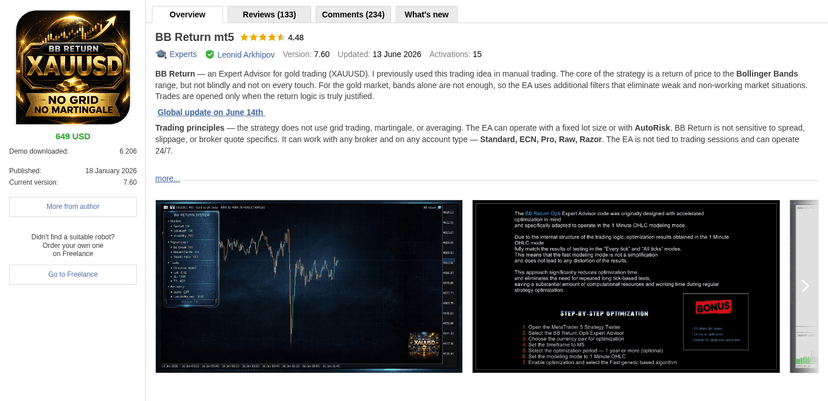
Short answer: shortlist it for testing, do not treat it as an automatic buy. This BB Return MT5 review looks at a XAUUSD M5 mean-reversion Expert Advisor that sells for $649 on the MQL5 Market as of July 2026, ships with a free tester demo, and allows 15 activations. Those are genuinely useful things for a buyer who intends to validate software before funding it.
What is missing is independent evidence. Everything on the listing that describes how BB Return trades — the Bollinger Bands return logic, the “no grid, no martingale, no averaging” claim, the roughly 80–100 trades per year, the spread and slippage tolerance — is a seller statement. The product’s own “Live signal” link resolved to “signal is not found in our database” when checked on 26 July 2026, so there is no public account record to inspect. A 4.48 rating across a 133-entry Reviews tab tells you about buyer sentiment, not about audited returns.
Bottom line: BB Return is testable, and that matters more than most marketing copy. Download the free demo, run real-tick tests on your own broker’s XAUUSD feed with your real spread and commission, then forward-test out of sample. Buy only if your own results — not the seller’s description — justify $649 that you cannot get refunded.
What is The BB Return EA and Who Is It For?
BB Return is a MetaTrader 5 Expert Advisor sold in the MQL5 Market. Its stated job is narrow: trade gold against the US dollar on the five-minute chart, using a Bollinger Bands “return” concept. In plain terms, the developer describes entries built around price stretching away from a band and then coming back toward the mean, with additional undisclosed filters deciding which of those stretches are worth trading.
| Listing detail | BB Return MT5 |
|---|---|
| Platform | MetaTrader 5 |
| Instrument and timeframe | XAUUSD, M5 (developer-stated) |
| Core approach | Bollinger Bands mean reversion plus undisclosed filters (claim) |
| Grid / martingale / averaging | None, per the developer |
| Price | $649 one-time (as of July 2026) |
| Demo | Free, Strategy Tester only |
| Activations | 15 |
| Version | 7.60, updated 13 June 2026 |
| Published | 18 January 2026 |
| Demo downloads | 6,206 |
| Rating / reviews | 4.48 displayed, 133 in the Reviews tab |
All figures above were retrieved from the product page on 26 July 2026. Version 7.60 on a product first published in January 2026 means the code has moved quickly in about six months. Frequent revisions can indicate active maintenance, but they also mean the version you test may not be the version that produced any historical result you were shown.
The realistic buyer is an MT5 user who already trades or tolerates gold, understands what a mean-reversion system does in a trending market, and is willing to spend time in the Strategy Tester before spending money. If you want a hands-off product you can attach and forget, this is the wrong purchase — not because BB Return is unusually risky, but because nothing on the listing lets you skip your own validation work.
BB Return Features and Trading Approach
Treat this whole section as developer claims. They are the specification you should test against, not findings we verified by trading the EA.
Entry logic and filters
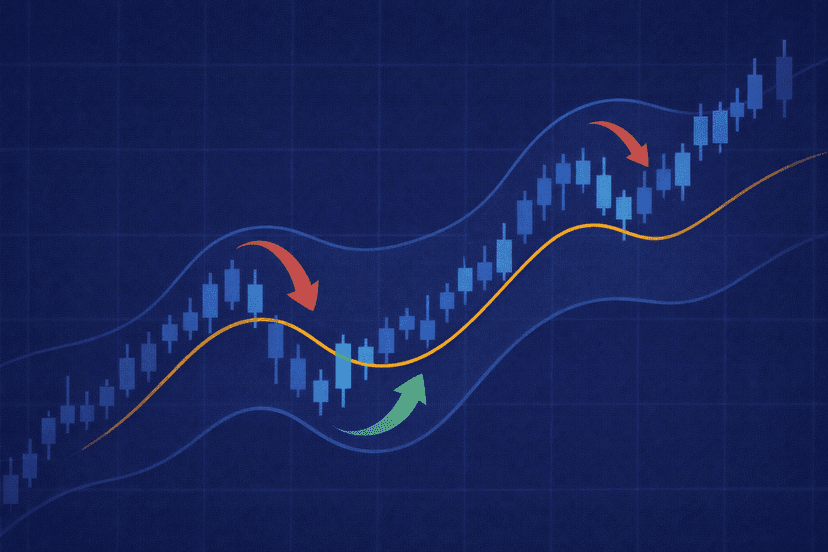
The stated core is a Bollinger Bands return: the EA reacts when price extends away from the bands and looks for the move back toward the average. Extra filters sit on top of that, and the developer does not disclose what they are. That is normal for a commercial EA, but it has a practical consequence — you cannot reason about the edge from the description, so the tester is the only place you learn how the system actually behaves.
Position sizing: fixed lot or AutoRisk
You can run a fixed lot size or the EA’s AutoRisk mode, which scales the position to the account. The developer states a $100 minimum for 0.01 lots. Read that as a technical floor for the smallest possible position, not as a sensible funding level. AutoRisk on a small balance means the size grows and shrinks with equity, which does not cap the damage a bad stretch can do — it only changes how the damage is distributed.
Trade frequency and operating window
The developer claims roughly 80–100 trades per year with no session restriction. That is a low-frequency profile: fewer than two trades a week on average. Low frequency has two consequences worth planning for. First, a statistically meaningful live sample takes a long time to accumulate, so patience is part of the evaluation. Second, per-trade outcomes carry more weight — one unusually bad sequence is a larger share of the year’s record than it would be for a scalper.
Risk architecture and broker claims
BB Return is advertised as using no grid, no martingale, and no averaging into losers. If accurate, that removes the specific failure mode where an EA hides a losing position behind an expanding basket. It does not make the product low risk; a directional mean-reversion system can still take a run of stop-outs when gold trends hard. The listing also claims the EA works on any broker or account type and is insensitive to spread and slippage. Those are exactly the claims that break most often in practice, so verify them on your own broker’s XAUUSD symbol with your real costs before you accept them.
The listing further mentions a separate BB Return Opti tool offered as a bonus alongside the purchase. Factor it in as a possible extra, not as a reason to buy: an optimisation helper does not add evidence about the trading logic itself.

BB Return Price, Demo and License (as of July 2026)
As of July 2026, the BB Return buy box showed $649 as a one-time purchase, with a free demo, 15 activations and free updates. That is the number to plan around.
There is a conflict on the same page. The product description still contains text saying “$359 is not the final price,” while the live buy box asks $649. Do not budget from the description. Treat $649 as the current price, recheck the buy box immediately before paying, and be aware that a listing carrying stale pricing copy may also carry stale copy elsewhere.
Three license mechanics matter more than the headline price:
- The demo cannot trade live. Demo versions of paid MQL5 Market products run only in the Strategy Tester. You cannot attach the free version to a live or demo chart and watch it trade forward in real time.
- Activations are hardware-bound. Each activation ties the product to a hardware and operating-system configuration. Moving to a new computer — or installing on a VPS — generally consumes another activation. Fifteen is generous, but it is finite, so plan your machine moves rather than reinstalling casually.
- Purchases cannot be returned. MQL5 Market rules state that purchased products are non-returnable. There is no trial-and-refund path, which is precisely why the tester demo is the decision point.
Free updates are a real benefit on a product at version 7.60, since you are not paying again for the next revision. Just remember that a revision can change behaviour, so a favourable test on one version is not a permanent result.
Trust Evidence, Transparency and Risk
The most common mistake buyers make with marketplace EAs is treating the marketplace itself as a performance guarantee. It is not. MQL5 verifies seller identity documents and formally checks that a product does what its description says. The rules state plainly that the marketplace does not guarantee an EA’s profitability, and that passing the automated check does not guarantee future results or error-free operation. Identity verification and a functionality check are a floor against outright fraud, not a performance audit.
What the ratings and downloads actually show
A 4.48 rating with 133 entries in the Reviews tab and 6,206 demo downloads shows interest and generally positive sentiment. It does not show risk-adjusted returns, drawdown, or how the EA behaved through different gold regimes. Reviews also skew toward recent experience, and a product published on 18 January 2026 has only been public for about six months as of this review — short enough that no reviewer has seen a full range of market conditions with it.
The missing live signal
This is the biggest transparency gap. The product page links to a live signal, but that link resolved to “signal is not found in our database” when checked on 26 July 2026. Whatever the reason — deleted, moved, or never populated — the practical effect is the same: there is no public, trade-by-trade account record you can examine for this EA. Do not accept a screenshot or a quoted growth figure as a substitute. If a seller advertises monitoring, the monitoring should be reachable.
Strategy and market risk
Gold is a volatile instrument, and mean reversion is the strategy family most exposed to sustained directional moves. The logic that profits from price snapping back to the average is the same logic that keeps fading a move that does not come back. Add M5 execution, where execution costs weigh more heavily the smaller a strategy’s per-trade target is, and the “insensitive to spread and slippage” claim becomes something you must measure on your own broker rather than assume.
Model risk sits alongside it. Undisclosed filters and a rapid version history mean the strategy you validate is partly a black box. Combine that with AutoRisk sizing on an underfunded account and a bad regime can compound quickly. An EA is software; it is not a regulated financial product, and no rating or download count changes that.

How to Test and Setup BB Return
Because the purchase is final and the demo runs only in the Strategy Tester, your entire pre-purchase evidence base is what you build yourself. Do it properly. The standard MQL5 guidance for stress-testing an EA before buying maps directly onto BB Return.
| Test | How to run it | What it tells you |
|---|---|---|
| Real ticks | Set the tester’s modelling mode to every tick based on real ticks, on XAUUSD M5 | Whether results survive realistic intrabar price movement |
| Real trading costs | Enter your broker’s actual gold spread and commission as custom conditions | How much of the edge the cost of trading consumes |
| Random delay | Enable the tester’s random execution delay | Sensitivity to latency and non-instant fills |
| Second broker | Repeat the same test on another broker’s XAUUSD history | Whether the result is broker-specific, contradicting the “any broker” claim |
| Extended history | Test across as much history as your data allows, covering trending and ranging gold | Regime dependence and worst-case drawdown |
| Out-of-sample forward test | Reserve a period the settings were never tuned on | Whether the configuration is fitted to the past |
Keep the configuration honest. The developer recommends default settings, which is convenient: test the defaults first, and only then explore changes. If you optimise heavily and adopt whichever parameter set produced the prettiest curve, you have produced a backtest, not live-trading evidence.
Set expectations about sample size too. At a claimed 80–100 trades per year, a three-month forward period may contain only 20–25 trades. That is enough to catch obvious breakage — errors, wildly different fills, unexpected position sizes — but far too few to confirm an edge. Plan for a long observation window and size positions as though the strategy might be wrong.
After purchase, the setup itself is simple: XAUUSD on M5, defaults, and either a fixed lot or AutoRisk. The decision that deserves real thought is capital. The $100 stated minimum only makes the smallest lot possible; it does not make gold trading at that balance prudent.

Is A VPS Useful?
Yes, for uptime — and you should be clear that uptime is the only thing it buys you. MetaTrader documents virtual hosting precisely for the case where an EA needs to run around the clock without depending on your own machine staying awake, connected and undisturbed. The developer also lists a VPS as optional for stable 24/7 operation.
A hosted MT5 terminal does not improve the strategy. It will not reduce the drawdown of a mean-reversion system in a trending gold market, guarantee a fill, or turn a losing configuration into a profitable one. What it removes is a category of avoidable failure: a Windows update mid-session, a home connection dropping while a position is open, or a laptop lid closing before the EA manages an exit.
For BB Return specifically, the frequency profile shapes the priority. At roughly 80–100 trades per year, continuous availability matters far more than shaving milliseconds off execution. Missing a handful of entries because your terminal was offline is a large distortion when the whole year contains fewer than a hundred trades. Reliability first, latency second.
One licensing detail catches people out. Installing the EA on a third-party VPS is a new hardware and OS configuration, so it generally consumes another activation. With 15 available that is not a crisis, but decide where the EA will live before you start installing it in several places. Plan the migration once, and confirm the hosted terminal connects to the same broker server and gold symbol you tested against — a different symbol suffix or a different feed changes the conditions you validated.
BB Return Pros and Cons
Pros
- Free demo lets you run full Strategy Tester evaluations before paying anything.
- Simple stated setup: one instrument, one timeframe, recommended default settings.
- Choice between fixed-lot and AutoRisk position sizing.
- 15 activations plus free updates gives room to move machines and stay current.
- No grid, martingale or averaging claimed, which rules out the most common hidden-exposure design.
Cons
- $649 is a high, non-refundable outlay with no reachable public live-account record to check first.
- Every performance-relevant statement is a seller claim, independently unverified.
- The linked live signal was unavailable when checked, removing the main transparency asset.
- The description’s “$359” price text conflicts with the $649 buy box.
- Gold volatility plus mean reversion is a regime-sensitive combination with real tail risk.
- Undisclosed filters and a fast version history make the logic hard to reason about.
Alternatives to BB Return EA
If BB Return’s price or evidence gap stops you, three marketplace products give useful context. All figures were retrieved on 26 July 2026 and can change.
| Product | Price | Version / activations | Approach |
|---|---|---|---|
| BB Return MT5 | $649 one-time | 7.60 / 15 | XAUUSD M5 Bollinger Bands mean reversion |
| Aurum AI MT5 | $499 one-time | 1.5 / 15 | XAUUSD M5, same author |
| AOT | $189 per year | 3.7 / 20 | 16-pair M15 mean reversion |
| Quantum Queen X | $1,099.99 one-time | 4.3 / 10 | Gold, explicitly trend-following grid |
Aurum AI MT5 is the closest comparison because it comes from the same author and also targets XAUUSD on M5 at $499. If you are already evaluating one, evaluate both in the tester — same broker, same costs, same period — rather than choosing on price.
AOT takes the opposite diversification stance: mean reversion across 16 pairs on M15 for $189 a year. Spreading the same strategy family across many instruments changes the risk profile compared with concentrating it in gold, and the annual licence lowers the upfront commitment while adding a recurring cost.
Quantum Queen X is included as a contrast, not a recommendation. At $1,099.99 it is a gold EA that explicitly uses a trend-following grid — the exact design BB Return says it avoids. Grid systems can show smooth equity curves for long stretches and then give it all back in one adverse run, so the comparison is really about which failure mode you are willing to own.
BB Return MT5 FAQ
Is BB Return a grid or martingale EA?
The developer states that BB Return uses no grid, no martingale and no averaging into losing positions. That is a seller claim rather than a verified finding, and it is straightforward to check yourself: run the demo in the Strategy Tester and inspect the trade list for multiple simultaneous positions in the same direction or lot sizes that increase after losses. Even if the claim holds, it removes one specific risk design — it does not make the EA low risk.
How much does BB Return MT5 cost?
As of July 2026 the buy box showed $649 as a one-time purchase with 15 activations and free updates. The description on the same page still contains older text referring to $359, which does not match the live price. Use $649 for planning and confirm the figure at checkout, because MQL5 Market purchases cannot be returned.
Can the free BB Return demo trade live?
No. Demo versions of paid MQL5 Market products run only in the Strategy Tester. You cannot attach the free demo to a live chart, and you cannot run it forward on a broker demo account in real time either. Backtesting on real ticks with your own spread and commission is the only pre-purchase evidence available to you.
What deposit does the seller recommend?
The developer states a $100 minimum for 0.01 lots. Read that as the technical floor for opening the smallest position, not as a recommended funding level. Gold moves quickly, and AutoRisk sizing on a thin balance can still produce material loss. Decide your capital from the drawdown you observed in testing and the loss you can absorb, not from the listing’s minimum.
Does BB Return require a VPS?
Not technically, but continuous hosting is sensible if you run it live. The developer lists a VPS as optional for stable 24/7 operation, and MetaTrader’s own virtual hosting exists for round-the-clock EA operation. The benefit is uptime, not better returns or guaranteed fills. Note that installing on a VPS is a new hardware configuration and will generally consume one of your 15 activations.
Can BB Return’s MQL5 reviews or backtests guarantee returns?
No. MQL5 verifies seller identity and formally checks that a product does what its description says, and the rules state explicitly that this does not guarantee profitability, future results or error-free operation. A 4.48 rating across 133 review entries reflects buyer sentiment over roughly six months, and a backtest — including one you run carefully yourself — describes the past. Neither is a forecast, and with the product’s linked live signal unavailable there is no public account record to fall back on.

About the author
Matthew Hinkle
Lead Writer & Full Time Retail Trader
Matthew is NYCServers' lead writer. In addition to being passionate about forex trading, he is also an active trader himself. Matt has advanced knowledge of useful indicators, trading systems, and analysis.
Areas of Expertise