
How Prop Firm Payouts Work: Splits, Cycles & Methods
How prop firm payouts work: profit splits from 80-100%, payout cycles from 14 days to on-demand, withdrawal methods, and rules that can void a payout.
Here is how prop firm payouts actually work: you trade a simulated account, and when you make profit inside the firm’s rules, the firm pays you a real-money share of those simulated gains. Three variables decide what lands in your bank account — the profit split percentage, the payout cycle, and the withdrawal method.
The headline numbers look generous. FTMO pays 80–90%, Topstep pays 90%, and FundedNext advertises up to 95%. But the split is only one lever. Minimum payout amounts, per-request caps, winning-day requirements, and review windows all shape when and how much you can withdraw. This guide walks through each lever using verified terms from FTMO, Topstep, and FundedNext, current as of August 2026.
Profit Splits: What 80/20, 90/10 and “Up to 95%” Really Mean
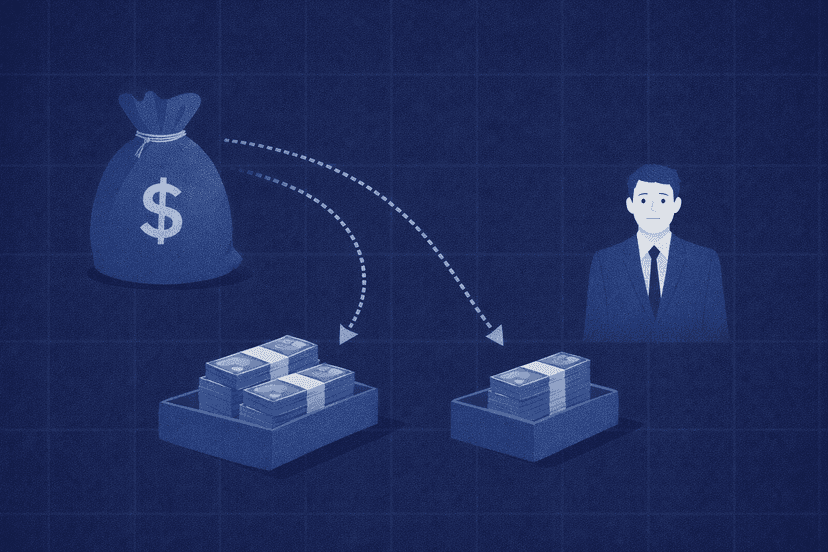
The profit split is your share of the gains you generate on the funded account. A 90/10 split means you keep 90% and the firm keeps 10%. Simple in principle — but firms quote splits in ways that need unpacking.
FTMO’s split depends on which challenge you passed. The 1-Step evaluation pays 90% of profit from the start. The 2-Step evaluation starts at 80%, rising to 90% once you qualify for the Scaling Plan or the Premium Programme. Topstep’s official payout policy sets a flat 90/10 split on its funded accounts. Traders who were on the Topstep dashboard before January 12, 2026 kept a legacy perk of 100% of their first $10,000 in lifetime profits — but that no longer applies to new sign-ups.
FundedNext’s “up to 95% reward share” is a ceiling, not the default. Its published CFD challenge specs show an 85% reward share on specific challenge types. Whenever you see “up to” in a split, check the terms for the challenge type you are actually buying — the base figure is what you will earn on day one.
| Firm | Profit split | First payout timing | Payout methods |
|---|---|---|---|
| FTMO | 90% (1-Step); 80% rising to 90% (2-Step, via Scaling Plan) | 14th day after first placed trade, then any following day | Bank wire, Visa Direct / Mastercard Send card push, Skrill, crypto |
| Topstep | 90/10 | After 5 winning days of $150+ Net P&L (Standard) or 3 days at the 40% consistency target | Instant transfer to US bank accounts via Aeropay |
| FundedNext | Up to 95% (85% on specific CFD challenge types) | After completing the trading cycle; processed within 24 hours | Reward Request via dashboard |
All figures verified from the firms’ official payout pages as of August 2026. Splits and eligibility rules change frequently — confirm on the firm’s own payout policy page before buying a challenge.

Payout Cycles: 14-Day, Winning-Day, and On-Demand Models
The payout cycle determines how often you can request money. There are three broad models in use, and each of the three firms represents one of them.
FTMO — fixed first window, then flexible. According to FTMO’s payout FAQ, your reward claim becomes available in Account MetriX on the 14th day after your first placed trade, or any day after that. You choose the date; once the first cycle completes, subsequent payouts follow the same request-when-ready pattern. All positions and pending orders must be closed before the claim.
Topstep — performance-gated. On the Express Funded Account, the Standard path requires 5 non-consecutive winning days of $150 or more in Net P&L, plus positive net profit since your last payout. The alternative Consistency path needs only 3 winning days, but each must hit a 40% consistency target. You are not waiting on a calendar; you are waiting on qualifying trading days.
FundedNext — cycle completion, fast processing. You submit a Reward Request from the dashboard after completing the trading cycle, and FundedNext’s reward page claims 99.99% of rewards are processed within 24 hours — the firm’s own figure, with average processing times quoted between roughly 4.7 and 40 hours depending on the page.
Notice the trade-off: faster or more flexible cycles usually pair with caps or gating conditions. Topstep lets you qualify in as few as 3 trading days, but caps how much each request can take out. FTMO makes you wait 14 days for the first payout but imposes no per-request percentage cap. Speed and size rarely come together.
Eligibility Rules That Gate Your Payout
Passing the challenge and being in profit does not automatically mean you can withdraw. Each firm layers eligibility conditions on top of the cycle. As of August 2026, the main gates are:
- Minimum payout amounts. Topstep requires at least $125 per request. FTMO’s minimums vary by method: $20 profit for bank wire, $50 for crypto.
- Per-request caps. Topstep’s Express Funded Account caps each payout at 50% of the account balance, up to $2,000–$6,000 depending on account size and path. A limited-time promo doubles the cap for traders who opt into a Daily Loss Limit.
- Winning-day and consistency requirements. Topstep’s 5-winning-day and 40%-consistency paths are the clearest examples; profits earned in one outsized day may not count toward eligibility on the consistency path.
- Closed positions. FTMO requires every position and pending order to be closed before the reward claim.
- Review windows. FTMO reviews the account for 1–2 business days after the claim, with payment typically arriving 1–2 business days after invoice approval. Budget roughly a working week from request to money.
- Profit since last payout. Topstep requires positive net profit since your previous withdrawal — you cannot cycle the same profit through repeated requests.
These rules exist because payouts are the firm’s real cash going out against your simulated performance. Read the payout policy with the same care you read the daily drawdown rules — a technically profitable month can still leave you ineligible to withdraw.

Payout Methods: How the Money Reaches You
Once approved, the withdrawal rail decides speed, limits, and fees. FTMO offers four routes and charges no commission of its own on withdrawals: bank wire (minimum $20 profit), instant card push via Visa Direct or Mastercard Send (up to $20,000 per transfer), Skrill (up to $3,000), and crypto (minimum $50).
Topstep partnered with Aeropay to push approved payouts to US bank accounts in seconds — the firm claims a 9-second average instant payout and a 99.26% approval rate. FundedNext handles withdrawals through the Reward Request flow in its dashboard, with the 24-hour processing promise noted above.
Practical takeaway: the same approved payout can arrive in seconds or in days depending on the rail. If you rely on payouts as income, pick the method with the limits and speed that match your withdrawal size — a $20,000 card push at FTMO covers most traders in one transfer, while Skrill’s $3,000 ceiling forces splitting larger rewards.
Withdrawing vs. Compounding: Rollover and Scaling Plans
You do not have to withdraw everything. FTMO’s 2-Step accounts allow rollover: keep some or all of the reward (minimum $20/€20) on the account instead of withdrawing it. The retained profit raises your balance, which effectively deepens your drawdown buffer for the next cycle.
Growth plans reward that patience. FTMO’s Scaling Plan increases the account balance by 25% every four active months for qualifying traders, up to $2,000,000 total — and raises the 2-Step split from 80% to 90%. Topstep’s version sits on the Live Funded Account: after 30 winning days, you unlock daily access to up to 100% of your profits with no per-request caps.
The trade-off is straightforward. Withdrawing everything each cycle locks in cash but keeps your buffer thin and your account size static. Rolling profit forward compounds your capacity and can raise your split — but that retained profit is exposed if you later breach a rule and lose the account. Many funded traders split the difference: withdraw a fixed percentage, roll the rest.
Realistic Expectations and Red Flags
The most useful payout statistic does not come from a marketing page. Topstep’s own 2025 performance disclosure states that of participants from January to December 2025, only 16.8% of Trading Combines were completed, 51.8% of individuals passed at least once — and just 33.3% of funded-level participants received a payout. In other words, at one of the industry’s most established firms, two out of three funded traders never withdrew a cent that year.
Treat aggregate totals with the same caution. FTMO’s “$650M+ paid in rewards worldwide”, Topstep’s “$1.4B+ paid out”, and FundedNext’s “$295.6M+ rewarded” are the firms’ own claims, not independently audited figures. They tell you the firm pays; they tell you nothing about your odds of being paid.
Before buying a challenge, check three things: whether the firm publishes any payout or pass-rate statistics, whether the payout policy lists prohibited-conduct clauses that can void a pending payout, and how disputes are handled. Denied payouts almost always trace back to a rule breach — often a drawdown or consistency violation mid-cycle rather than anything at withdrawal time. That is also why execution stability matters: a disconnection or slippage spike at the wrong moment can push an open position through a daily loss limit and void the payout you were about to request. Traders running EAs or holding positions near their limits typically run their platform on a forex VPS so the connection is not the weak link.
One framing point worth remembering: FTMO, Topstep, and FundedNext all state that funded accounts operate in simulated or demo environments. Your payout is a real-money reward calculated from simulated profits — you are not trading the firm’s live capital, and no payout is guaranteed income.
Prop Firm Payouts: FAQ
How long until my first prop firm payout?
It depends on the firm’s cycle. At FTMO, you can claim on the 14th day after your first placed trade, then allow 1–2 business days for review and 1–2 more for payment. At Topstep, you qualify after 5 winning days of $150+ (or 3 days at the 40% consistency target), so an aggressive trader can reach a first payout in under two weeks. FundedNext processes reward requests within 24 hours once the trading cycle is complete.
Do prop firms really pay?
Established firms do pay — FTMO, Topstep, and FundedNext all publish large cumulative payout totals, though these are their own marketing claims. The more honest question is how many traders get paid: Topstep’s 2025 disclosure shows only 33.3% of funded-level participants received a payout that year. Firms pay; most traders still don’t qualify.
What’s the highest profit split available?
FundedNext advertises up to 95%, though its verified CFD challenge specs show 85% on specific challenge types. FTMO reaches 90% (immediately on 1-Step, or via the Scaling Plan on 2-Step), and Topstep pays a flat 90%. On Topstep’s Live Funded Account, 30 winning days unlocks access to up to 100% of profits. Always check the base split for your specific challenge, not the “up to” headline.
Can a prop firm deny my payout?
Yes. Payouts can be denied for rule breaches — drawdown violations, consistency failures, prohibited trading conduct, or open positions at claim time. FTMO reviews each account for 1–2 business days before approving a reward, and Topstep reports a 99.26% approval rate on requests. Most denials trace to a rule broken during the trading cycle, not at the withdrawal step itself.
Are prop firm payouts taxed?
In most jurisdictions, yes. Prop firm payouts are typically treated as self-employment or contractor income rather than capital gains, because you are paid a reward under a contract, not trading your own capital. The firm generally does not withhold tax for you, so set aside a portion of every payout and confirm the treatment with a tax professional in your country.

About the author
Matthew Hinkle
Lead Writer & Full Time Retail Trader
Matthew is NYCServers' lead writer. In addition to being passionate about forex trading, he is also an active trader himself. Matt has advanced knowledge of useful indicators, trading systems, and analysis.
Areas of Expertise