
ATR Stop Loss in Forex: Volatility-Based Stops Guide
Learn how to set ATR stop losses in forex. Use average true range to place volatility-based stops, size positions, and trail winners with the right multiplier.
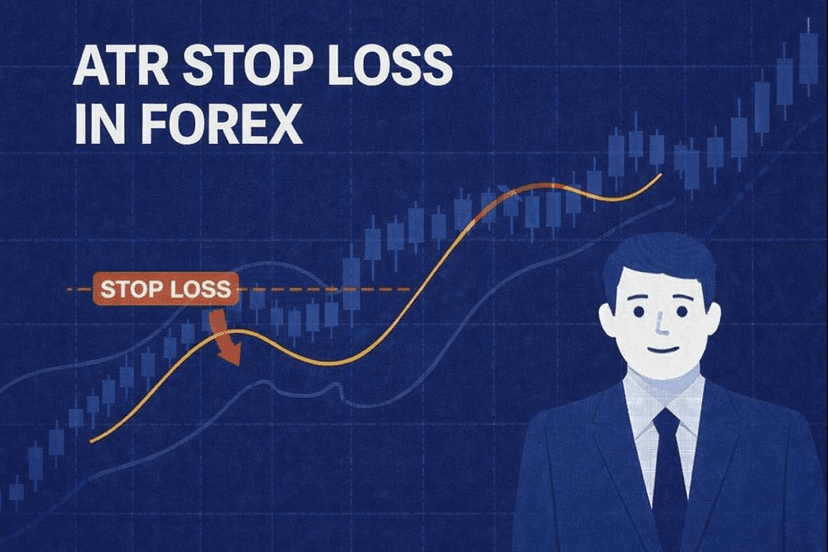
If a fixed-pip stop keeps getting clipped by ordinary market noise, use an ATR stop loss instead. It sets your stop distance from current volatility: calculate the Average True Range, multiply it by a chosen factor, then place the stop that distance beyond your entry or a relevant price level.
The quick verdict is that ATR gives you a repeatable, market-adaptive distance, but it does not choose trade direction or make a weak setup profitable. You still need a valid entry, a logical invalidation level, position sizing, and enough potential reward to justify the risk.
What Average True Range Measures
J. Welles Wilder Jr. developed the Average True Range and introduced it in his 1978 book New Concepts in Technical Trading Systems, the same book that presented RSI, Parabolic SAR, and ADX. ATR measures the magnitude of recent price movement. It says nothing about whether price is moving up or down.
That distinction matters. A rising ATR means ranges are expanding, whether the market is rallying, falling, or swinging sharply in both directions. A falling ATR means movement is contracting. ATR is therefore a volatility input, not a buy or sell signal.
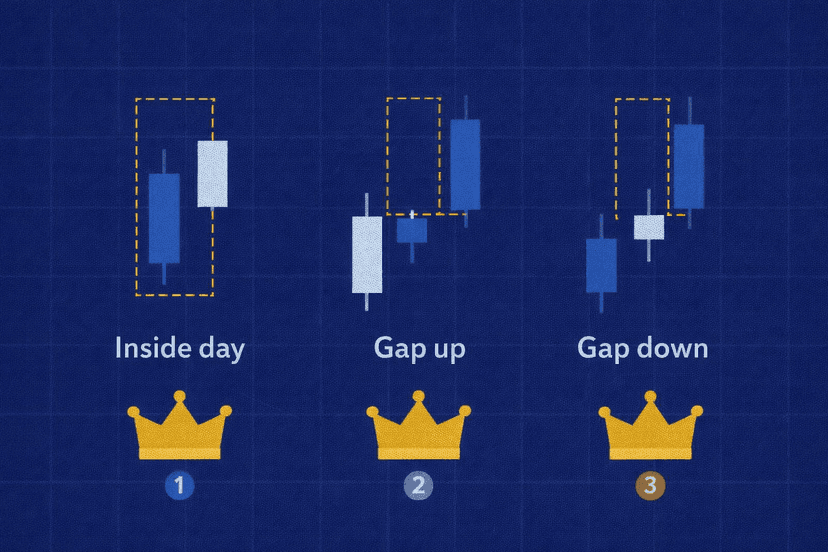
True Range captures gaps as well as candle range
For each candle, True Range is the greatest of these three measurements:
- Current high minus current low
- The absolute value of current high minus the previous close
- The absolute value of current low minus the previous close
The absolute values keep the result positive. The second and third measurements capture gaps or limit moves that a simple high-low range would miss, which is why True Range uses the previous close rather than relying on the current candle alone.
How ATR is calculated
The default setting is 14 periods. The first ATR is the simple average of the first 14 True Range values. After that, Wilder’s smoothed moving average uses this exact formula:
Current ATR = ÷ 14
Wilder recommended 14-period smoothing, although he sometimes used an eight-period ATR. Your platform normally handles the calculation and displays ATR in a subwindow in price units. On a five-decimal EUR/USD quote, for example, an ATR reading of 0.00080 represents 8 pips.
Raw ATR values are absolute, so do not compare them across instruments. An ATR of 0.0010 on one pair and 0.1000 on another does not prove that the second offers a better trade. Interpret each reading in the context of that instrument’s price scale and timeframe.
How to Set an ATR Stop Loss
The basic calculation is stop distance = ATR × multiplier. Apply the reading from the same timeframe used to define your setup, then convert the result into pips or points before sizing the position.
- Long trade: Stop price = entry price − (ATR × multiplier)
- Short trade: Stop price = entry price + (ATR × multiplier)
This entry-based method is easy to automate. A structure-based variation is often more useful for manual trading: identify the swing low, support zone, swing high, or resistance level that invalidates the setup, then use ATR to judge whether the stop has enough room beyond ordinary volatility. If the structural stop is much farther away, accept the wider distance and reduce position size rather than forcing the stop closer.
Illustrative EUR/USD calculation
Assume EUR/USD is at 1.0850 and its 14-period ATR on your trading timeframe is 0.00080, or 8 pips. With a 2× multiplier, the stop distance is 0.00080 × 2 = 0.00160, or 16 pips.
- A long entry at 1.0850 gets an ATR stop at 1.0834.
- A short entry at 1.0850 gets an ATR stop at 1.0866.
This is a math example, not a live ATR reading or trade recommendation. Before placing the order, check whether the calculated stop also makes sense relative to market structure and whether the resulting target is realistic.
Choosing an ATR Multiplier by Trading Style
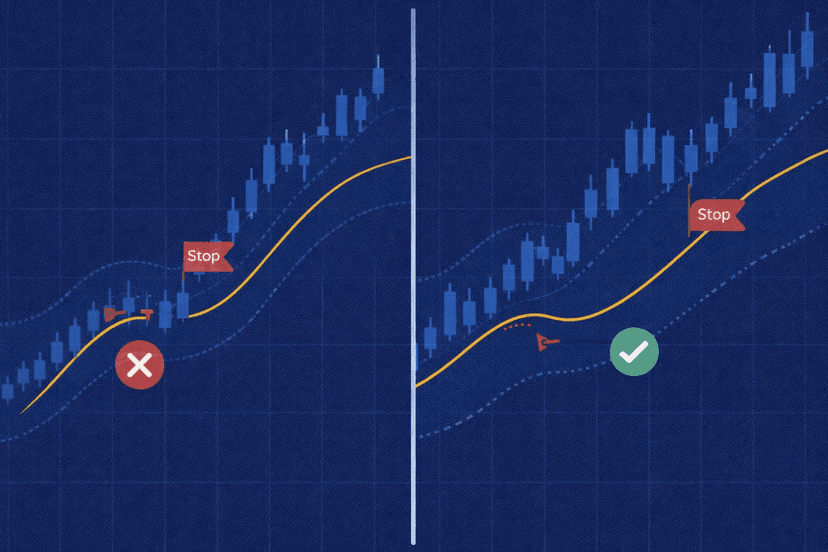
A common practitioner range is roughly 1.5× to 3× ATR, but it is not an official rule. A tighter multiplier reacts faster and risks more noise-driven exits. A wider multiplier gives price more room but increases stop distance, which means you must trade a smaller position to keep cash risk unchanged.
| Trading style | Suggested starting multiplier | ATR timeframe |
|---|---|---|
| Scalping | 1.5×–2× | Execution chart, often 5- or 15-minute |
| Intraday trading | 1.5×–2.5× | 15-minute to 1-hour |
| Swing trading | 2×–3× | 4-hour or daily |
| High-volatility instrument | 3× or more after testing | Timeframe used for the setup |
Treat these values as testable starting points. The ATR period and chart timeframe are separate choices: ATR(14) on a 15-minute chart measures 14 intraday candles, while ATR(14) on a daily chart measures 14 daily candles. Match the data to the holding period instead of borrowing a setting from an unrelated strategy.
More volatile pairs and instruments may need a larger multiplier. StockCharts illustrates this principle with a 5× Chandelier Exit multiplier for volatile HPQ shares, rather than the indicator’s default 3×. That equity example is not a command to use 5× in forex; it shows why the multiplier should reflect the instrument and be tested on the strategy’s own history.
Judge a multiplier by more than how often stops survive. Review maximum adverse movement, average loss, average winner, and risk-to-reward across a meaningful sample. Making a stop wider can reduce premature exits while still harming expectancy if the larger losses are not offset by the strategy’s winners.
ATR Position Sizing Keeps Risk Consistent
ATR determines distance; position sizing converts that distance into account risk. Use this relationship:
Position size in lots = cash risk ÷ (stop distance in pips × pip value per lot)
Suppose an illustrative $10,000 account risks 1%, or $100, on the 16-pip EUR/USD stop above. Assuming a pip value of $10 per standard lot, the calculation is $100 ÷ (16 × $10) = 0.625 standard lots. If ATR rises and the same multiplier produces a 25-pip stop, size falls to 0.40 lots. The volatility-based stop gets wider, but planned cash risk remains $100.
This is the core benefit of ATR position sizing: it creates a self-adjusting risk limit tied to current movement. Quiet conditions allow a larger position behind a smaller stop; volatile conditions force a smaller position behind a larger stop.
Calculate reward from the final stop distance, not from the stop you hoped to use. A 16-pip stop needs 32 pips of potential reward for a 1:2 risk-to-reward target before trading costs. If nearby resistance leaves only 12 pips of room, lowering the multiplier to manufacture a better ratio puts the calculation ahead of the chart. The cleaner choice may be to skip the trade.
ATR Trailing Stops and the Chandelier Exit
An ATR trailing stop adapts as volatility and price change. Instead of setting one fixed exit at entry, it follows a favorable move while leaving room for routine pullbacks. The Chandelier Exit is a well-known version developed by Charles Le Beau and featured in Alexander Elder’s books.
Its default settings use a 22-period lookback and a 3× ATR multiplier:
- Chandelier Exit for a long = 22-day high −
- Chandelier Exit for a short = 22-day low +
On a daily chart, “22-day high” is literal. On another timeframe, traders commonly interpret the logic as the highest high or lowest low across 22 bars. A long position exits when price falls through the long Chandelier level; a short exits when price rises through the short level.
The method is designed to keep a position in a trend without placing the exit directly against current price. It can still give back open profit, and a sharp reversal can cross the calculated level. If you code it as a strict trailing rule, do not let a recalculation loosen the stop or add risk after entry.
Common ATR Stop Mistakes and Automation Risk
Most ATR errors come from treating one input as a complete trading system. Avoid these mistakes:
- Reading direction into ATR: High or rising ATR does not tell you to buy or sell. It only describes movement.
- Comparing raw values across pairs: ATR is an absolute price measurement. Compare a pair with its own history, not another instrument’s raw number.
- Using the wrong timeframe: A daily ATR can be irrelevant to the noise around a five-minute entry, while a five-minute ATR can be too narrow for a multi-day trade.
- Keeping lot size fixed: When ATR expands, a fixed lot size and wider stop increase cash risk. Recalculate volume for every stop distance.
- Moving the stop against the trade: Widening an initial or trailing stop after entry breaks the risk calculation. Define any adjustment rules before entering.
Automation removes manual calculations but adds an operational dependency. An Expert Advisor that recalculates ATR, sizes orders, or trails a Chandelier Exit must remain connected to the trading platform when an update is due. If the home computer sleeps, loses power, or disconnects, terminal-side management may not run as intended.
Running an ATR-based EA on a forex VPS can keep MetaTrader online around the clock without relying on your home machine. A VPS does not improve the stop logic or guarantee execution at the requested price; it provides a persistent environment for the rules you have already tested. Monitor the platform, confirm the EA is active, and keep a broker-side protective stop on every position.
ATR Stop Loss Checklist
Use ATR as one part of a defined risk process, not as a shortcut around trade selection. Before sending an order:
- Read ATR on the timeframe that matches the setup.
- Choose a tested multiplier and calculate the stop in pips.
- Check that the stop sits beyond normal noise and respects market structure.
- Reduce lot size as stop distance expands so cash risk stays fixed.
- Confirm that the available reward still supports your minimum risk-to-reward ratio.
- Never widen the stop simply to avoid realizing a planned loss.
The practical advantage is consistency. Your stop breathes with the market, your position size compensates for that changing distance, and each trade begins with a known cash risk.
ATR Stop Loss FAQ
What is the best ATR setting for a stop loss?
ATR(14) is the standard starting point because Wilder recommended 14-period smoothing. It is not automatically best for every strategy. Test the period, multiplier, and chart timeframe together; changing any one of them changes the stop’s behavior.
Is 2× ATR a good stop loss?
A 2× ATR stop sits inside the common 1.5×–3× practitioner range and is a reasonable testing baseline for many intraday and swing approaches. It is not a universal optimum. Your instrument, timeframe, entry logic, and market structure determine whether it is too tight or too wide.
Can I compare ATR values across forex pairs?
No. ATR is expressed as an absolute price value, so different quote scales and volatility profiles make raw readings misleading across pairs. Compare a pair’s ATR with its own past values, then convert the stop distance into pips and cash risk for that specific trade.
Does ATR work for trailing stops?
Yes. An ATR trailing stop adjusts its distance as volatility changes. The Chandelier Exit is a standard example, using a 22-period high or low and a default 3× ATR multiplier. It is intended to follow trends while allowing room for normal pullbacks.
Can an ATR stop loss prevent losing trades?
No. ATR adapts stop distance to recent volatility; it does not predict direction or improve win rate by itself. Its value is making placement and position sizing more systematic. Losses remain part of trading, so each stop still needs a predefined cash-risk limit.

About the author
Thomas Vasilyev
Writer & Full Time EA Developer
Tom is our associate writer, and has advanced knowledge with the technical side of things, like VPS management. Additionally Tom is a coder, and develops EAs and algorithms.
Areas of Expertise