
MAM vs PAMM Accounts: A Guide for Money Managers
MAM vs PAMM accounts compared on trade allocation, withdrawals, fee models and licensing, plus which structure fits your money-management setup.
What’s The Differences Between MAM vs PAMM?
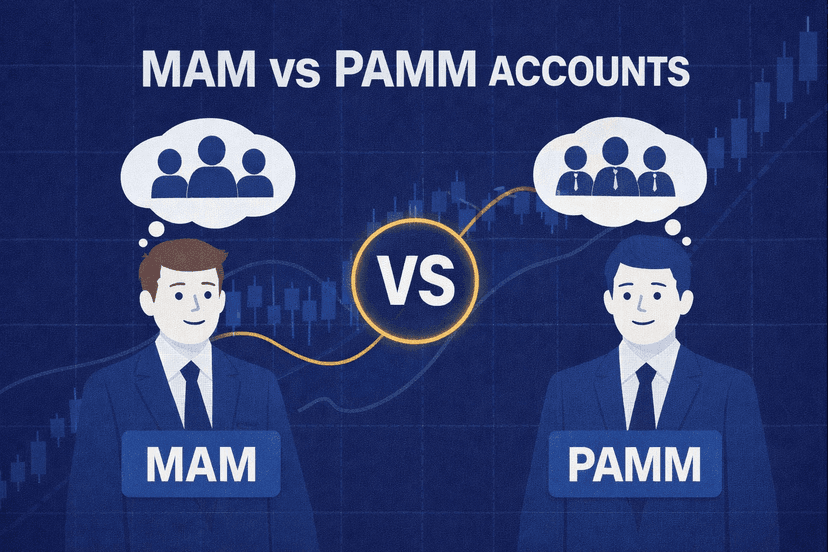
MAM vs PAMM is not a contest between two competing products. It is two answers to one question: does each investor keep their own trading account, or does everyone buy a share of one pooled account? With a MAM (multi-account manager), each client keeps their own funded account and an allocation engine mirrors your master-account orders into their sub-accounts. With a PAMM (percent allocation management module), client money sits in a single pooled account, each investor holds a percentage share, and results are distributed proportionally at a scheduled rollover.
The decision rule is one sentence. Do investors need their own account and their own risk level? Choose MAM. Do you want one strategy scaled across many small investors, with automatic proportional distribution and a public leaderboard? Choose PAMM. Everything else is downstream of that structural difference.
One warning before you read broker product pages: these acronyms are not standardized. Brokers apply “MAM”, “PAMM” and “LAMM” inconsistently, and some offerings sold as MAM run a lot-allocation mode that behaves like the older LAMM model. Check the allocation settings and the custody structure, not the three-letter label.
What Is a PAMM Account?
PAMM stands for percent allocation management module, sometimes written as percentage allocation money management. Investors allocate funds to a manager who trades pooled capital from one master account, and each investor’s participation is tracked proportionally. As Brokeree’s PAMM documentation puts it, at each rollover the trading results are divided between investors and the money manager depending on their respective shares in the PAMM account.
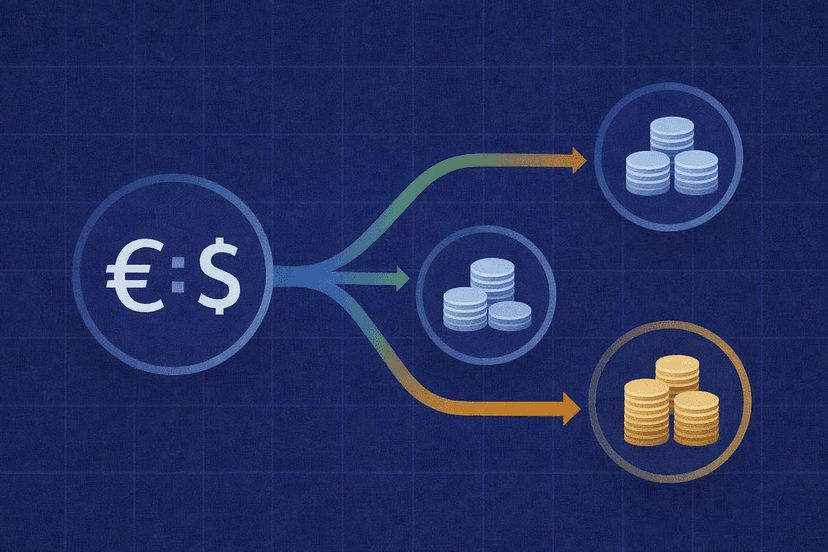
The mechanic is easier to see with numbers. Take three managed accounts in one pool holding shares of 9.3%, 49.5% and 41.2%, converted to a common currency so the ratios are comparable. The manager sends one buy order for 10,000,000 EURUSD; the system allocates 930,000, 4,950,000 and 4,120,000 respectively, and P&L is calculated per account against those volumes. Every investor gets the same trade at the same relative risk — only the size differs.
Access works through a limited power of attorney: the investor attaches funds to a manager appointed on that basis, which lets the manager trade the capital but gives no ability to withdraw it. The manager’s own money typically stays in the pool too — the standard alignment argument for PAMM, and an argument about incentives rather than a guarantee.
The LAMM lineage nobody explains
PAMM is a more advanced descendant of LAMM, the lot allocation management module. In a LAMM system, if the manager buys one standard lot, every client account is increased by one standard lot regardless of the relative size of that account. That works when client accounts are roughly the size of the manager’s and breaks down badly when they are not: the same one-lot position is a rounding error on a large account and a margin call on a small one. Percent allocation was the fix — allocate proportionally to capital instead of copying lots.
That history matters commercially, because plenty of brokers still sell a “MAM” whose lot-allocation mode is LAMM behaviour in a MAM wrapper. Sign up for per-client proportional risk, get per-client fixed lots, and your smallest client finds out first.
What Is a MAM Account?
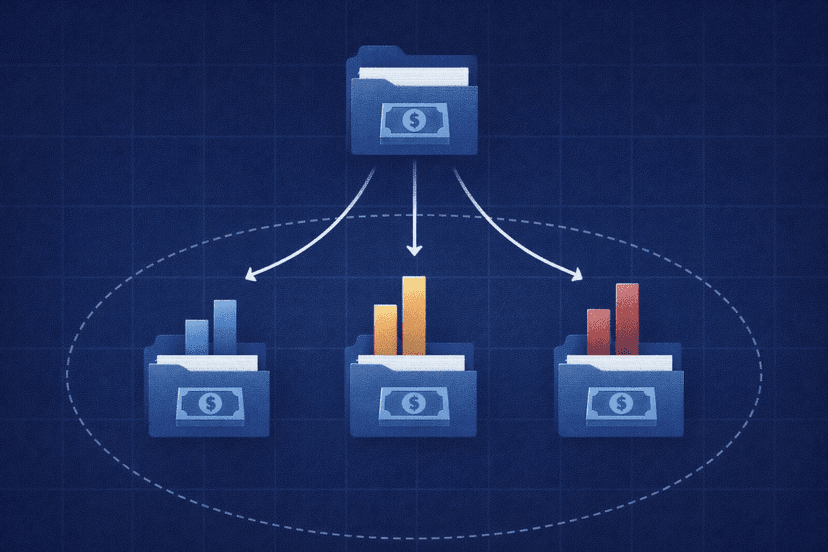
A MAM account — multi-account manager — puts an allocation engine between your master account and separate client sub-accounts. You place one order on the master; the engine writes a corresponding position into each linked sub-account. The critical difference from PAMM is custody: the client’s money never leaves their own account, balances never merge, and there is no pool to hold a share of.
Because each sub-account is a real account, allocation becomes a per-client setting rather than a pool-wide one. The methods you will typically be offered:
- Pro-rata by equity or balance: volume in proportion to each sub-account’s own equity — the default, and the closest MAM equivalent of PAMM’s percentage model.
- Lot allocation: a fixed lot size per account, LAMM-style. Simple, and dangerous when account sizes diverge.
- Fixed percentage or ratio: each account gets a set share of master volume, independent of its equity.
- Per-account risk multipliers: a scaling factor on top of the base method, so a conservative client runs the same strategy at a fraction of the risk.
MAM clients keep their own platform login, statements and deposit/withdrawal channel. From their side it looks like a normal trading account that happens to trade itself — a real selling point for anyone who wants auditability.
How We Compared Them
What follows compares structures, not specific broker offers. Almost every concrete term — minimum investment, fee ceilings, rollover frequency, enabled allocation methods, whether withdrawals need manager confirmation — is configured by the broker, not fixed by the technology, so two brokers selling the same PAMM software can hand you very different products.
The criteria that decide the outcome are custody, allocation method, per-client customisation, withdrawal handling, fee models and timing, transparency and reporting load, scalability, likely regulatory classification, and the infrastructure that must stay online for allocation to work. The table below runs both structures across each, and the sections after it take the ones that matter most in turn.
MAM vs PAMM Comparison Table
| Criterion | MAM (multi-account manager) | PAMM (percent allocation management module) |
|---|---|---|
| Fund structure | Separate accounts, never merged | Pooled capital in one master account |
| Whose account holds the money | Each investor’s own trading account | The PAMM master account; investors hold a percentage share |
| Allocation method | Configurable per sub-account: pro-rata by equity, by lot (LAMM-style), fixed ratio, plus multipliers | Proportional to each investor’s share of the pool |
| Per-client risk customisation | Yes — leverage, multiplier and instrument set can differ per client | No — a share of a pool cannot be customised |
| Withdrawal handling | Affects only that sub-account | Changes every investor’s ratio; may require manager confirmation and proportional partial closes |
| Profit distribution timing | P&L lands in each sub-account as trades close | Distributed at scheduled rollovers, not continuously |
| Typical fee types | Broker-configured — the fee menu is whatever the broker’s module supports | Up to five types in some systems: performance, management, entry, deposit, withdrawal |
| Investor visibility of individual trades | Full — trades appear in their own account history | Pool performance, share size and allocated P&L; trade-level visibility depends on the system |
| Reporting | Standard per-account platform statements | Pool reports plus share statements; leaderboards are a common broker feature |
| Best-fit client profile | Fewer, larger, hands-on clients who want custody and their own risk level | Many smaller investors buying one strategy with automatic distribution |
| Likely regulatory classification (US framing) | Closer to discretionary managed accounts — CTA territory | Closer to a commodity pool — CPO territory |
| Platform support | Broker-side module; availability varies by broker | Broker-side module; some vendors support cross-server pools, most do not |
Read the last two rows together: the regulatory column is the consequence of the structural ones, and the part most vendor comparisons leave out entirely.
Allocation Methods and What They Do To Your Risk
Proportional allocation is the sane default in both structures, and the clearest published formula for it is cTrader Copy’s equity-to-equity model: investor’s equity ÷ provider’s equity × provider’s volume. In the documented example, an investor with 1,000 following a provider with 4,000 equity who trades 4 lots receives 1 lot. The same arithmetic underlies PAMM shares and equity-based MAM allocation: everyone takes the same percentage gain or loss regardless of account size, which is what most clients assume they are buying.
Lot allocation ignores equity entirely, and that is its failure mode — one lot on the master becomes one lot everywhere. If your master account is materially larger than a client’s, that client runs a wildly different risk profile while believing they run the same strategy. It only makes sense when every account in the group is deliberately kept at a similar size.
Fixed percentage or ratio allocation sits between the two and is the mechanism behind per-account risk multipliers — useful when a client wants half your risk or double it. The trade-off is drift: an account that has doubled while others stayed flat is no longer taking the risk you configured six months ago. Ratios need review; proportional allocation self-corrects.
The minimum-volume rounding problem
Proportional allocation has one hard limit that catches managers out: brokers have a minimum trading volume and a volume step. When the calculated size for a small account falls below that minimum, the trade size is adjusted to the step allowed by the broker — cTrader documents exactly this. The account does not get its mathematically correct 0.007 lots; it gets whatever the step permits, which is more risk than intended.
The effect compounds across a book of small investors, because every rounding is upward relative to intent. If you plan to accept small allocations, check the broker’s minimum lot step, work out the smallest account at which your typical position still allocates cleanly, and set your investor minimum above it.
Withdrawals, Rollovers and The Liquidity Problem
This is where the structures genuinely diverge day to day. In a MAM, an investor leaving withdraws from their own account: positions close, money goes, no other client is touched. The only knock-on effect is on future allocation weight, since the departing account no longer contributes to the total.
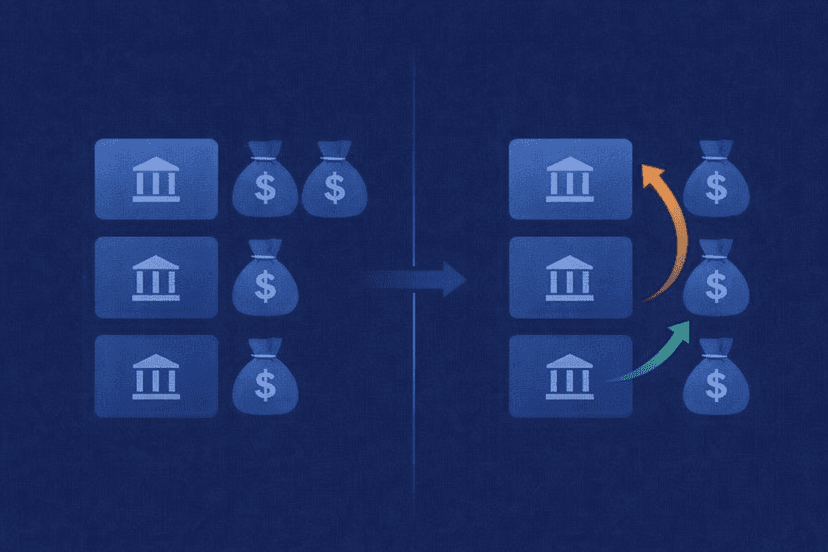
In a PAMM, one investor leaving changes everyone’s percentage share, because shares are defined relative to the pool. If that share is backed by open positions, the pool has to unwind part of them to release the capital. PAMM systems ship machinery for exactly this. Brokeree documents three controls: investor-level stop-loss levels that auto-close an investment at a set loss and return remaining funds to the investor’s trading account; automatic investor request confirmation, where the system alerts the manager to a withdrawal request and auto-confirms after a set period — 30 minutes, for example; and partial trade close on withdrawal, where if a requested withdrawal could push the PAMM account into a margin call or stop-out, the system closes open positions proportionally to the withdrawable share.
That third feature exists for a reason: uncontrolled withdrawals from a pool with open positions can push the whole pool toward margin call, harming the investors who stayed. It is a structural liquidity risk MAM does not have, and it means you should never tell a prospective PAMM investor they can withdraw instantly at any time.
Rollovers, and why timing matters
PAMM distributions do not happen continuously. They happen at scheduled rollovers, when results are divided between investors and the manager according to their shares at that point. Between rollovers an investor’s balance is a claim on the pool, not a settled figure — explain that before they sign up, not after their first mid-period withdrawal request.
There is a mirror-image hazard on the manager’s side of any equity-proportional system. Because allocation is recalculated from equity, deposits and withdrawals on the master account with open positions recalculate exposure — cTrader explicitly warns that a provider depositing or withdrawing while positions are open can cause losses for investors’ copy-trading accounts. Move your own capital when you are flat, not when you are exposed.
Fees: What You Can Actually Charge
Brokeree’s PAMM lets managers charge up to five types of fee — performance, management, entry, deposit and withdrawal. Beyond that documented example, do not assume any particular fee menu: the broker approves the manager, defines the offer terms and configures the fee model, so what you can charge under either structure is whatever your broker’s module supports. Ask for the fee configuration in writing before you sign up clients.
High-water marks, properly explained
A performance fee without a high-water mark lets you charge twice for the same gains: profit, take a fee, lose it, make it back, take another fee. The high-water mark (HWM) model prevents that. In cTrader’s documented high-water mark model the HWM starts at the initial investment amount, the fee is charged on the difference between end-of-period equity and the HWM, and no fee is charged when equity sits below it. After a fee is deducted, pre-fee equity becomes the new HWM if it exceeds the historical one, so the provider is not paid twice for the same performance.
Fees are not charged continuously either. cTrader’s documented HWM trigger events are the 1st of each month, the provider stopping the strategy, the investor stopping copying, and the investor withdrawing funds. The four-month example below, on an initial EUR 10,000 allocation with a 30% performance fee, is the clearest published illustration.
| Month | High-water mark | Month-end equity | Chargeable profit | Performance fee (30%) |
|---|---|---|---|---|
| January | 10,000 | 12,000 | 2,000 | 600 |
| February | 12,000 | 11,000 | 0 | 0 |
| March | 12,000 | 12,500 | 500 | 150 |
| April | 12,500 | 14,000 | 1,500 | 450 |
February is the whole point: the account recovered 1,000 that month and the manager charged nothing, because equity was still below the January peak. March’s fee applies only to the 500 above that peak, not the 1,500 gained since the February low. Note what HWM does not do — it prevents double-charging for the same gains, and nothing more.
Benchmark numbers, and a caveat
There are no universal MAM or PAMM fee ceilings, but cTrader Copy publishes caps that make a useful sanity check. As of August 2026: performance fee up to 40% of investor net profit under the HWM model, management fee up to 10% per year of investor equity accrued daily, and volume fee up to USD 10 per million of copied volume charged per side. cTrader also takes a 30% commission on all fees earned by the strategy provider from 4 July 2026 onward, deducted automatically with no extra charge to investors.
Those are cTrader Copy’s figures for cTrader Copy, not MAM or PAMM universals — do not quote them as industry standards. What transfers is the arithmetic: on USD 1,000 allocated at 10% performance, 5% management and USD 5 per million, a USD 700 net profit produces a USD 70 performance fee, management accrues at 1,000 × 0.05 ÷ 365 = USD 0.14 per day, and one EURUSD lot at 1.19 generates a volume fee of 1.19 × 100,000 ÷ 10⁶ × 5 × 2 = USD 1.19.
The lesson for your own schedule: management and volume-based fees accrue whether or not you make money. An investor who has a flat year and still pays fees will feel misled unless you disclosed the model up front, in writing, with a worked example on their allocation size.
Transparency, Reporting and Investor Expectations
PAMM investors generally see pool-level performance, the size of their share and their allocated P&L. Broker-hosted leaderboards and rating widgets are a standard PAMM feature and a genuine client-acquisition channel — investors browse ranked managers and allocate without you ever pitching them. That is PAMM’s real commercial advantage, and why it scales to many small investors in a way MAM does not.
MAM investors see their own account statements: every trade, every fee and every balance movement in their own name — far easier to defend to a client who cares about auditability than a share of a pool.
Platform-level transparency reduces your reporting workload either way. MetaQuotes markets this for fund-style operations on MT5: investors log into their terminal from a PC or mobile device to check current status in real time, with the manager choosing which parameters clients can monitor, removing the manual reporting cycle. It also allows separate access for employees and investors, performance reports, and payouts adjusted by rates and commissions.
Two caveats worth raising before they become complaints: a leaderboard ROI figure is a record of what happened, not a promise of what will happen, and a public track record cuts both ways — the ranking that wins allocations during a good run loses them, publicly, during a bad one.

The Regulation Section (Do Not Skip This)
This is general information, not legal advice, and it is the part of the MAM vs PAMM decision no broker product page will make for you. Your software choice does not change your legal characterisation; your structure does, because pooling money is a legally meaningful act.
In the United States, the Commodity Exchange Act requires certain firms in the derivatives industry to register with the CFTC, which has delegated registration responsibility to the NFA. Two categories matter. A commodity pool operator (CPO) operates a commodity pool and solicits funds for it — a commodity pool being an enterprise in which funds contributed by a number of persons are combined for the purpose of trading futures, options on futures, retail off-exchange forex contracts or swaps. That maps onto a PAMM almost word for word. A commodity trading advisor (CTA) advises others, for compensation or profit, as to the value or advisability of trading those same instruments — closer to the MAM model of discretionary management of individual customer accounts.
Exemptions exist but are narrower than managers hope. CPO registration is required unless an exemption under CFTC Regulation 4.5 or 4.13 applies, and exempt CPOs must still file a notice of exemption electronically. CTA exemption criteria under Regulation 4.14 include advice given to 15 or fewer persons in the past 12 months where the entity does not generally hold itself out to the public as a CTA. Whether a public PAMM leaderboard or rating page bears on that condition is a question for qualified counsel rather than something to assume either way.
Registration is a real process with real costs. A CTA files Form 7-R, completes the membership application and Member Questionnaire, and pays a non-refundable USD 200 application fee plus dues; principals and associated persons file Form 8-R, submit fingerprint cards, meet proficiency requirements and pay USD 85 each. Registered CTAs with discretion over customer accounts, and all registered CPOs, must be NFA Members.
In the United Kingdom, Article 37 of the FSMA 2000 (Regulated Activities) Order 2001 makes managing assets belonging to another person, with the exercise of discretion, a specified activity where those assets include an investment that is a security, structured deposit or contractually based investment. Permission is required, and which broker’s module you use is irrelevant to that.
The takeaway: a pooled PAMM looks like a fund, a MAM looks like discretionary managed accounts, and your classification depends on your jurisdiction, your client base and how you market the service. Resolve your licensing position before you solicit a single investor, and take advice specific to your situation.

Copy Trading: The Third Option Most Guides Ignore
MAM and PAMM are not the only choices, and for a manager without a broker relationship they are often not the realistic ones. Copy trading is a third structure: followers keep and fund their own accounts and set their own volume and risk parameters, in contrast to PAMM where investor funds are combined within a managed structure. On cTrader Copy, investor funds move to a separate copy-trading account under the same cTID, usable only for copying that one strategy, allocated on the equity-to-equity formula described earlier — our cTrader Copy trading guide walks through the provider side of that setup step by step. Copy platforms more broadly offer per-follower modes based on equity, free margin and multiplication — the same family of allocation choices a MAM exposes.
The documented limitations matter before you build a business on it. Trades are not copied when the investor has insufficient funds, when their broker does not offer the instrument, or when their leverage is lower than the provider’s and free margin is insufficient, and stocks and shares symbols are excluded entirely. Providing a strategy requires a live hedging account — netting accounts cannot provide strategies — and strategy-list inclusion requires a positive balance, at least one deal in the last 72 hours, and an all-time ROI above -90%.
Position it honestly: lowest barrier to entry, weakest per-client customisation, no pooled capital. Its best use for an aspiring money manager is building a verifiable public track record before approaching a broker for MAM or PAMM access. If you would rather run allocation yourself while you wait for that access, third-party MT4 trade copier software replicates orders between accounts you control, and a cTrader VPS keeps the provider terminal connected while it does.
Running it in practice: platform, uptime and VPS
Both structures put a master terminal at the centre, and that terminal is a single point of failure across every client account at once: if it disconnects mid-session, allocation stops. Orders placed afterwards do not reach sub-accounts, and positions already open across the book sit unmanaged. A retail trader losing connectivity has one problem; a money manager has as many problems as they have clients.
You cannot fix this at the platform level yourself either. MetaQuotes states plainly that its server software is self-hosted rather than SaaS — you deploy it on your own hardware and maintain your own infrastructure. So MAM and PAMM capability is a broker-side decision: you cannot install a PAMM module, only choose a broker that already runs one.
What you can control is the reliability of the master terminal: a forex VPS close to the broker’s trade server to keep allocation latency low, enough CPU and RAM headroom for the master plus any monitoring terminals, and a deliberate plan for updates and restarts instead of letting them land mid-session. Size the machine against realistic terminal counts rather than guesswork — the same discipline covered in our guide to managing multiple accounts on one VPS — and treat maintenance windows as a client-facing commitment.
Which Should You Choose?
- A handful of larger clients, each wanting their own risk level and unrestricted withdrawals → MAM. Per-account multipliers and separate custody are exactly what this client type asks for.
- Many small investors, one strategy, automatic distribution and a leaderboard → PAMM. The rating page does your client acquisition; rollover distribution does your accounting.
- Clients who insist on custody of their own funds and full statement visibility → MAM. “Your money stays in your account” is a straightforward promise; “you hold a share of a pool” is not.
- You want a public track record with no broker onboarding → copy trading first. Build the record, then upgrade once a broker will take you seriously.
- You are based in, or soliciting from, the United States → resolve your CTA/CPO status before choosing software. Pooling and soliciting for the pool describes a commodity pool; discretionary management of individual accounts describes a CTA.
- Clients spread across MT4, MT5 and cTrader → check cross-server support before committing. Brokeree states its PAMM works across MT4, MT5 and cTrader, so a manager on MT4 can attract investors from cTrader and MT5 accounts — but that is a vendor feature, not a property of PAMM generally.
If two scenarios apply, let the regulatory one decide. Allocation settings can be reconfigured in an afternoon; a registration category cannot.
FAQ
Is a PAMM account safer than a MAM account?
Neither is safer in trading terms — both run the same strategy and both can lose money. Structurally, MAM keeps each investor’s funds in their own account, so one investor’s exit cannot force positions closed for everyone else. PAMM concentrates that liquidity risk in the pool, which is why PAMM systems include stop-loss levels, withdrawal confirmation delays and proportional partial closes. Manager skin-in-the-game is an alignment argument, not a safety guarantee.
Can investors withdraw from a PAMM account at any time?
Not necessarily. Withdrawal handling is configured by the broker. A request may need manager confirmation, with the system auto-confirming after a set period such as 30 minutes, and if the withdrawal could push the pool into a margin call or stop-out the system may close open positions proportionally to the withdrawable share. Distributions also happen at scheduled rollovers rather than continuously. Check the specific terms before promising anything to an investor.
Do I need a licence to run a MAM or PAMM account?
It depends on your jurisdiction, client base and how you market the service, and on whether an exemption applies — this is general information, not legal advice. In the US, operating a pool and soliciting for it falls under the CPO definition, while exercising discretion over individual customer accounts falls under the CTA definition; both are CFTC categories administered by the NFA, with limited exemptions under Regulations 4.5, 4.13 and 4.14. In the UK, managing another person’s assets with discretion is a specified activity under Article 37 of the RAO 2001 and requires permission. Take advice before soliciting.
What is the difference between MAM, PAMM and LAMM?
LAMM is lot allocation: the manager buys one lot, every client account gets one lot regardless of size. PAMM is percent allocation and its direct descendant: pooled capital, proportional shares, distribution at rollover. MAM is separate client accounts fed by an allocation engine that can run proportional, lot-based or fixed-ratio allocation per account. Because brokers use the terms loosely, a product sold as MAM may run lot allocation — check the allocation settings rather than the acronym.
How much can a money manager charge in fees?
There is no universal ceiling; your broker’s module defines what you can charge. Some PAMM systems support up to five fee types — performance, management, entry, deposit and withdrawal. For a published benchmark, cTrader Copy caps performance fees at 40% of investor net profit under a high-water mark model, management fees at 10% per year of investor equity accrued daily, and volume fees at USD 10 per million charged per side, as of August 2026 — figures specific to cTrader Copy, not industry standards.
Do MAM and PAMM accounts work on MT4, MT5 and cTrader?
Availability is decided by your broker, not by you. MetaQuotes distributes server software for brokers to self-host rather than as a SaaS product, so a manager cannot install a MAM or PAMM module independently — you choose a broker that already offers one. Cross-platform pools exist as a vendor feature: Brokeree states its PAMM works across MT4, MT5 and cTrader, letting a manager on one platform take investors from another. Do not assume that applies to every provider.
The Bottom Line
Stop looking for a winner in MAM vs PAMM. Decide first whether your clients keep their own accounts or buy into a pool, because that choice determines your withdrawal mechanics, your customization options, your reporting story and how a regulator is likely to characterize what you do. MAM is the default for a small book of larger, hands-on clients; PAMM is the default for scaling one strategy across many small investors; copy trading is the on-ramp for building the track record that gets you either one. And whichever you pick, remember which part is actually hard: the software is the easy part, and your licensing status — not the broker’s product page — decides what you are legally allowed to run.

About the author
Thomas Vasilyev
Writer & Full Time EA Developer
Tom is our associate writer, and has advanced knowledge with the technical side of things, like VPS management. Additionally Tom is a coder, and develops EAs and algorithms.
Areas of Expertise