
Prop Firm IP Address Rules: Multiple Accounts, One Home
How prop firm IP address rules affect multiple accounts, couples and roommates – and when shared Wi-Fi, a VPN or a VPS can trigger a compliance review.
There is no universal “one IP address, one trader” law across the prop industry. Prop firm IP address rules are firm-specific: a shared household connection is legitimate at some firms and a red flag at others. Two people in one house can trade the same firm’s accounts from the same Wi-Fi — provided they are separately verified, use their own devices and logins, and trade independently.
Quick verdict: your public IP is a signal, not a verdict. None of FundedNext, Topstep or FTMO bans shared addresses outright; each polices what a shared address can hide — identity sharing, device sharing, coordinated trading, copying between people, exceeding capital caps, and location masking. Read the current written policy for each program you hold, keep everything except the router separate, and get support’s confirmation in writing before you trade rather than after a flag lands. All firm policies below are as of August 2026 and can change.
What Prop Firm IP Address Rules Actually Cover
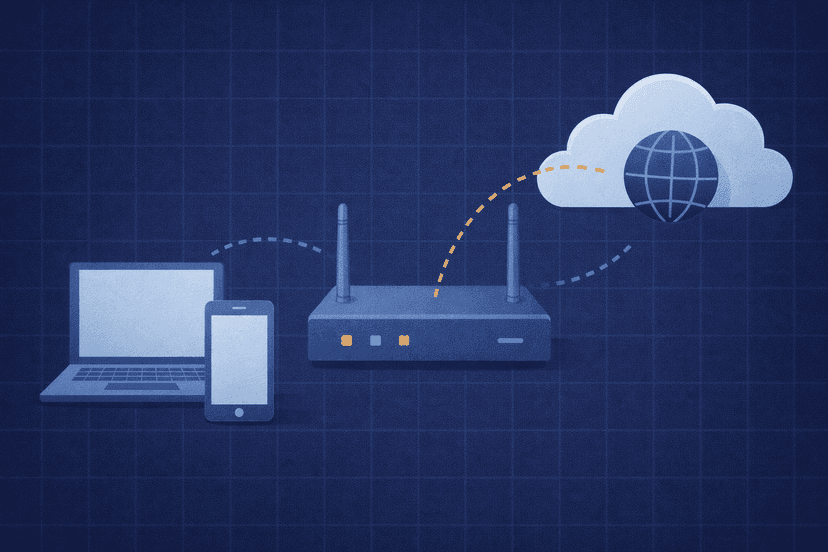
Panic about shared IPs comes from misunderstanding how home networks work. Your devices sit behind the router on private addresses, and the router performs network address translation to map them onto the public address your ISP assigned. RFC 3022, the IETF specification for traditional NAT, describes this: network address port translation lets multiple local nodes reach the Internet through one external address, and home-office nodes routinely share the address given to the router.
A shared public IP is therefore an ordinary outcome of that design, in a household, office, dorm or coffee shop. Treating a matching IP as proof of cheating would mean flagging ordinary network architecture. What compliance teams actually do is correlate the IP with other signals — and these four concepts are treated very differently:
- Network identity — the public IP your platform connects from. Shared across a household behind one router.
- Device identity — the physical machine and its fingerprint. Where several firms draw a hard line.
- Account identity — the KYC-verified owner, their login and their payment method.
- Trading behaviour — entry and exit timing, sizing and directional overlap across accounts.
A shared IP is treated firm by firm. A shared IP combined with a shared device and mirrored entries is the pattern that invites review and sanctions. FundedNext’s trading device and network policy is explicit about that split: home Wi-Fi, mobile data and public Internet are all allowed as long as the IP is not from a restricted jurisdiction, but each trader must use their own device, and sharing one machine with another trader — family included — is prohibited.
Two Traders, One Household: Safe Patterns and Risky Ones
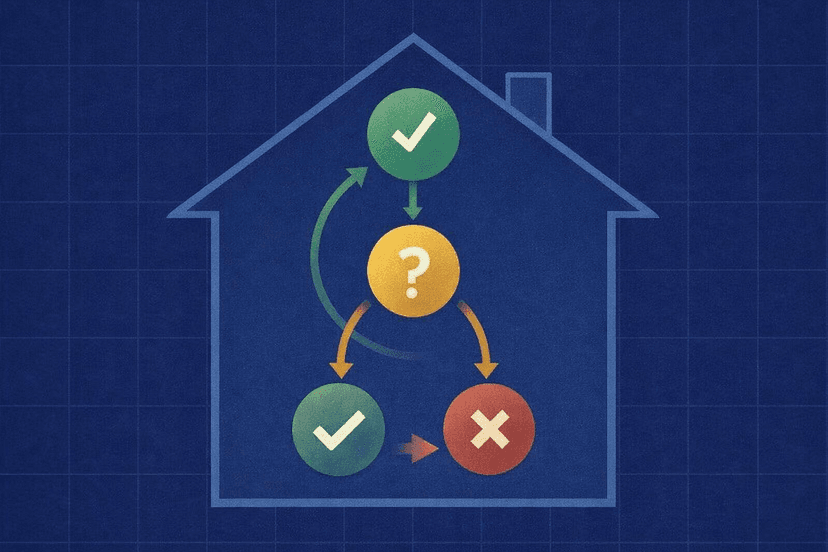
Couples, siblings and roommates trading the same firm is addressed directly in published policy. Topstep’s prohibited conduct page states plainly that friends and family may trade with the firm, so long as they avoid coordinated trading, account sharing and any arrangement designed to work around the rules. The permission exists — it is conditional. The pattern that survives review looks like this:
- Each person is separately KYC-verified in their own legal name, with their own email, phone number and login.
- Each person pays for their own evaluation from their own payment method — no one funding a partner’s challenge.
- Each person trades from their own computer, with their own platform installation and unshared credentials.
- Trading decisions are genuinely independent — different instruments, different sizing, or at minimum no synchronised execution.
The pattern that risks sanctions is the mirror image. One person placing trades on both accounts is account sharing, whoever owns them on paper. Two accounts traded in concert on the same instrument and direction is coordinated trading. Two accounts taking opposite sides to farm the payout structure is cross-account hedging. Topstep lists all three as prohibited conduct alongside VPNs, proxies and TOR, with sanctions escalating from a warning through trading-day deletion, account reset, closure and action on pending payouts.
Copying deserves its own warning, because the permission is narrow. FundedNext allows copy trading between accounts owned by the same person via a master/slave setup, up to $300,000 of combined capital. Copying between two different people — explicitly including family — is prohibited, and a VPS-based copier is permitted only across the owner’s own Challenge accounts. If you and your partner run the same EA on the same settings from the same house, the resulting trades can correlate closely enough in the firm’s logs to prompt a copying review.
The other risky pattern is registration gaming: opening a second profile under a relative’s name to get around a capital cap. FTMO permits unlimited accounts but caps pre-scaling capital at $400,000 per trader or strategy across its 1-Step and 2-Step programs, forbids different registrations to exceed that, and may suspend identical strategies running above the cap. Using a household member’s identity to buy more capacity is the specific behaviour the cap exists to stop.
Official Rule Examples Compared
Three well-documented firms show how far the policies diverge. The table below summarises their published positions as of August 2026. Treat it as orientation, not authority — the firms’ own help pages are the authority, and they get edited without notice.
| Firm | Shared household / network | VPN & VPS | Multiple accounts & coordination | Practical takeaway |
|---|---|---|---|---|
| FundedNext | Home Wi-Fi, mobile data and public Internet allowed if the IP is not restricted; own device required, sharing one with another trader (family included) prohibited | VPN allowed — paid service with a consistent IP and country recommended. VPS allowed; a private dedicated IP recommended, with no sharing, no manual trading, qualifying trade-taking EAs only, extra usage fee | Copying only between one person’s own Challenge accounts via master/slave, up to $300,000 combined; copying between people, family included, prohibited. Aggregate capital capped at $300,000 | Same Wi-Fi is fine; same laptop is not |
| Topstep | Friends and family may trade with no coordination, no account sharing and no rule workarounds; personal device required | VPNs, proxies and TOR prohibited. VPS and remote-server trading prohibited; VPS automation can lead to suspension or removal | Coordinated trading, account sharing and cross-account hedging prohibited. Sanctions run from warning to day deletion, reset, closure or payout action | Household trading permitted, but no remote infrastructure at all |
| FTMO | Travel and connecting from different locations generally accepted | VPN and VPS generally allowed, but MetaTrader and cTrader users should not connect from — or geolocate to — the United States | Unlimited accounts, but pre-scaling capital capped at $400,000 per trader or strategy across 1-Step and 2-Step; separate registrations to exceed it forbidden, identical strategies above the cap may be suspended | Flexible on infrastructure, strict on the capital cap and U.S. geolocation |
Read the middle column again. The same tool — a VPS with a dedicated IP — is conditionally allowed at FundedNext, generally allowed at FTMO, and prohibited at Topstep. There is no portable answer. Hold accounts at more than one firm and you are complying with more than one rulebook at once, with the strictest governing your setup.
VPN, VPS and Changing IP Addresses
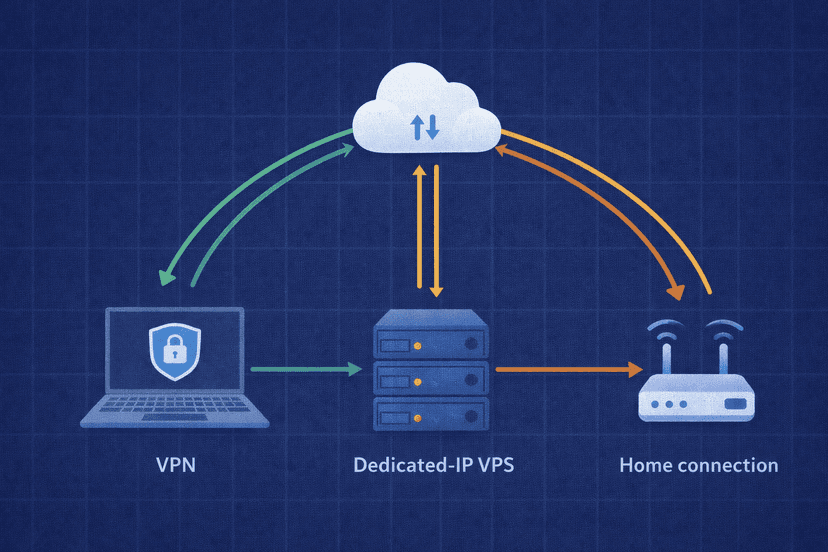
“My IP changed” is not automatically a problem. Where a connection uses dynamic addressing, a router reboot or an ISP lease renewal can hand you a new address overnight, and switching to mobile data changes it too. Neither is deceptive. FundedNext explicitly allows home Wi-Fi, mobile data and public Internet, and FTMO explicitly accommodates traders who travel. What draws attention is the character of the change and the differences between a VPS and a VPN — four scenarios, four risk profiles:
- Dynamic residential or mobile IPs — routine. Same person, same country, same device, occasional address change.
- Free or shared-exit VPNs — the worst of both worlds. FundedNext warns that free VPN users can share an exit IP with strangers, so unrelated traders appear to connect from the same address. That is how an innocent trader manufactures the exact correlation compliance is hunting for. FundedNext’s guidance is a paid service with a consistent IP and country.
- A VPS with a private dedicated IP — a workable option where it is permitted, but permission is narrow. For FundedNext VPS hosting, the firm recommends a private dedicated IP and separately bans sharing it, bans manual trading, restricts use to qualifying trade-taking EAs, and charges an additional usage fee. Topstep prohibits VPS and remote-server trading outright and warns that VPS automation can result in suspension or removal.
- Geolocation masking — never acceptable. Using a VPN to appear in a permitted country while trading from a restricted one is misrepresentation, not network optimisation. FTMO shows where the line sits: VPN and VPS use is generally allowed, but MetaTrader and cTrader users should not connect from or geolocate to the United States.
The dangerous myth here is that a dedicated IP equals compliance. It does not. A dedicated IP addresses one problem — being mistaken for a stranger who shares your exit node. At Topstep, remote-server trading is prohibited whatever the address, and automation there can result in suspension or removal. At FundedNext it is recommended, not a permission slip, and the manual-trading ban and usage fee still apply. Two traders in one house who both move to a VPS are no safer than they were on shared Wi-Fi if they are still copying each other’s trades.
For EA users the practical question is not whether your provider hands you a static address. It is whether your firm’s written policy permits server-based execution at all, for your program and platform.
A Household Compliance Checklist Before You Place a Trade
Work through this before the first trade, not after a support ticket arrives. These items are cheap in advance and expensive to reconstruct later.
- Compare each person’s rulebook separately. Pull up the current device, network, VPN/VPS and multiple-account pages for every firm and program in the house — not a forum summary, and not last year’s version.
- One trader, one device. Separate machines, separate user accounts, separate platform installations. Device sharing is what turns a shared IP into a rule breach at FundedNext and Topstep.
- Never share credentials. Not the dashboard, not the platform login, not “just this once while I’m at work.” Enable multi-factor authentication to make casual login sharing harder.
- Keep trades demonstrably independent. No copier between household accounts, no identical EA settings, no calling out entries across the room. Expect to explain any overlap in timing.
- Stay inside the caps. Track combined simulated capital per person — $300,000 aggregate at FundedNext, $400,000 pre-scaling at FTMO — and never open a profile in someone else’s name to buy more room.
- Document the household in advance. Matching KYC records, proof of address for each person, and a support ticket describing the setup with the reply saved. Written confirmation is the evidence you will want later.
- Re-check after any change. A new ISP, a move, a new VPS or a firm policy update is each a reason to reread the rules and, if the change is material, tell the firm.
If a compliance or trust team contacts you, the response matters as much as the facts. Pause the activity being questioned, answer with records rather than argument, and supply the KYC documents, device details and any support confirmation you saved. Do not open another account or profile while the review is open — that turns a question about your setup into a documented attempt to evade it.
Be realistic about what disclosure buys you. Telling support in advance is strong evidence of good faith — but it is not immunity. A firm can still review, suspend or withhold a payout if the trading itself breaches the rules.
Bottom Line: Shared Wi-Fi Is Context, Not a Loophole
A shared household IP is a fact to disclose, not a breach to hide and not a technicality to exploit. The firms that write clear policy — FundedNext, Topstep and FTMO among them — all separate the network from what actually matters: who owns the account, whose hands are on the keyboard, whether the trades are independent, and whether the capital sits inside the cap.
Get those four right and the IP address stops being interesting. Get them wrong and no amount of network engineering saves the account. The only authorities that count are the firm’s current written terms and its support team’s answer in writing. Check both before you buy your next evaluation.
Prop Firm IP Address Rules: FAQ
Can two people in the same house trade with the same prop firm?
At Topstep and FundedNext, yes, with conditions. Topstep’s prohibited conduct policy states that friends and family may trade as long as they do not coordinate trades, share accounts or work around the rules. FundedNext allows home Wi-Fi but requires each trader to use their own device and prohibits sharing a machine with another trader, family included. Verify each person separately, keep devices and logins apart, and confirm the arrangement with support before you start.
Can I run multiple prop firm accounts from one IP address?
At FundedNext and FTMO, yes, when all the accounts belong to you — what limits you is capital, not connectivity. FundedNext caps aggregate simulated capital across your FundedNext Accounts at $300,000; its own example has a trader running five $100,000 Challenges but advancing only three. FTMO allows unlimited accounts but caps pre-scaling capital at $400,000 per trader or strategy, and forbids different registrations to get around it.
Do I need a dedicated IP address for prop firm trading?
FundedNext, Topstep and FTMO do not require one for ordinary home trading, and a dedicated IP does not guarantee compliance. It matters mainly for VPS use at a firm that permits it, and for avoiding a shared VPN exit address: FundedNext recommends a private dedicated IP for VPS use, bans sharing it, bans manual trading on it, restricts it to qualifying trade-taking EAs, and charges an additional usage fee. At Topstep it is irrelevant, because VPS and remote-server trading are prohibited outright.
Can switching from Wi-Fi to mobile data breach my account?
Not by itself. FundedNext’s device and network policy explicitly allows home Wi-Fi, mobile data and public Internet, provided the IP is not from a restricted jurisdiction, and FTMO accommodates traders who travel. A residential IP can change through dynamic addressing anyway. The problem is not that your address changed — it is a change that misrepresents where or who you are, such as geolocating into a country your program does not permit.
Is a VPN or VPS allowed by prop firms?
It depends entirely on the firm. FundedNext permits VPNs and recommends a paid service with a consistent IP and country, warning that free VPN users can share an exit IP with strangers. FTMO generally allows VPN and VPS use, with the caveat that MetaTrader and cTrader traders should not connect from or geolocate to the United States. Topstep prohibits VPNs, proxies and TOR, requires a personal device, and bans VPS and remote-server trading. Check your own firm’s current policy, and never use either tool to conceal your identity or location.

About the author
Thomas Vasilyev
Writer & Full Time EA Developer
Tom is our associate writer, and has advanced knowledge with the technical side of things, like VPS management. Additionally Tom is a coder, and develops EAs and algorithms.
Areas of Expertise