
What Happens After You Pass a Prop Firm Challenge?
Learn what happens after you pass a prop firm challenge, from account review and KYC to funded access, trading rules, payouts, and scaling safely.
What Happens After You Pass a Prop Firm Challenge: The Sequence
The next step that happens after passing a prop firm challenge is a review sequence, not an instant handover of spendable capital. You stop trading the evaluation account, the firm audits your results against its rules, you complete identity verification, you sign an account agreement, and only then do funded-stage credentials arrive. How long that takes is firm-specific: FTMO quotes review windows measured in business days, while Topstep can activate an Express Funded Account within minutes.
Passing guarantees nothing on its own. FundedNext states directly that its post-challenge risk review can still prevent an account from being issued if you violated its rules or terms during the evaluation. Treat the window after you hit the target as the challenge’s final stage, not a victory lap.
One distinction trips up traders constantly: “passed” may only mean phase one is finished. In a two-step prop firm challenge, clearing the first profit target moves you to a verification account with its own fresh target and rules — a second evaluation, not funding.
| Step | What you do | What the firm does |
|---|---|---|
| 1. Stop trading | Close positions and place no new orders on the passed account | Freezes the account for review |
| 2. Results review | Wait; do not dispute on day one | Audits trades against objectives, risk rules, and terms |
| 3. Identity checks | Submit ID and proof of address (or company documents) | Runs KYC/KYB and compliance screening |
| 4. Agreement | Read and sign the trader/account agreement | Issues the contract that governs the funded stage |
| 5. Activation | Pay any activation fee; accept credentials | Creates the funded-stage account and platform login |
| 6. Rule re-check | Download the current rulebook for the new account | Applies funded-stage limits, which often differ from the challenge |
| 7. First trades | Start small and build the payout clock | Monitors compliance and payout eligibility |
Every firm runs its own version with its own timings, fees, and terminology. The order of operations is what stays stable, so use it as a map and fill in the specifics from your dashboard and agreement.
Review, KYC, and the Trader Agreement
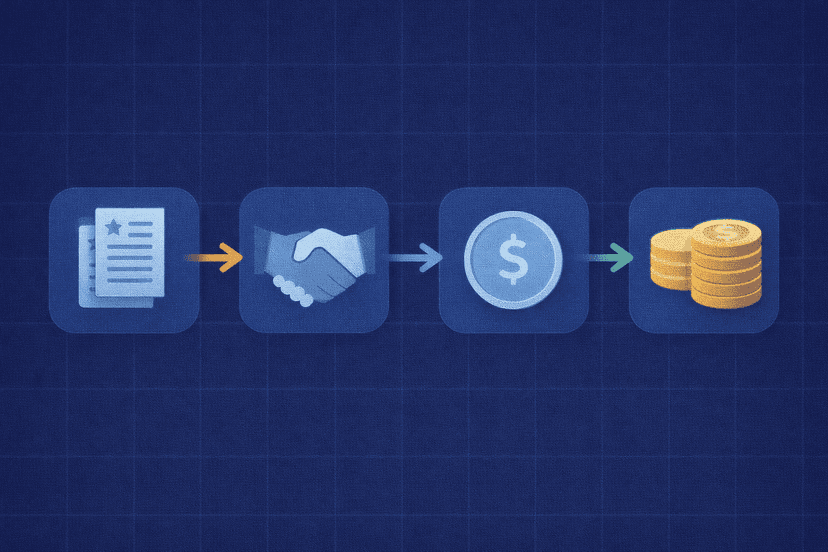
The review step is a compliance audit. The firm re-examines your trade history for breaches that dashboards may not flag in real time — prohibited strategies, coordinated trading across accounts, or terms violations that only surface on inspection. A passed dashboard is not an approved account.
Published review windows give you a sense of scale. FTMO reviews 1-Step results in typically one to four business days, and its 2-Step challenge review typically takes one to two business days before Verification credentials are issued. Once all applicable objectives are met, FTMO requires Identity verification and its Account Agreement.
Identity checks are mandatory. FTMO says personal compliance checks usually take under one business day and company checks up to three, with natural-person KYC requiring a government ID showing nationality plus proof of address. FundedNext also makes KYC mandatory, typically completes it in around 48 hours, and may ask for a utility bill or bank statement issued within the previous three months.
Have the documents ready before you hit the target — the clock only starts when you upload them:
- Government photo ID showing your nationality, in date and fully legible.
- Proof of address — commonly a utility bill or bank statement from the last three months.
- Name and address consistency across your profile, your documents, and your intended payout method.
- Company documents if you contract through an entity, which extends the check.
After approval, delivery is usually quick. FundedNext issues a Stellar 2-Step account roughly 24 to 48 hours after approved KYC. Topstep activation can take minutes, though its dashboard status may take up to 30 minutes to update. Activation is not always free: as of July 26, 2026, Topstep’s Standard path charges a $149 one-time Express Funded Account activation fee, while its No Activation Fee path does not.
Read the agreement rather than skimming it. It defines the legal relationship, the reward mechanism, the rules that can terminate the account, and how the firm can change terms. And do not keep trading a completed evaluation account unless your dashboard explicitly says to continue — post-target trades can breach rules on an account that has nothing left to gain.

Does “Funded” Mean a Live-Money Account?
Often, no. Many firms run the funded stage on simulated accounts that pay real money on simulated results. FTMO describes its post-pass Account as a demo account with fictitious capital and real market quotes, where clients do not place live-market trades — yet profitable simulated performance can still earn real-money rewards.
Topstep uses the same model at the first funded tier. Its Express Funded Account is a simulated funded-level account that starts at a $0 balance while retaining the account’s buying power, and it can later lead to a Live Funded Account. Simulated first, live only after further conditions are met. That leaves three models you might land in:
- Simulated funded account with real rewards — you trade a demo environment on real quotes and are paid on the results.
- Simulated first, live later — a performance and compliance record unlocks a live-funded tier.
- Live execution — some programs route orders to a live account, with different rules and counterparty arrangements.
Whichever applies, the headline number on your account is buying power and risk allocation — not cash you own or can withdraw. A “$100,000 account” defines how large your positions and loss limits can be. Your withdrawable amount is your share of the profit produced under the agreement, nothing more. Check which model you are in, because “funded” is marketing language, not a technical definition.

Funded-Account Rules That Can Still Close the Account
The funded stage has its own rulebook, and it frequently differs from the challenge you just passed. The fastest way to lose an account you spent weeks earning is to trade day one with last week’s parameters. Re-read these first:
- Daily loss limit — the reset time, and whether it measures balance or equity including floating losses.
- Maximum loss — static from the starting figure, or trailing your highest balance or equity.
- Consistency and best-day rules — whether one large day blocks a payout even when you are profitable overall.
- Position sizing and lot caps — including limits tied to account size or open exposure.
- News and weekend restrictions — holding windows around high-impact releases and the weekend gap.
- Prohibited strategies — latency arbitrage, tick scalping, cross-account hedging, and group trading.
- Inactivity rules — how many days without a trade can close the account.
- Copy trading and EAs — whether automation is permitted, and whether copying between your own accounts is a breach.
- IP and VPS policy — which hosting arrangements are allowed and what sharing patterns trigger a flag.
The hosting point deserves attention if you automate. Firms watch for accounts sharing an address or execution footprint, so run your platform on hosting your agreement permits and keep one clean, documented setup. Never mask your location or share access to get around a rule — that is a terms breach in its own right.
Then size down. Risking less per trade in the first weeks costs you a slower first payout and buys the one thing that matters now: staying inside the limits long enough for the payout clock to run.
When Can You Request the First Payout?
Payout eligibility is a set of conditions, not a date. Firms typically combine a minimum time, an activity or consistency requirement, a profit threshold, a closed-position requirement, and an approval review. Here are two published policies, as of July 26, 2026:
| Program (as of July 26, 2026) | Eligibility | Profit split | Notes |
|---|---|---|---|
| FTMO 1-Step | Reward claim opens on day 14 or later after the account’s first trade, with all positions and orders closed | 90% | Timing runs from your first trade, not from the pass date |
| FTMO 2-Step | Same day-14-or-later claim window, all positions and orders closed | 80%, rising to 90% when specified scaling or premium conditions are met | The higher split is earned, not automatic |
| Topstep Express Funded (Standard) | 5 winning days of $150 or more | 90/10 | Per-request caps vary by account and path |
| Topstep Express Funded (Consistency) | 3 trading days with a largest-day ratio no higher than 40% | 90/10 | Fewer days, but concentrated profit blocks eligibility |
Two patterns stand out. The clock usually starts at your first funded-stage trade, so delaying your start delays your payout. And the split you were sold may be the ceiling, not the default — FTMO’s 2-Step accounts sit at 80% until specified scaling or premium conditions lift them to 90%.
Check the mechanics before you submit: whether open positions must be closed at request time, any minimum withdrawal, per-request caps, the approval window, which payment methods are supported in your country, and who absorbs transfer fees. A request that clears eligibility can still stall on a mismatched payment name.
Finally, understand what a withdrawal does to your risk buffer. Where the loss threshold is measured from the balance, taking profit out can pull your equity back toward the breach level and leave you with less room than the day before. Plan the withdrawal amount and your next position sizes together.

Scaling Without Giving the Account Back
Scaling is earned through time, consistency, processed payouts, and clean rule compliance — it does not arrive because you passed. FTMO’s published scaling plan shows the shape of the requirement: at least four months on the account, at least 10% total net simulated profit, at least two processed rewards, and a positive balance. Qualifying accounts can then receive a 25% increase every four months.
Read that as multi-month operating discipline, not a growth hack. The trader who reaches a scaling threshold is the one who never had a near-miss on the daily limit, not the one who posted the biggest week. Build the setup that makes that possible:
- A risk dashboard showing your distance to the daily limit and maximum loss threshold in account currency, not percentages you convert under pressure.
- A personal daily stop set below the firm’s limit, so a bad session ends before the rule does it for you.
- A trading journal recording rule state alongside P&L — the best-day ratio matters as much as the total.
- Alerts on drawdown proximity, unusual position size, and connection loss.
- Permitted, stable hosting for automated strategies, so an overnight disconnect or a home power cut does not leave an EA half-managed. A low-latency trading VPS keeps the platform online continuously; confirm the arrangement is allowed under your agreement first.
- An outage and EA-failure plan — how you flatten positions, who you contact, and what you do when the strategy misbehaves rather than the market.
Your Final Post-Pass Checklist
Run it in order and the funded stage starts on solid ground:
- Stop trading the passed evaluation account unless the dashboard says to continue.
- Confirm whether you have been funded or advanced to a second phase.
- Submit KYC documents immediately, with names and addresses matching your payout method.
- Read the account agreement in full before signing, including reward and termination terms.
- Check whether your plan carries an activation fee and what it buys.
- Download the current funded-stage rulebook and rebuild your risk limits from it.
- Note your payout eligibility conditions and when your clock starts.
- Trade the first weeks at reduced size, and treat the first payout as a process test, not an income event.
The highest-value action on that list is the sixth. Firm rules change, promotions alter terms, and funded-stage parameters routinely differ from evaluation parameters. Build your limits from the documents you were given today, not from a comparison table you read before buying the challenge.
Frequently Asked Questions
How long does a funded account take after passing?
Usually days rather than weeks, depending on the firm and how fast you complete verification. FTMO reviews 1-Step results in typically one to four business days and 2-Step results in typically one to two. FundedNext issues a Stellar 2-Step account roughly 24 to 48 hours after approved KYC, and Topstep activation can take minutes, with dashboard status updating within about 30 minutes of passing.
Do you need KYC to get a funded account?
At the major firms, yes. FundedNext states that KYC is mandatory, typically takes around 48 hours, and may require a utility bill or bank statement issued within the previous three months. FTMO requires Identity verification and its Account Agreement once objectives are met, with natural-person checks needing a government ID showing nationality plus proof of address.
Is a funded prop firm account real money?
The rewards can be real money while the trading is simulated. FTMO describes its Account as a demo account with fictitious capital and real market quotes where clients do not place live-market trades, yet profitable simulated performance can earn real-money rewards. Topstep’s Express Funded Account is likewise a simulated funded-level account that can later lead to a Live Funded Account. Programs differ, so check your agreement.
Can you lose the account after passing?
Yes, at two separate points. Before issuance, a post-challenge risk review can prevent an account from being granted — FundedNext says exactly that about rule or terms violations during the evaluation. After issuance, funded-stage rules apply in full: daily loss limits, maximum loss thresholds, consistency requirements, prohibited strategies, and inactivity clauses can each close the account.

About the author
Thomas Vasilyev
Writer & Full Time EA Developer
Tom is our associate writer, and has advanced knowledge with the technical side of things, like VPS management. Additionally Tom is a coder, and develops EAs and algorithms.
Areas of Expertise