
One-Step vs Two-Step Prop Firm Challenges: Which Is Better?
Compare one-step vs two-step prop firm challenges by fees, targets, drawdown, refunds, and retry risk to choose the better evaluation route.
Quick Verdict: One-Step Speed vs Two-Step Breathing Room
The choice between one-step vs two-step prop firm challenges comes down to speed versus room for error. A one-step evaluation can get you through the qualification process faster, but it is not automatically easier or cheaper. Tighter daily loss limits, trailing drawdown, consistency rules, and a non-refundable fee can outweigh the benefit of removing a second phase.
For most risk-conscious traders, a two-step evaluation is the better default when it pairs wider or static loss limits with a refundable fee. Choose one-step when speed has real value to you and your own verified results show that your strategy can handle its exact drawdown and consistency rules. The label alone never decides the better deal; the contract does.
FTMO provides a useful matched-plan example: its 1-Step route is faster but imposes a 3% daily loss limit, end-of-day trailing maximum loss, and a 50% Best Day rule. Its 2-Step route takes longer but uses a 5% daily loss limit, static maximum loss, and no Best Day rule. Those specifics were current on July 23, 2026, and should be rechecked before purchase.

What One-Step and Two-Step Challenges Actually Mean
A one-step prop firm challenge has one evaluation phase between purchase and eligibility for the firm’s post-evaluation account. Reach the profit target without breaching the rules, complete any required trading days, and satisfy any consistency conditions, and you can move to the next stage of the firm’s onboarding process.
A two-step prop firm challenge divides the evaluation into an initial challenge and a verification phase. FTMO, for example, calls these the FTMO Challenge and Verification. Passing phase one does not mean you have earned a continuous return that carries into phase two. The verification account resets, and you pursue its separate target under the rules assigned to that phase.
That phase count is where the shared meaning ends. Firms do not use standardized definitions for one-step and two-step programs. They can set different profit targets, calculate drawdown from balance or equity, trail the loss threshold or keep it static, impose minimum days or consistency rules, and change conditions after the evaluation. Reset prices, free repeats, refund triggers, payout terms, and weekend or news restrictions are also firm-specific.
The5ers illustrates why you must compare rules rather than labels. As of July 23, 2026, its displayed $5,000 Hyper Growth 1-Step plan listed a 10% target, 3% daily loss, 6% stop-out level, unlimited time, and a $52 fee. Its High Stakes 2-Step plan instead listed 10% and 5% targets with 5% daily and 10% overall loss limits. Those numbers differ from FTMO even though both firms use familiar one-step and two-step wording.
How We Compare Prop Firm Evaluations
Start by matching the account size, account currency, platform, and any paid add-ons. Then compare the complete route from checkout to the first eligible reward, not just the headline target or lowest advertised fee. These are the criteria that materially change the difficulty and cost:
- Number of phases: how many separate accounts and targets must you complete?
- Profit targets: what return is required in each phase, and does the account reset between them?
- Daily and maximum loss: are limits based on balance, equity, initial capital, or a high-water mark?
- Drawdown behavior: is the overall threshold static, intraday trailing, or end-of-day trailing?
- Pacing rules: are there minimum trading days, a deadline, or a best-day or consistency rule?
- Fee treatment: is one payment enough for all phases, and exactly when does a refund become available?
- Retry exposure: after a breach, do you restart, reset at a discount, or qualify for a free repeat?
- Post-evaluation rules: do loss limits, consistency conditions, permitted strategies, or payout requirements change?
Time to funding matters, but it should be measured as the time your strategy needs to satisfy every rule, not the number of phases printed on the sales page. A one-phase route that forces you to reduce size or spread profits across more days can take longer than its name suggests.
One-Step vs Two-Step Prop Firm Challenges: Comparison Table
The first two columns describe common tendencies, not universal rules. The final column uses matched $100,000 FTMO plans to show how large the differences can be within one firm. FTMO rules and displayed prices are stated as of July 23, 2026.
| Criterion | One-step tendency | Two-step tendency | FTMO $100K example (as of July 23, 2026) |
|---|---|---|---|
| Evaluation phases | One | Two: initial challenge plus verification | 1-Step: one phase; 2-Step: Challenge plus Verification |
| Profit target | One target, often paired with tighter controls | Separate target in each reset phase | 1-Step: 10%; 2-Step: 10%, then 5% |
| Maximum daily loss | Can be tighter | Can offer more daily room | 1-Step: 3%; 2-Step: 5% |
| Maximum loss | May trail balance or equity highs | May remain static from initial capital | 1-Step: 10% end-of-day trailing; 2-Step: 10% static |
| Consistency rule | More likely to constrain concentrated profits | May omit a best-day condition | 1-Step: 50% Best Day rule; 2-Step: none |
| Minimum trading days | Can allow immediate completion | Can require activity in each phase | 1-Step: none; 2-Step: four per phase |
| Time to eligibility | Potentially faster because verification is removed | Potentially slower because both phases must be completed | Depends on the trader; the 2-Step minimum is four trading days in each phase |
| Displayed entry fee | Not necessarily cheaper | One fee may cover both phases | 1-Step: €499; 2-Step: €439 promotional display, with €540 also displayed |
| Fee refund | May be non-refundable | May be returned after a reward milestone | 1-Step: no refund; 2-Step: 100% fee refund eligibility with the first Reward withdrawal |
| Failure and retry | A breach restarts the only evaluation unless another policy applies | A late phase-two failure may send you back to phase one | Reset, repeat, and discount terms must be checked at purchase |
The table exposes the central trade-off. FTMO’s one-step route removes Verification and minimum trading days, yet it gives the trader less daily loss room and adds both trailing drawdown and a profit-concentration constraint. The two-step route asks for another target on a new account, but the static loss floor and higher daily limit can make ordinary strategy variance easier to absorb.
It also shows why fee comparisons need context. The displayed promotional 2-Step price was lower than the 1-Step fee in this snapshot, and only the 2-Step fee was refundable. A future promotion, currency selection, platform choice, or add-on could reverse the checkout comparison, so treat these as dated examples rather than permanent pricing.
Targets and Time to Funding
One-step wins the structural speed comparison because there is no verification phase. If two traders can reach the same 10% target under the same risk rules, the trader with one phase reaches eligibility first. Real evaluations rarely hold everything else constant, however. A lower daily limit, moving loss floor, or consistency condition can force the one-step trader to use smaller positions and take more trades.
FTMO’s matched plans make this tension clear. The 1-Step plan requires 10% with no minimum trading days. The 2-Step route requires 10% in the Challenge and 5% in Verification, with at least four trading days in each phase. You should not call that a continuous 15% target: Verification begins on a reset account, so phase-one profit does not become extra drawdown cushion for phase two.
Estimate completion time from your strategy’s tested return distribution. A system that normally earns 1% a month at the position size needed to stay inside a 3% daily limit will not suddenly become a safe 10%-per-month system because the evaluation has one phase. Increasing risk to exploit the shorter route can make the theoretical time advantage disappear in repeated breaches.
Minimum days can also change behavior. Four days per phase prevents a two-step trader from completing on one exceptional session, but it does not require oversized trades. A no-minimum-day one-step plan offers flexibility, not a reason to rush. The fastest credible route is the one your existing process can pass without changing its risk profile.
Drawdown, Consistency, and Strategy Fit
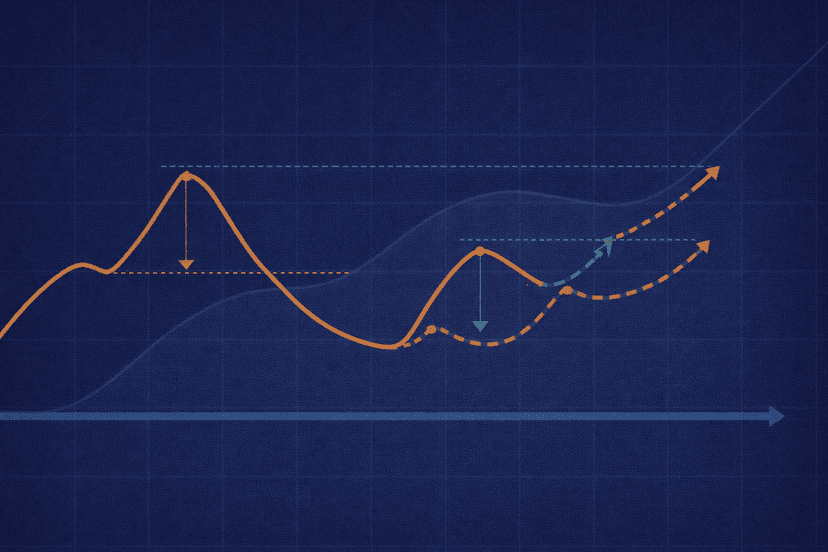
Profit targets tell you where to finish. Drawdown rules determine whether you survive long enough to get there. Before paying a fee, identify the loss metric, the reference point, and the reset time for every limit.
Static vs End-of-Day Trailing Loss
A static maximum-loss threshold remains tied to initial capital. On FTMO’s 2-Step plan, the 10% maximum loss is based on the initial account size. Profitable days therefore create more distance between current equity and the fixed floor. A trailing threshold instead follows gains according to the firm’s formula, so some or all of that extra cushion can disappear as the threshold moves higher.
FTMO’s 1-Step maximum loss trails end-of-day highs rather than every intraday tick. That distinction matters: the day’s closing result can move the next loss boundary even if an intraday gain later vanished. An end-of-day trail is generally less reactive than an intraday trail, but it still changes the amount of room available after profitable closes. Read the firm’s worked examples rather than assuming “10% maximum loss” always means a fixed $10,000 cushion on a $100,000 account.
Daily Loss Uses Equity, Not Just Closed Trades
At FTMO, detailed loss calculations include equity, open profit and loss, swaps, and commissions. A floating loss can therefore breach a limit before you close the position. The daily threshold resets at 00:00 CE(S)T, which can surprise a swing trader holding exposure across the reset when the new day’s allowance is recalculated.
This makes a 3% daily limit materially different from a 5% one. A scalper with several correlated positions, an EA that opens a basket, or a swing trader carrying overnight exposure must budget for transaction costs and adverse open P&L, not only planned stop-loss amounts. A Forex VPS can keep an EA connected, but it cannot make a rule breach disappear or protect a strategy from excessive risk.
Best-Day and Consistency Rules
FTMO’s 1-Step plan applies a 50% Best Day rule, while its 2-Step plan has no Best Day rule. The purpose is to limit how much of the qualifying performance comes from one day. A trader who reaches the headline target with one concentrated win may need additional profitable results to satisfy that condition.
That can be a poor fit for event-driven systems, selective swing strategies, or EAs whose returns arrive in clusters. It can be less restrictive for a strategy that produces many similarly sized gains. Judge fit with daily results from representative forward tests, not an average monthly return that hides concentration.
Fees, Refunds, and the Real Cost of Retries
Prop firm challenge fees are entry costs, not deposits into the advertised account balance. Match account size, currency, platform, and add-ons before comparing them, and capture the live checkout price because promotions can change. For FTMO’s $100,000 plans on July 23, 2026, the global widget displayed 1-Step at €499 and 2-Step at a €439 promotional price, with €540 also displayed.
The refund terms change the economic comparison. FTMO says one 2-Step fee covers both the Challenge and Verification and becomes refundable with the first Reward withdrawal. The 1-Step fee is non-refundable. “Refundable” does not mean risk-free: you still lose access to the fee if you breach before reaching the stated reward milestone.
A Planning Formula for Repeat Attempts
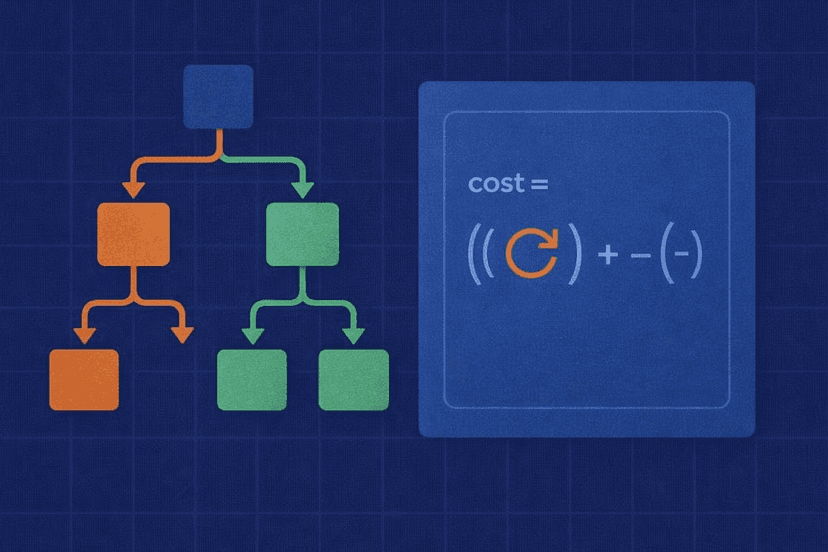
You can estimate retry exposure with a simple planning model: expected pre-refund entry spend equals the entry fee divided by your probability of completing the whole evaluation. For a two-step route, if you treat the phase outcomes as independent, whole-evaluation probability equals your phase-one completion probability multiplied by your phase-two completion probability.
For example, suppose your own records suggest a 60% probability of completing phase one and a 70% probability of completing phase two under the exact rules. The planning probability is 0.60 × 0.70, or 42%. At a €439 entry fee, the simplified expected pre-refund spend is about €1,045. This is arithmetic based on hypothetical personal inputs, not an industry pass-rate claim or a forecast of your result.
Run the same calculation for a one-step plan using your measured probability under its tighter controls. A single phase can still have a worse expected cost if trailing loss or consistency rules sharply reduce your completion probability. Conversely, a strategy built around smooth daily returns may preserve enough of its completion rate for one-step speed to justify a higher or non-refundable fee.
The simplified model assumes repeated attempts at the same fee and probability. Real outcomes differ because discounts, resets, free repeats, rule changes, and trader behavior affect later attempts. Two-step programs add another practical risk: failing late in phase two can require a full restart from phase one. Confirm the firm’s breach, reset, and repeat policy rather than assuming progress will be preserved.
FTMO offers abridged free trials for both formats with 5% targets. These are useful for checking platform setup and rule discipline, but passing one does not qualify you for an account or guarantee success in the paid challenge. Treat a free trial as a minimum filter: if you cannot follow the abridged rules consistently, paying for a faster route is unlikely to fix the process.
Which Challenge Should You Choose?
The best format is the one that preserves your normal risk process. Map your situation to the scenarios below, then verify that the specific firm’s current contract actually matches the tendency.
Choose One-Step for Proven, Controlled Speed
Choose a one-step prop firm challenge when your results already show low drawdown, distributed daily profits, and reliable compliance with the offered loss limits. It is most defensible when you value a shorter path, do not need a fee refund, and can absorb the entry cost without changing how you trade. A strategy with frequent modest wins may handle both trailing thresholds and a best-day rule better than a strategy dependent on rare outsized sessions.
Do not choose it merely because “one” sounds easy. FTMO’s example removes Verification but cuts maximum daily loss from 5% to 3%, changes maximum loss from static to end-of-day trailing, and adds the 50% Best Day rule. Test those rules together against trade-level and daily equity data.
Choose Two-Step for More Validation and Loss Cushion
Choose a two-step prop firm evaluation when static drawdown, a wider daily allowance, or refund eligibility matters more than reaching the post-evaluation stage quickly. This route often suits swing traders and variable-return strategies that need room for open equity fluctuations or uneven timing. It can also suit a cautious trader who sees Verification as evidence that the phase-one result was repeatable rather than a lucky streak.
Accept the trade-off explicitly: a second target creates another point of failure, and minimum-day rules extend the route even after you reach a target early. A phase-two breach may erase the practical value of completing phase one. Use your separate phase probabilities when budgeting retries.
Choose Neither When the Rules Distort Your Strategy
Walk away if the loss formula does not fit your stops, the consistency rule conflicts with your return pattern, or the fee loss would provoke revenge trading. The same applies if your EA, news trading, weekend holding, or jurisdiction is not allowed. An evaluation is not attractive simply because one version is less restrictive than the other.
Also understand what comes after a pass. FTMO and The5ers disclose that their provided or evaluation accounts use fictitious funds in simulated environments. Do not equate “funded” with custody of the advertised account balance. Evaluate the firm’s reward agreement, payout conditions, and post-evaluation rules as carefully as the challenge itself.
Pre-Purchase Checklist
Rules and prices can change, so complete this check against the current terms immediately before payment:
- Drawdown formula: identify static, intraday trailing, or end-of-day trailing behavior and the exact reference value.
- Daily reset: confirm the firm’s time zone and what happens to positions held across midnight.
- Open P&L: check whether floating losses, swaps, and commissions count toward daily and overall limits.
- Trading permissions: verify news, weekend, EA, copy-trading, and prohibited-strategy rules.
- Pacing: record each target, minimum trading days, deadlines, and best-day or consistency limits.
- Fee and refund: confirm the live checkout total, what all phases include, and the exact refund trigger.
- Breach and retry: find out whether a failure means a new purchase, paid reset, discounted retry, or free repeat.
- Post-evaluation changes: compare funded-stage loss limits, consistency rules, permitted holding, scaling, and inactivity terms.
- Rewards: verify eligibility dates, payout conditions, split, and any conditions attached to the fee refund.
- Legal fit: read the simulated or live-account disclosure and confirm that your jurisdiction is eligible.
Save a copy of the applicable rules and checkout details. If a material term is unclear, ask the firm for a written answer before trading. The few minutes spent on this check are worth more than choosing a route from its name or advertised speed.
Frequently Asked Questions
Is a one-step prop firm challenge easier?
Not necessarily. One-step removes a phase, which can shorten the path, but the firm may offset that advantage with tighter daily loss, trailing drawdown, or consistency rules. FTMO’s 1-Step plan, for example, had a 3% daily limit and 50% Best Day rule versus 5% and no Best Day rule on 2-Step as of July 23, 2026. Compare your strategy against every rule rather than treating phase count as difficulty.
Is a two-step challenge cheaper?
It can be, but the label does not guarantee a lower cost. In FTMO’s dated $100,000 example, 2-Step displayed a €439 promotional price, with €540 also shown, while 1-Step was €499. The 2-Step fee covered both phases and was eligible for a 100% refund with the first Reward withdrawal; the 1-Step fee was non-refundable. Your real cost also depends on the probability and price of repeat attempts.
What happens if you fail phase two?
You may have to buy a new evaluation and restart from phase one, even if you completed the first phase cleanly. Some firms instead offer paid resets, discounts, or free repeats under specific conditions. There is no universal two-step policy, so read the current breach and retry terms before paying and include a full restart in your cost planning.
Which format is better for EAs or swing traders?
Strategy behavior matters more than whether trading is manual or automated. An EA with smooth, distributed returns may fit one-step, while a basket EA exposed to floating drawdown may benefit from a wider daily limit and static maximum loss. Swing traders should pay close attention to open-equity treatment, swaps, midnight resets, news and weekend rules, and best-day constraints. Test the exact rule set on representative data before choosing.
Does passing a prop firm free trial prove you can pass the challenge?
No. FTMO’s abridged free trials for both formats used 5% targets as of July 23, 2026, and passing one neither qualifies you for an account nor guarantees paid-challenge success. A free trial is still useful for checking platform setup, daily-loss discipline, and whether your strategy conflicts with obvious rules before you risk an entry fee.

About the author
Matthew Hinkle
Lead Writer & Full Time Retail Trader
Matthew is NYCServers' lead writer. In addition to being passionate about forex trading, he is also an active trader himself. Matt has advanced knowledge of useful indicators, trading systems, and analysis.
Areas of Expertise