
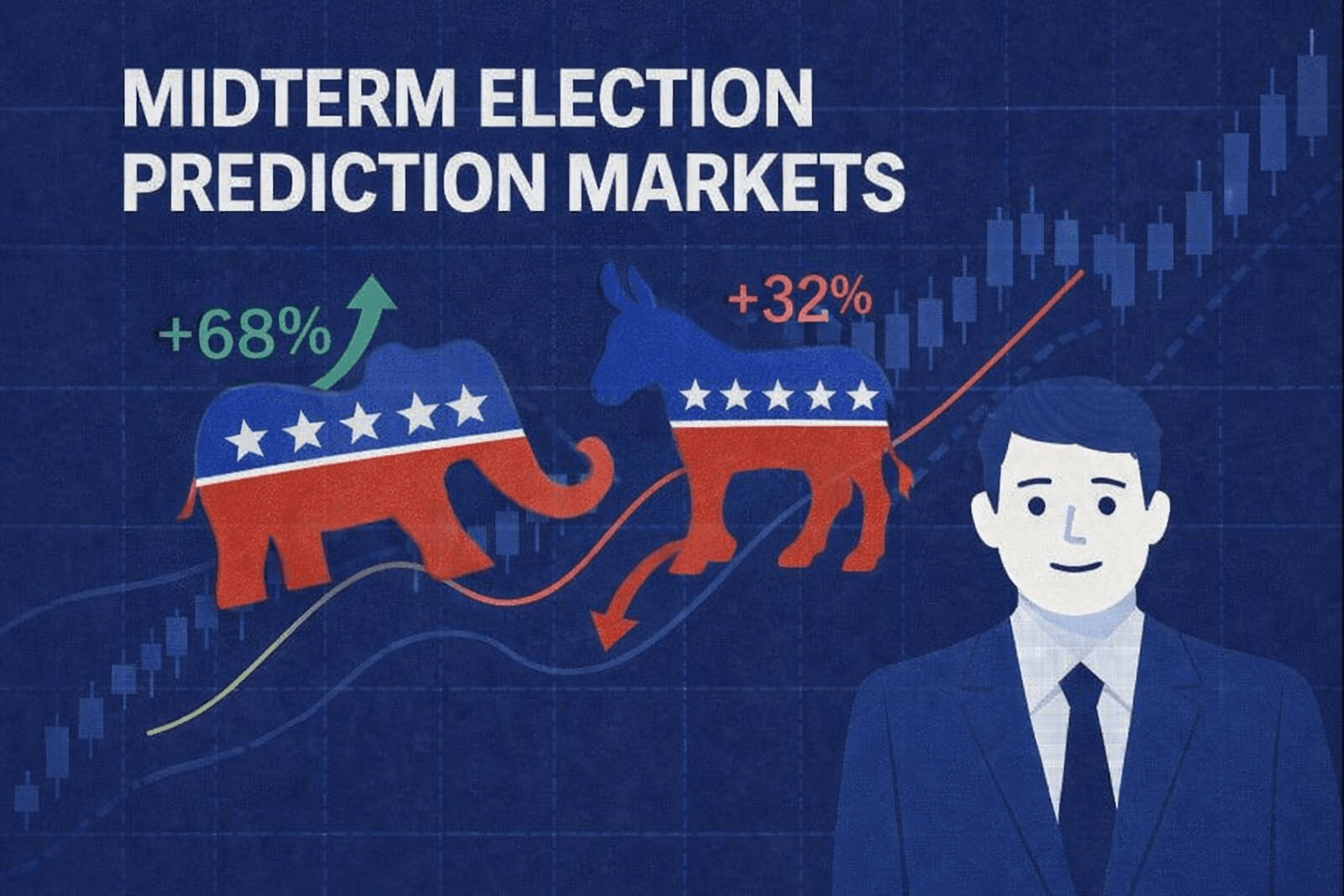
2026 Midterm Election Prediction Markets: Trading Guide
Trade the 2026 US midterms on prediction markets: which contracts exist, how prices map to odds, real edges, plus the regulatory and settlement risks.
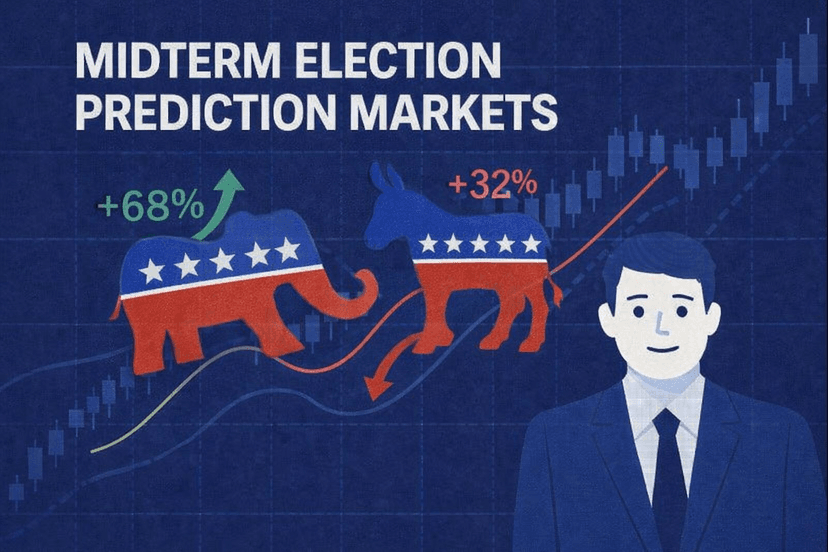
What 2026 Midterm Election Prediction Markets Let You Trade
The 2026 US midterms are shaping up to be one of the most heavily traded political events in the short history of event contracts, and if you want a piece of the action you need to understand the instruments before you start. Trading midterm election prediction markets is not the same as filling out a bracket or placing a sportsbook bet — each contract is a binary claim that settles at $1 if the outcome happens and $0 if it does not, and the price in between is the market’s live estimate of probability. That single mechanic is what you need to internalize before anything else.
The contracts on offer fall into a few tiers. The headline markets are control of Congress: will Republicans or Democrats hold the House after the election, and the same question for the Senate. Below those sit seat-count markets — for example, the number of Senate seats each party finishes with — which behave more like a range bet than a coin flip. Finally there are individual race markets on specific competitive Senate and gubernatorial contests, which are thinner but often where the sharpest disagreements (and edges) live.
Each tier trades differently. Control-of-chamber markets are deep, slow-moving, and dominated by macro polling narratives. Seat-count and individual-race markets are choppier, more sensitive to single news events, and far more prone to thin liquidity.
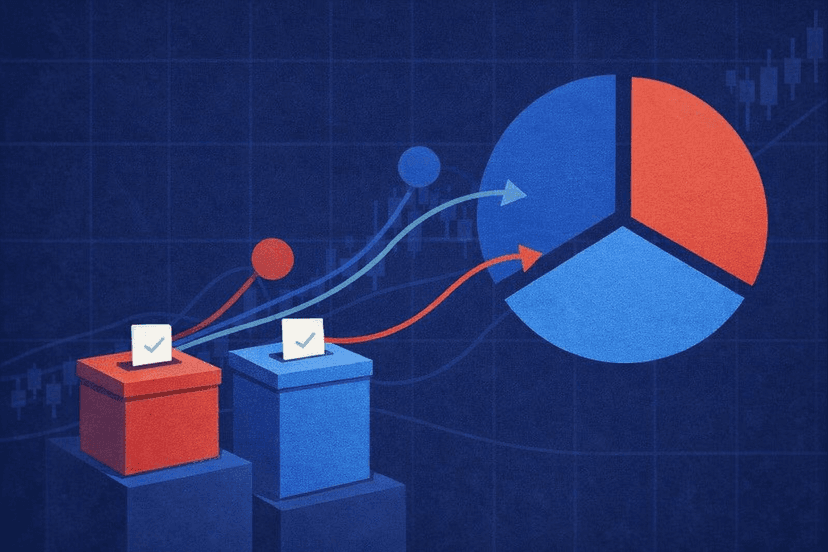
How Election Contract Prices Map to Probability
The most important skill in election trading is reading a price as a probability. A contract trading at 62¢ is the market saying there is roughly a 62% implied chance the event resolves yes. Buy it, and you risk 62¢ to make 38¢ if you are right; the reward-to-risk is baked directly into the price. This is why a “cheap” 8¢ long shot is not automatically good value and an “expensive” 90¢ favorite is not automatically a trap — the payout structure already compensates for the odds.
Because prices are probabilities, complementary contracts should sum to roughly 100¢. If “Republicans hold the House” trades at 60¢ and “Democrats take the House” trades at 44¢, that 104¢ total reflects the spread and the platform’s edge, not free money. Understanding this relationship is the foundation of every strategy that follows, and we walk through it in detail in our guide to how prediction market odds work.
| Contract price | Implied probability | Risk / reward on a yes buy |
|---|---|---|
| 10¢ | ~10% | Risk 10¢ to make 90¢ |
| 50¢ | ~50% | Risk 50¢ to make 50¢ |
| 75¢ | ~75% | Risk 75¢ to make 25¢ |
| 92¢ | ~92% | Risk 92¢ to make 8¢ |
Your entire edge as a trader is finding contracts where you believe the true probability differs from the priced probability. If you think Republicans holding the House is really a 70% event but the market prices it at 60¢, you have a theoretical edge. The hard part — and the rest of this guide — is being right about that gap more often than the sharks on the other side of your trade.
Where to Trade: Kalshi, Polymarket, and Legal Status
The venue you choose determines your legal standing, your settlement risk, and the depth of the markets you can access. The two dominant names are Kalshi and Polymarket, and they sit on opposite sides of the regulatory line. Kalshi is a CFTC-regulated designated contract market — it received its license in 2020 and, after a multi-year fight with the CFTC, was cleared by a federal appeals court in October 2024 to offer election contracts to US residents. That regulated status is its core selling point.
Polymarket took the opposite path. It settled with the CFTC in 2022 for $1.4 million and wound down US operations, running its election markets offshore on crypto rails. In July 2025 the DOJ and CFTC ended their probes without new charges, and Polymarket then acquired the CFTC-licensed exchange QCEX for roughly $112 million and received an amended CFTC designation in November 2025, opening a compliant path back into the US market. For a side-by-side breakdown of fees, liquidity, and settlement mechanics, see our ranking of the best prediction market platforms in 2026 if you want to weigh the smaller venues too.
Here is the catch you must check before you fund an account: state law. Through 2026 a wave of states moved against these platforms — Arizona filed criminal charges, Massachusetts, Michigan, Nevada, Ohio, Washington, and Wisconsin filed suits, and Minnesota passed an outright ban effective August 1, 2026. The CFTC has countersued several states asserting exclusive federal jurisdiction, but the outcome is unsettled. Your first step is always to confirm the platform legally serves your state today, because availability can change between now and election night.
Edges and Strategies for Midterm Election Trading
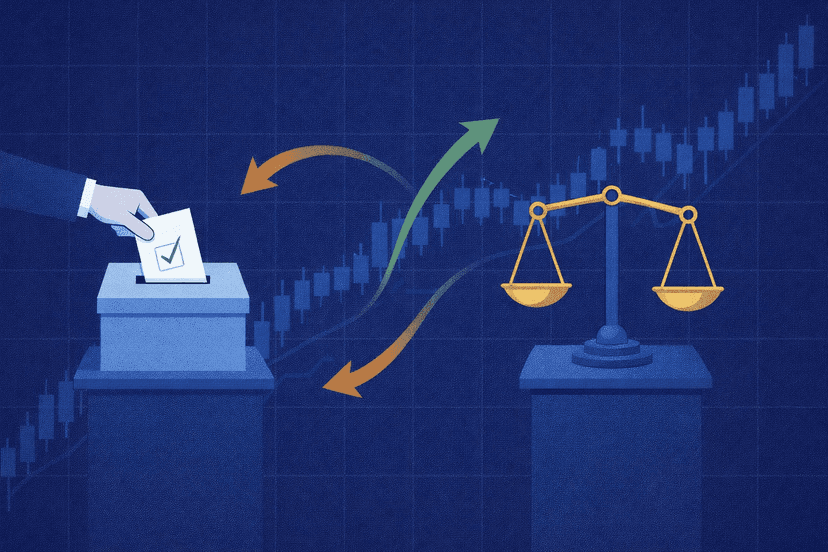
Winning election traders are not fortune tellers; they are disagreement hunters. The first and most durable edge is the polls-versus-market gap. When high-quality polling aggregates point one way but the market price lags — often because retail sentiment or a single loud narrative is dragging it — you have a candidate trade. The discipline is to trust the base rate and the aggregate over the story of the day.
A second edge is resolution timing and event structure. Some contracts resolve on election night; others can drag for days if races are close and counting is slow. A contract that is “99% decided” but still trades at 90¢ because settlement is a week away is offering you an annualized return for holding through the noise — sometimes attractive, sometimes not worth the tail risk of a recount. Read the settlement rules before you assume a near-certain outcome is free money.
Third is cross-market arbitrage. When the same real-world question is priced differently on two venues, or when related contracts (control of the House versus specific House races) drift out of logical alignment, disciplined traders capture the spread. These edges are small and get arbitraged away fast, which is exactly why latency and automation matter — more on that below. If you are still building your process, our walkthrough of prediction market strategies for beginners lays out the fundamentals before you scale up size.
Whatever strategy you run, size it like a professional. The Wall Street Journal reported in May 2026 that on these platforms roughly 2.9 users lose money for every one who profits — the house structure and the sharks grind down everyone else. Position sizing, not prediction, is what keeps you in the game long enough for a real edge to pay off.
The Risks Nobody Advertises
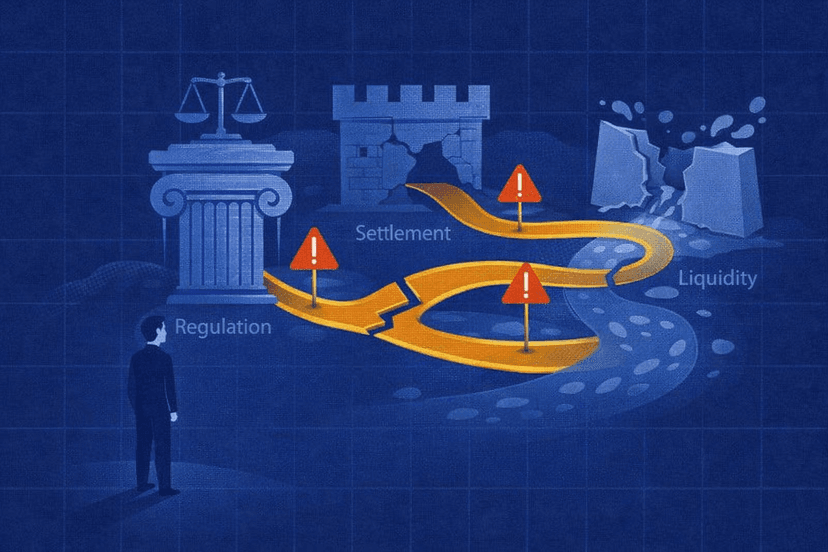
The glossy marketing around election trading hides four risks that can cost you far more than a bad prediction. The first is regulatory risk. As the state actions above show, a platform that is legal for you today may be geofenced out of your state tomorrow, potentially with open positions to unwind. Never park capital you cannot afford to have frozen or forced-closed on short notice.
The second is settlement and resolution risk. Prediction markets have repeatedly frozen or re-settled contracts when wording turned out to be ambiguous — Kalshi reimbursed roughly $2.2 million after a poorly worded contract, and Polymarket has withheld payouts on disputed markets. An election contract can hinge on the exact definition of “control” or a certification date you never read. The fine print is the product; treat it that way.
The third is insider and manipulation risk. Investigations across 2026 exposed traders acting on non-public information, and reporting found that a strikingly high share of “long shot” event bets resolved in the bettor’s favor — a pattern consistent with information asymmetry rather than luck. In an individual-race market, the person on the other side of your trade may simply know something you do not.
The fourth is liquidity risk. Control-of-Congress markets are deep, but individual-race and seat-count contracts can be thin, with wide spreads that punish you on both entry and exit. A common problem is a “paper” edge that evaporates the moment you try to trade real size and move the price against yourself. If a market is thin, the fix is smaller size and patient limit orders — never a market order into an empty book.
Execution and Infrastructure: Latency, Bots, and VPS
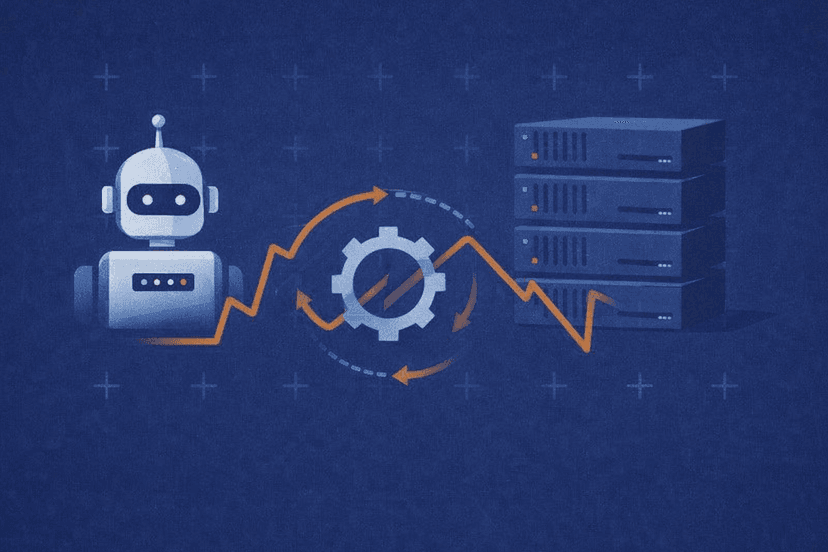
On election night, prices move in seconds as results print, and the traders who capture the best fills are the ones sitting closest to the exchange with automation ready to fire. This is where infrastructure stops being optional. A home connection adding 80–150ms of latency, a laptop that might sleep or drop Wi-Fi, and manual clicking are all liabilities when a Senate race gets called and a contract repriced from 40¢ to 85¢ in a single tick.
Active election traders address this with two things: a trading bot and an always-on, low-latency server to run it. Automation lets you place, cancel, and hedge orders faster than any human, and it enforces your risk rules when the emotional temptation to chase a moving market is highest. If you want to build one, our tutorial on why prediction-market bots need a VPS explains the setup.
The reason a low-latency trading VPS matters is simple: it puts your bot in a data center with a fast, stable route to the venue, running 24/7 without the risk of your home machine rebooting during the one hour that matters all cycle. Finally, remember that infrastructure sharpens execution — it does not create an edge where none exists. A fast server running a losing strategy just loses faster; the setup only pays off once your underlying read on the market is sound.
Frequently Asked Questions
Is trading the 2026 midterms on prediction markets legal in the US?
It depends on the platform and your state. Kalshi is a CFTC-regulated exchange cleared by a federal appeals court in October 2024 to offer election contracts to US residents, and Polymarket has built a compliant US path through its CFTC-licensed QCEX acquisition. However, through 2026 several states — including Arizona, Nevada, Ohio, and Minnesota — moved to ban or restrict these platforms, while the CFTC countersued asserting federal jurisdiction. The legal picture is genuinely unsettled, so confirm the platform legally serves your state before you fund an account.
How do I read an election contract price?
Read the price directly as a probability. A contract trading at 65¢ means the market implies about a 65% chance the event resolves yes, and buying it risks 65¢ to make 35¢. Complementary yes and no contracts should add up to roughly 100¢ plus a small spread. Your edge as a trader comes from finding contracts where you believe the true probability differs from the priced probability — not from picking “cheap” long shots, whose low price already reflects their low odds.
Can I actually make money trading midterm election markets?
Some traders do, but the odds are against the average participant. The Wall Street Journal reported in 2026 that roughly 2.9 users lose money for every one who profits on these platforms, and sophisticated “sharks” — plus occasional insiders — take the other side of retail trades. Consistent profit requires a real edge (such as a genuine polls-versus-market gap), disciplined position sizing, and respect for settlement and liquidity risk. Treat it as speculative trading, not a reliable income source.
Do I need a VPS to trade election markets?
Not for casual, manual trading. A VPS becomes valuable when you run an automated bot or want the fastest, most reliable execution during high-volatility moments like election night, when prices reprice in seconds. A low-latency VPS keeps your bot in a data center with a fast route to the exchange and runs it 24/7 without the risk of a home machine sleeping or dropping its connection. The infrastructure improves execution, but it does not manufacture an edge — your strategy still has to be sound.

About the author
Matthew Hinkle
Lead Writer & Full Time Retail Trader
Matthew is NYCServers' lead writer. In addition to being passionate about forex trading, he is also an active trader himself. Matt has advanced knowledge of useful indicators, trading systems, and analysis.
Areas of Expertise