
Blue Guardian Review 2026: Rules, Pricing, Payouts and EA Policy
Our Blue Guardian review covers the rules of every CFD program, regular prices and the Black Friday sale, payouts and the profit split, and Blue Guardian's EA and VPS rules.

Published
The Blue Guardian prop firm sells simulated CFD and futures accounts, and its forex programs are among the cheapest to start, with regular prices from $26.66. It offers five CFD evaluations and two instant accounts on MetaTrader 5 and Match Trader, with an 80% to 90% profit split. On CFD accounts it allows Expert Advisors that are your own setup and a VPS that only you use, but it bans high-frequency, tick-scalping and arbitrage bots, and its futures accounts ban fully automated trading. The trade-offs are 3% to 4% daily loss limits, trailing drawdowns on most programs, and a "Guardian Shield" on funded accounts that closes your trades at a 1% or 2% floating loss.
We don't buy or trade prop firm challenges, so this Blue Guardian review is built from Blue Guardian's own public pages, checked on November 26, 2026 and linked below. Payout totals are Blue Guardian's own claims.
What Blue Guardian Is
Blue Guardian is a prop trading firm run through two companies named in its site footer: Blue Guardian Limited in Saint Lucia provides the simulated trading platforms, and Iconic Exchange FZCO in Dubai handles educational products and payments. Its about page names Sean Bainton as founder and CEO. The pages we checked give no founding date, but the top payouts on its payouts page go back to March 2024.
The money isn't real on the CFD side. Blue Guardian's How Blue Guardian works article says: "All CFD accounts, including funded accounts, are demo accounts in a simulated environment with virtual funds." Its CFD programs are the 1 Step Standard, 1 Step Nano, 2 Step Standard and 2 Step Nano evaluations, Buy Now Pay Later (BNPL), and two instant accounts, Instant Standard and Instant Starter, in sizes from $5,000 to $400,000.
Blue Guardian also runs a futures program, Blue Guardian Futures, with Zero, Elite, Reserve and Direct accounts on NinjaTrader (Tradovate). This review covers the CFD programs that forex traders buy and notes where the futures rules differ.
The restricted countries article lists Afghanistan, Albania, Algeria, Cuba, Iran, Jordan, Libya, Myanmar, North Korea, the Philippines, Senegal, Syria and Vietnam for CFD accounts, plus countries on OFAC's sanctions list. The futures list is much longer. The United States is on neither list, and US clients can buy CFD accounts on Match Trader only.
Blue Guardian Rules
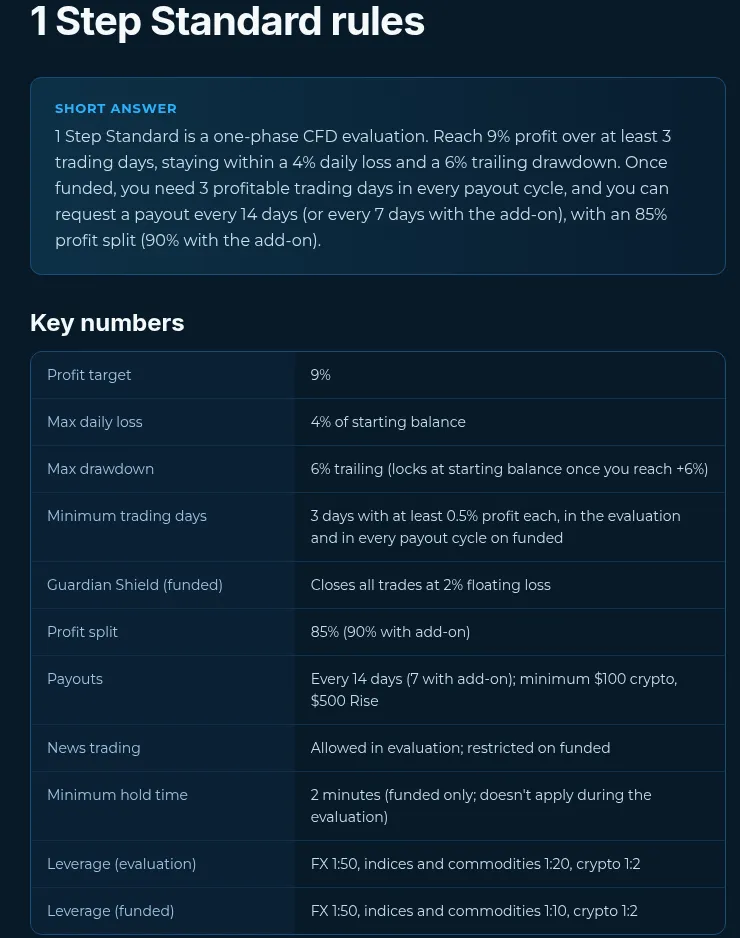
Each program has its own article in Blue Guardian's FAQ, and every limit is a percentage of the starting balance. The daily loss limit is measured from whichever is higher at the 5:00 PM New York reset, your balance or your equity. The trailing drawdowns trail your highest closed balance and lock at the starting balance once you are up by the drawdown amount.
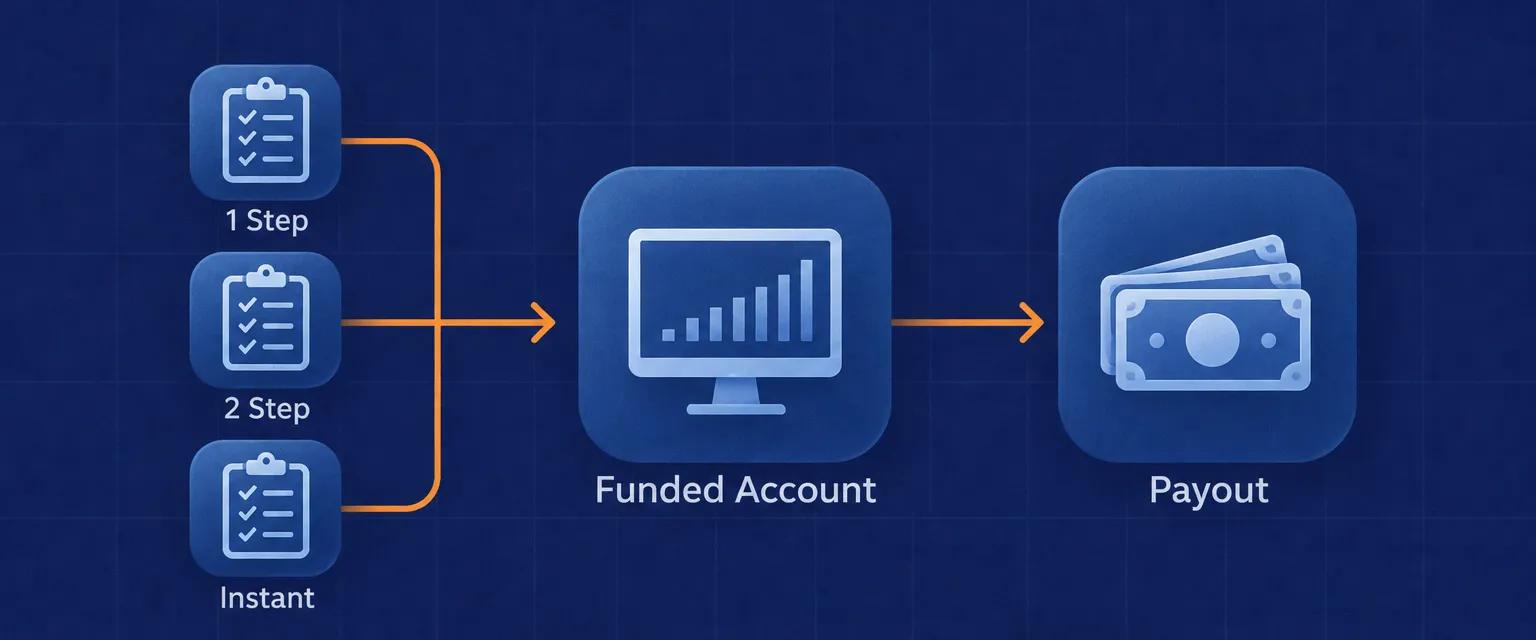
One-phase evaluations
| Rule | 1 Step Standard | 1 Step Nano | Buy Now Pay Later |
|---|---|---|---|
| Profit target | 9% | 10% | 4% |
| Daily loss | 4% | 4% | 4% |
| Maximum drawdown | 6%, trailing | 6%, trailing | 8%, trailing |
| Consistency rule | None | Best day under 50% of profit, in the evaluation and on funded | Best day under 20% of profit, funded only |
| Minimum days | 3 days of 0.5% profit to pass, and 3 in every payout cycle | None to pass; 5 days of 0.5% profit before a payout | None to pass; 5 days of 0.5% profit before a payout |
| Profit split | 85% (90% with add-on) | 85% (100% with add-on) | 80% |
| Payouts | Every 14 days (7 with add-on) | Every 7 days | On demand |
The qualifying days on the 1 Step Standard don't need to be consecutive. On the 1 Step Nano, a $1,000 best day needs more than $2,000 of total profit, and Buy Now Pay Later charges an activation fee when you pass.
Two-phase evaluations
| Rule | 2 Step Standard | 2 Step Nano |
|---|---|---|
| Profit target | 8% in phase 1, 4% in phase 2 | 8% in phase 1, 5% in phase 2 |
| Daily loss | 4% | 3% |
| Maximum drawdown | 8%, static | 10%, static |
| Consistency rule | None | Best day under 50% of profit, funded only |
| Minimum days | 3 days of 0.5% profit in each phase, and 3 in every payout cycle | None |
| Profit split | 85% (90% with add-on) | 80% (100% with add-on) |
| Payouts | Every 14 days (7 with add-on) | Every 14 days, capped at 2% of starting balance |
These are the only programs with a static drawdown: on a $100,000 2 Step Standard your equity must stay above $92,000 however much you have made. The 2 Step Nano caps each payout at 2% of the starting balance, or $2,000 per cycle on $100,000.
Instant accounts
| Rule | Instant Standard | Instant Starter |
|---|---|---|
| Profit target | None | None |
| Daily loss | 3% | 3% |
| Maximum drawdown | 6%, trailing | 5%, trailing |
| Consistency rule | Best day under 20% (15% on $300K and $400K) | Best day under 15% |
| Minimum days | 5 days of 0.5% profit | 5 days of 0.5% profit |
| Profit split | 80% (90% with add-on) | 90% |
| Payouts | On demand | One payout on up to $250 of profit, crypto only |
On Instant Standard, a $1,000 best day needs at least $5,000 of total profit before you can withdraw, and on $200,000 and larger accounts the first two payouts are capped at $10,000 each. Instant Starter is a one-off $5,000 account, one per trader: you can request $250 of profit at most, which is $225 at its 90% split before the 3% processing fee, by crypto only, and the account closes after that payout.
Guardian Shield and other funded rules
Funded Standard accounts, BNPL and the instant accounts carry a rule called Guardian Shield. If your open trades reach a combined floating loss of 2% (1% on BNPL and the instant accounts), it "will usually close all open trades". The first time, "your profit split drops to 50% permanently", and the second time the account is permanently breached. The Nano accounts don't have it.
On funded accounts you must also hold each trade for at least 2 minutes, and using more than 80% of your margin counts as "all or nothing" gambling. Every CFD account must trade at least once every 30 days under the inactivity rule.
News trading is allowed during evaluations and on Instant Starter. On funded accounts and Instant Standard, the news trading rules bar opening or closing trades on affected instruments from 5 minutes before to 5 minutes after high-impact news or any FOMC event. Profit made in that window is removed, but the account isn't breached.
If you are choosing between one and two phases, our guide to one-step vs two-step prop firm challenges explains the trade-off.
Blue Guardian Pricing and Account Sizes
Blue Guardian charges a one-time fee for each account, with no monthly fee. These are the regular prices on its forex pricing page on November 26, 2026, in US dollars:
| Account size | 1 Step Standard | 1 Step Nano | 2 Step Standard | 2 Step Nano | Instant Standard |
|---|---|---|---|---|---|
| $5,000 | $40 | $26.66 | $32 | – | $72 |
| $10,000 | $66 | $38.66 | $75 | – | $100 |
| $25,000 | $134 | $78.66 | $154 | $66.66 | $208 |
| $50,000 | $200 | $160 | $232 | $127 | $324 |
| $100,000 | $398 | $320 | $463 | $239 | $623 |
| $200,000 | $736 | $585 | $930 | $460 | $954 |
| $400,000 | – | – | – | – | $2,200 |
The cheapest regular price is the $26.66 1 Step Nano at $5,000. Instant Starter's regular price is $27. Buy Now Pay Later costs $10 up front, and when you pass you pay a one-time activation fee to get the funded account:
| Account size | BNPL activation fee |
|---|---|
| $5,000 | $52 |
| $10,000 | $98 |
| $25,000 | $202 |
| $50,000 | $352 |
| $100,000 | $686 |
| $200,000 | $1,033 |
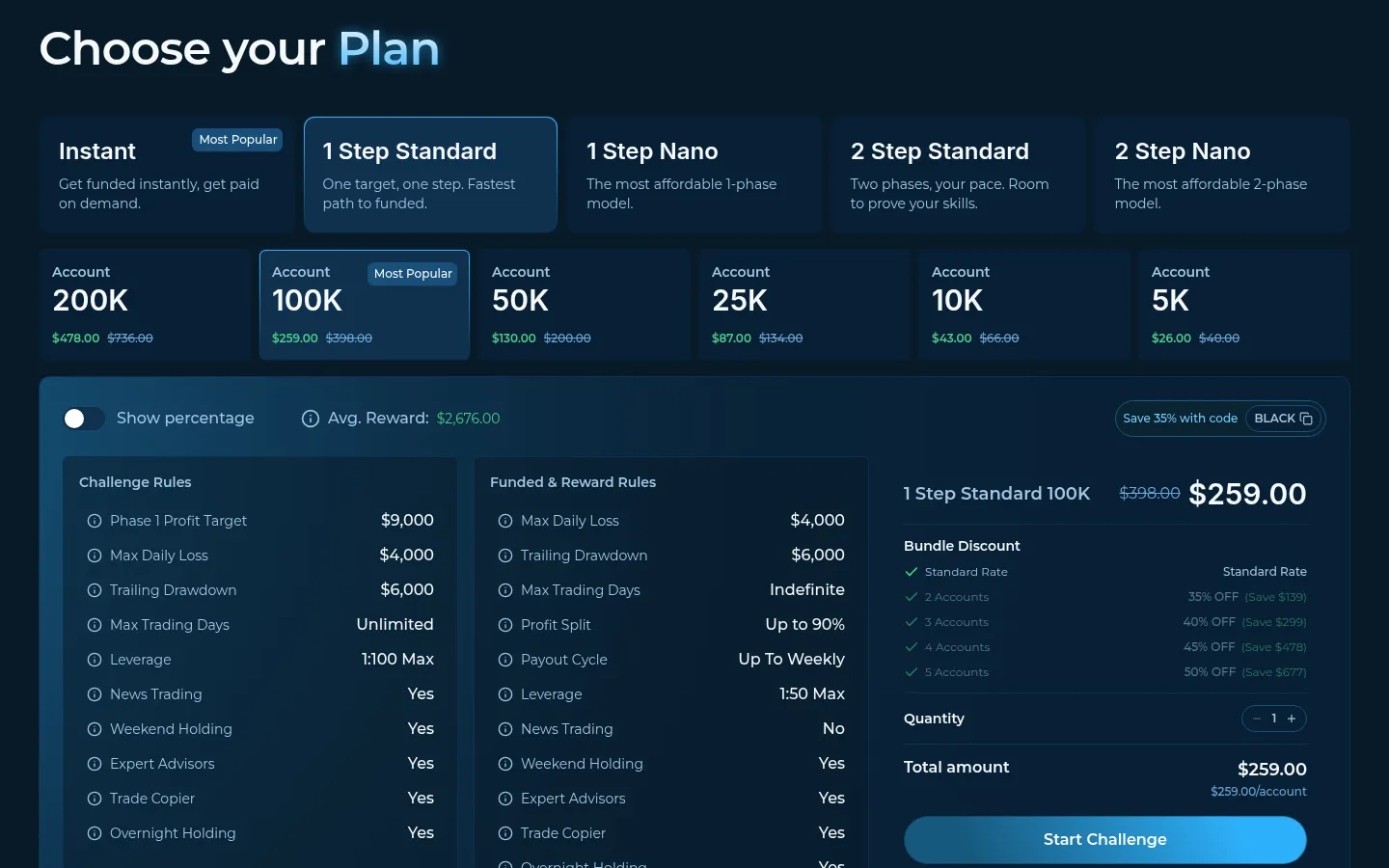
On sale on November 26, 2026, the pricing tables showed every price 35% lower with a code, so the $100,000 1 Step Standard was $259 instead of $398. The Instant Starter page showed $11 against the regular $27.
The payment article says the fee for a CFD account bought from January 21, 2026 is "refunded in full after your fourth payout", except on Instant Starter or if the account is hard-breached first. Futures fees are not refundable, with one exception: if you are moved to a Live Account, you "may receive a refund for your active accounts". The account limits article caps your active funded CFD balance at $400,000, and the scaling plan can raise it to $4,000,000, adding 30% of the initial balance each time you make 12% in 3 months.
Payouts and Profit Split
Blue Guardian's payout terms depend on the program. Its How payouts work article and the program articles set them out:
- Split: 80% or 85% by default on the evaluations and Instant Standard, rising to 90% or 100% with a paid add-on on most of them, and 90% on Instant Starter, as in the tables above. All funded futures accounts get 90%.
- First payout: on the funded account from a Standard evaluation, "your first payout is available once 14 days have passed since your first trade", or after 7 days with the add-on the pricing page calls "First Payout in 7 days". On the 1 Step Nano, BNPL and the instant accounts it comes after 5 trading days with 0.5% profit or more, subject to the consistency rule, and the 2 Step Nano pays every 14 days with no minimum days.
- Frequency: every 14 days on the Standard evaluations (every 7 with an add-on) and the 2 Step Nano, every 7 days on the 1 Step Nano, and on demand on BNPL and Instant Standard.
- Conditions: the account must be above its starting balance, with all positions closed and no rule violations, and once a trailing drawdown has locked you must leave 1% of the starting balance in it.
- Methods and fees: crypto, from $100 up to $1,000 per request, or Rise, from $500 with no maximum. "A 3% processing fee applies to every payout."
- Processing: "Eligible payout requests are processed within 24 business hours."
Blue Guardian's payout claim is "$49M+" in total payouts and "26,739+" payouts to date, shown on its payouts page, and its homepage says approved payouts are "processed in 1 hour on average". These are Blue Guardian's own, unaudited figures. Most people who buy a challenge don't pass it, the funded accounts are simulated, and a payout depends on following every rule until the day you withdraw.
Platforms
New CFD accounts trade on MetaTrader 5 or Match Trader, according to Blue Guardian's platforms article, updated November 20, 2026. US clients can only use Match Trader. TradeLocker "is no longer offered from 20 November 2026" for new accounts.
For Expert Advisors you need MT5, because Match Trader doesn't run MetaTrader EAs, so a US trader can't run an MT5 EA at Blue Guardian. Blue Guardian Futures trades on NinjaTrader (Tradovate).
Blue Guardian EA and VPS Rules
Blue Guardian's automation rules differ by market: on its CFD (forex) accounts your own EAs are allowed and some kinds of bot are banned, while its futures accounts ban fully automated trading.
The EA rule on CFD accounts. Every CFD program article, from the 1 Step Standard to Instant Starter, says: "Expert Advisors: allowed, if they're your own setup." The prohibited trading strategies article, updated November 17, 2026, bans on CFD accounts "Tick scalping, high-frequency trading and arbitrage bots", "Reverse arbitrage, latency arbitrage and hedge arbitrage" and "Trade emulators". Its at-a-glance table answers "Fully automated trading (bots, AI)" for CFD with "HFT, tick scalping and arbitrage bots not allowed". Blue Guardian doesn't define "your own setup", so before you run a bought EA, ask its support in writing.
The automation rule on futures accounts. The same article's futures section says: "Fully automated systems, AI and bots are not allowed on any account. Semi-automated trading is allowed only if you actively monitor and manually manage your trades." It adds that "Systems that place more than 200 trades a day are not allowed" and "Hands-off, round-the-clock automated trading is not allowed." Full automation is banned on Blue Guardian Futures, but not on CFD accounts beyond the bot types above.
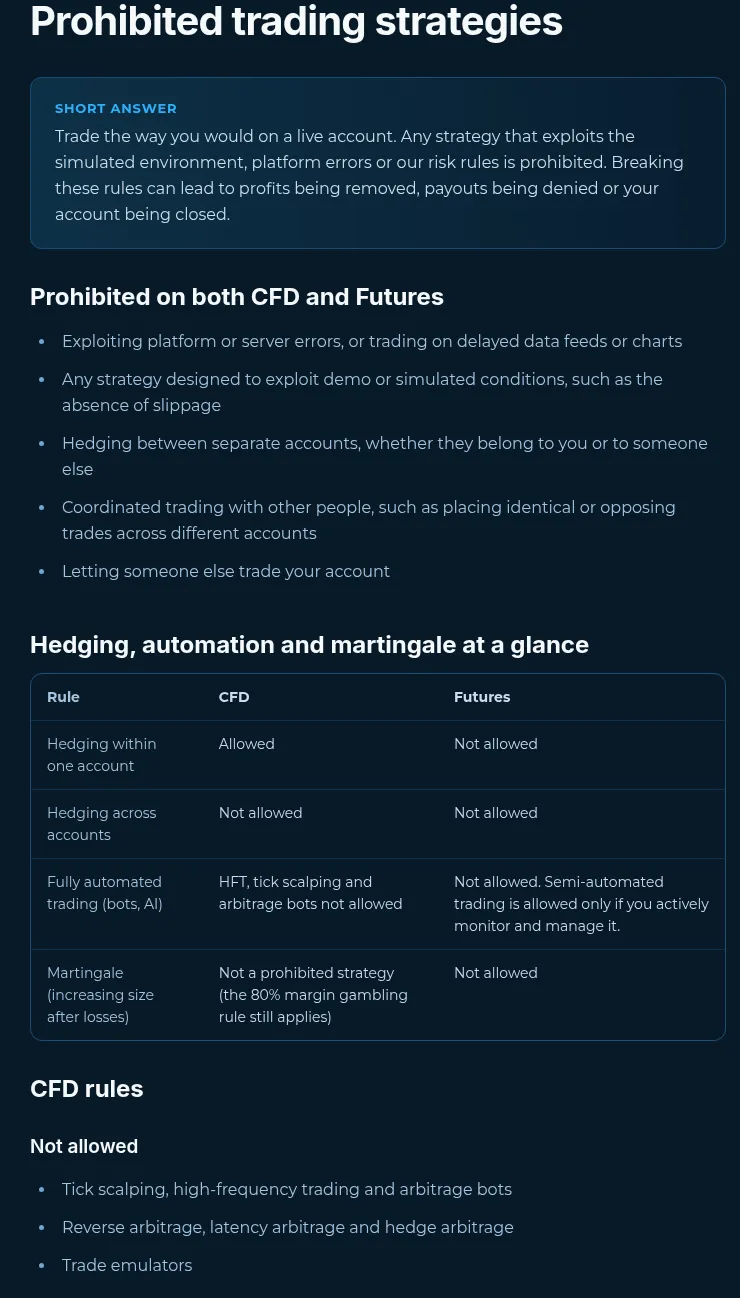
The VPS and IP rule. The CFD program articles say: "VPNs and VPS are allowed, but not to get around copy trading, group trading or signal rules." The account rules article adds a device rule: Blue Guardian records a device identifier, or CID, at every login and treats accounts as linked when one device logs in to more than one trader's account, including through "shared computers and VPS services". Its advice is: "Don't use public, shared or work computers, or shared VPS services." A CID match can lead to payout denial, profit removal or closure.
The copy-trading rule. On CFD accounts, "Copy trading: only between accounts you legally own, including between your own evaluation and funded accounts." The prohibited strategies article also bans "Hedging between separate accounts, whether they belong to you or to someone else" and "Coordinated trading with other people". On futures, copying is "Allowed, including with third-party copier software, but only between accounts you legally own".
What this means for your setup. For forex, run your own EA on an MT5 account, make sure it isn't a high-frequency, tick-scalping or arbitrage bot, and use a VPS that only you log in to. For Blue Guardian Futures, don't use a fully automated system at all. Our guide to the best prop firms for EA trading compares the EA rules of other firms.
Does Blue Guardian Have a Discount Code?
Yes, on November 26, 2026 Blue Guardian's own site showed a public promo code. The banner on every page read "35% OFF All accounts | CFDs & Futures Code: BLACK", and a pop-up called it a "Black Friday sale" with "Offer ends Nov 30 · 23:59 UTC". The forex pricing tables showed the sale prices beside the regular ones, and the Buy Now Pay Later page showed a separate "Save 25% with code BG25" on its activation fees. The pricing page also offered bundle discounts of 35% for 2 accounts, rising to 50% for 5.
A coupon code lowers the fee you pay up front. The refund terms are separate: Blue Guardian refunds the fee of a CFD account bought from January 21, 2026 in full after your fourth payout, but not for Instant Starter or an account hard-breached before then. Futures fees aren't refunded, except possibly for your active accounts if you are moved to a Live Account.
We have no affiliate code for Blue Guardian, and we earn nothing from any Blue Guardian code or purchase. We don't list third-party coupon sites.
Pros and Cons
Pros
- Low regular prices, from $26.66 for a $5,000 1 Step Nano, and a $10 start on Buy Now Pay Later.
- Your own EAs are allowed on every CFD program, and a VPS is allowed as long as only you use it.
- Two static-drawdown programs, the 2 Step Standard and 2 Step Nano, and no time limits on any evaluation.
- On-demand payouts on Instant Standard and BNPL.
- The scaling plan can grow a funded CFD allocation to $4,000,000.
Cons
- Guardian Shield closes funded trades at a 2% floating loss (1% on BNPL and instant accounts) and permanently cuts the split to 50% the first time.
- Daily loss limits are tight at 3% to 4%, and most programs use a trailing drawdown.
- Every payout carries a 3% processing fee, and crypto payouts are capped at $1,000 per request.
- Blue Guardian doesn't define what makes an EA "your own setup", and it bans fully automated trading on futures.
- Only two platforms for new CFD accounts, and US clients get Match Trader only, so no MT5 EAs.
Who Blue Guardian Suits
Blue Guardian suits forex traders on a budget, and traders who run an EA they built themselves on MT5 from their own VPS. The 2 Step Standard suits patient traders who want a static drawdown.
It suits traders who let positions run into large floating losses less, because of Guardian Shield, and futures traders who automate should look elsewhere.
Verdict
Blue Guardian is a low-cost forex prop firm with clear, published rules for every program. For EA traders it is more permissive than a quick reading of its rules suggests: on CFD accounts your own EAs and your own VPS are allowed, and the ban on fully automated trading applies to its futures accounts. The catches are Guardian Shield, tight daily limits, trailing drawdowns on most programs and a 3% fee on every payout.
Before you buy, read the rules of your exact program and check that your EA counts as your own setup. Most challenge buyers don't pass, Blue Guardian's CFD accounts are simulated, and a payout is made only if every rule is followed.
FAQ
Is Blue Guardian legit?
Blue Guardian is an operating prop firm that publishes its rules and payout terms and names the companies behind it. It says it has paid out more than $49 million, which is its own figure, and its CFD accounts are simulated.
What is Blue Guardian's Trustpilot rating?
Trustpilot's page for Blue Guardian blocked our browser when we checked on November 26, 2026, so we don't quote a rating here. Read the reviews on Trustpilot itself, and look at recent reviews about payouts and rule breaches rather than the overall score alone.
Does Blue Guardian allow EAs?
On its CFD accounts, yes, if the EA is your own setup. High-frequency, tick-scalping and arbitrage bots and trade emulators are banned. On Blue Guardian Futures, fully automated trading isn't allowed, and semi-automated trading is allowed only if you actively monitor and manage your trades.
Can I use a VPS with Blue Guardian?
Yes. Blue Guardian's CFD program rules say VPNs and VPS are allowed, but not to get around its copy trading, group trading or signal rules. Its device rule bans shared VPS services, so use a VPS that only you log in to.
Matthew Hinkle
Lead Writer & Full Time Retail Trader
Matthew is NYCServers' lead writer. In addition to being passionate about forex trading, he is also an active trader himself. Matt has advanced knowledge of useful indicators, trading systems, and analysis.
- Forex Trading
- Technical Analysis
- Trading Systems
- Market Indicators
Written by Matthew on
View profile