
NYCServers vs ForexVPS.net: Pricing, Uptime, and Setup Compared
NYCServers vs ForexVPS.net: Compare pricing, uptime, and setup. We examine ForexVPS.net’s 24 hour outage and what it means for traders.

Choosing a Forex VPS is not a cosmetic decision — it directly impacts execution speed, trade stability, and risk exposure. For traders running automated strategies, scalping systems, or always-on Expert Advisors, even a few minutes of downtime or poor latency can translate into missed entries, unmanaged positions, or real financial losses.
Two well-known providers in this space are NYCServers and ForexVPS.net. Both have operated in the Forex VPS market for years, both serve traders globally, and both promote low-latency infrastructure designed for MT4, MT5, and algorithmic trading. On the surface, their offerings can appear similar.
However, once you look beyond marketing claims, important differences emerge — in pricing transparency, infrastructure design, redundancy, hardware disclosure, setup experience, and support during critical incidents.
What We Found:
- NYCServers costs up to $430 less over 5 years compared to ForexVPS.net’s entry plan when using standard month-to-month pricing
- ForexVPS.net experienced a documented ~24-hour New York outage in August 2025 — Client’s services and trading platforms were offline and inaccessible
- NYCServers provides service monitoring & alerts through their custom built software, which comes included with all services
- NYCServers automatically places your VPS in the optimal data center based on your broker selection at checkout — no guesswork required
- ForexVPS.net is one of several brands operated by ThinkHuge Ltd, alongside game server hosting (PingPlayers), AI agents, and a second competing Forex VPS brand (FXVM)
This comparison provides a fact-based, side-by-side analysis of NYCServers and ForexVPS.net. We examine:
- Pricing and long-term cost differences
- VPS locations and latency optimization
- Hardware specifications and transparency
- Setup experience and platform readiness
- Monitoring, alerts, and control panel features
- Uptime claims versus documented incidents
- Policies, billing practices, and account credits
For full transparency, we operate NYCServers. That said, every claim in this article is supported by publicly available information — including published pricing pages, terms of service, status updates, and verified customer reviews — so readers can independently validate the facts.
The goal is simple: to help traders choose the Forex VPS that best fits their trading style, broker location, and risk tolerance — not based on slogans, but on verifiable data.
Quick Comparison: NYCServers vs ForexVPS.net
The table below highlights the key differences that matter most to Forex traders, including pricing, uptime reliability, latency optimization, hardware transparency, and operational policies. This provides a high-level snapshot before diving deeper into each area.
| Feature | NYCServers | ForexVPS.net |
|---|---|---|
| Starting Price | $25/mo ($250/year) | $35/mo ($336/year) |
| Uptime Guarantee / SLA | 100% during trading hours | 100% (homepage) / 99.99% (terms) |
| Documented Major Outage (2025) | None | ~24-hour New York outage |
| VPS Locations | New York, London, Tokyo | 22 global locations |
| Service Location Optimization | Automatic at checkout | Manual location selection required |
| Latency Checker | Server-by-server MT4/MT5 data | Broker-level only |
| Pre-installed Trading Platforms | Yes — selected at checkout | No — manual installation |
| Change VPS Location | Anytime from client area | Undocumented / unclear |
| Hardware Transparency | Yes | Not specified |
| Monitoring & Alerts | Built-in | Not advertised |
| VPS Management & Automation | Advanced control panel | Basic management |
| Backups | Available addon | Marketed as included, billed as add-on at checkout |
| Account Credits | Never expire | Expire after 6 months |
| Primary Business Focus | 100% Forex VPS infrastructure | Multi-brand: VPS, trading tools, game servers, AI agents |
| Best Fit For | Traders prioritizing stability, latency & automation | Traders needing niche regional locations |
Data verified from publicly available pricing pages, terms of service, status updates, and documentation as of December 2025.
Pricing & Long-Term Cost Comparison
For most traders, the monthly price is only part of the story. The real question is total cost over time, especially if you run a VPS year-round for automated trading. Below is a clear breakdown of pricing, plan value, and common add-ons that can change what you actually pay.

NYCServers Pricing Overview
- Basic: $25/mo ($250/year) — 2 vCPU, 2GB RAM, 60GB storage
- Standard: $40/mo — 2 vCPU, 4GB RAM, 70GB storage
- Professional: $60/mo — 4 vCPU, 8GB RAM, 100GB storage
- Dedicated Server: From $125/mo — full dedicated hardware
All plans include Windows Server, 24/7 support, access to NYCServers’ automated control panel features (including one-click trading software setup and many self-service management tools), and service monitoring & alerts software.

ForexVPS.net Pricing Overview
- Core: $35/mo ($336/year) — 2 vCPU, 4GB RAM, 100GB storage
- Edge: $55/mo — 4 vCPU, 6GB RAM, 150GB storage
- Prime: $75/mo — 6 vCPU, 8GB RAM, 200GB storage
ForexVPS.net’s entry plan starts at $35/mo for monthly billing, with discounted annual pricing available depending on term length and promotions.
Note: NYCServers pricing reflects standard month-to-month rates with no promotional discounts. ForexVPS.net pricing shown in their marketing materials often reflects discounted annual commitments. Both pricing structures are accurate as of December 2025.
Total Cost of Ownership (1-Year / 3-Year / 5-Year)
Using the entry-level plans shown above, NYCServers is typically lower cost over time. Over longer horizons, the difference becomes meaningful for traders who keep a VPS running continuously.
| Time Period | NYCServers (Basic) | ForexVPS.net (Core) | Estimated Difference |
|---|---|---|---|
| 1 Year | $250/year | $336/year | $86 less |
| 3 Years | $750 | $1,008 | $258 less |
| 5 Years | $1,250 | $1,680 | $430 less |
Note: Totals above compare published annual pricing for the entry plans and do not include promotional discounts, upgrades, taxes, or optional add-ons.
Optional Add-Ons & Pricing Transparency
When comparing VPS pricing, it’s important to consider common add-ons such as backups. In some cases, features marketed as “included” may still appear as paid add-ons at checkout, which can meaningfully change the final monthly cost. We’ll cover this more in depth in the article below.
For traders running automated strategies, backups and recovery options can be valuable — the key is that pricing is clearly disclosed upfront so the true monthly cost is easy to understand before purchase.
Next, we’ll look at the more important side of value: uptime, reliability, and what happens when a VPS provider experiences an incident during active trading.

Uptime, Reliability & Incident History
For Forex traders running automated strategies, uptime is not a marketing claim — it is a risk factor. When a VPS goes offline, trading platforms stop executing, open positions may go unmanaged, and protective logic within Expert Advisors can fail. Even short interruptions can have real financial consequences.
Uptime Guarantees Explained
Both NYCServers and ForexVPS.net promote high availability, but the way uptime is defined and enforced differs.
NYCServers service level agreement guarantees 100% uptime during active trading hours, reflecting how traders actually use a Forex VPS — continuously, while markets are open.
ForexVPS.net displays a “100% uptime” claim on its homepage. However, when checking their terms of service page we could not find a 100% uptime guarantee anywhere.
For traders, consistency between published guarantees and enforceable terms matters, particularly when downtime occurs during live market conditions.

Documented 2025 New York Outage
In August 2025, ForexVPS.net experienced a significant service interruption affecting its New York infrastructure.
According to ForexVPS.net’s publicly accessible status updates, service disruption began on August 11, 2025 and was not fully restored until approximately 24 hours later. The incident was attributed to a fiber-related network failure, with additional damage identified during remediation.
This event is documented on ForexVPS.net’s official status platform and can be independently verified using the link above.
Trader Impact During Downtime
During extended outages, traders can lose access to their trading platforms entirely. For those running automated strategies, this may result in missed executions, unmanaged positions, and an inability to respond to changing market conditions.
Because Forex VPS services are typically used to maintain continuous connectivity during market hours, downtime can have a disproportionate impact compared to general-purpose hosting environments.
The following excerpts are taken from publicly posted Trustpilot reviews written during the outage period. They reflect individual customer experiences and claims and are presented for context only. Loss amounts mentioned are reported by reviewers and have not been independently verified.


“VPS down for more than 24 hours and no communications.”— Trustpilot reviewer, August 2025 (Source)
“Since last night, many users — including dozens of my accounts — have been affected. The only thing we get from support is hours of silence or repeated apologies.”— Trustpilot reviewer, August 2025 (Source)
“New York server down for 24 hours. I losing 2500 USD.”— Trustpilot reviewer, August 2025 (Source)
These reviews illustrate how prolonged service interruptions can increase operational risk for traders, particularly those relying on automation or managing multiple accounts. While individual experiences vary, the duration of downtime and quality of communication during incidents play a critical role in overall service reliability.
Infrastructure Redundancy Comparison
Extended downtime can indicate limitations in redundancy at the network or infrastructure level. In this case, a fiber-related network failure was followed by a prolonged service interruption, which suggests that upstream network diversity may not have been sufficient to prevent extended downtime.
NYCServers’ infrastructure is designed with redundancy across multiple layers — including power, networking, and virtualization — to reduce the risk that a single component failure can disrupt trading environments during active market hours.
For Forex traders, reliability is not about eliminating every possible incident. It is about minimizing downtime, isolating failures, and maintaining platform availability when market conditions are most volatile.
Next, we’ll examine how VPS location and latency optimization affect execution speed — and why choosing the correct data center matters more than simply having more locations available.

VPS Locations & Latency Optimization
In Forex trading, latency is not an abstract technical metric — it directly affects order execution, slippage, and strategy performance. A VPS located closer to your broker’s trading server can reduce round-trip time by milliseconds, which is especially important for scalping systems, high-frequency strategies, and automated trading.
Why Broker Proximity Matters
Most major Forex brokers host their MT4 and MT5 trading servers in a small number of financial data centers, primarily in New York, London, and Tokyo. Placing a VPS in the same region — or ideally the same data center campus — minimizes network hops and reduces execution delay.
Choosing a VPS location without knowing where your broker’s servers are hosted can result in unnecessary latency, even if the VPS provider advertises many global locations.

Automatic vs Manual Location Selection
NYCServers assigns VPS locations automatically based on the broker selected during checkout. This removes guesswork and ensures that the VPS is placed in the data center that provides the lowest possible latency to the broker’s trading servers.
ForexVPS.net allows customers to manually select from a wide range of global locations. While this offers flexibility, it also places responsibility on the trader to know exactly where their broker’s servers are hosted. Selecting an incorrect location can result in higher latency and suboptimal execution.
For experienced traders who already know their broker’s infrastructure, manual selection may be sufficient. For most traders, automatic placement reduces the risk of making a costly mistake.
Understanding “3 vs 22” VPS Locations
At first glance, 22 VPS locations may appear superior to 3. In practice, what matters is not the number of locations offered, but whether those locations align with where brokers actually host their trading servers.
NYCServers focuses on New York, London, and Tokyo — the primary hubs used by Forex brokers, liquidity providers, and trading infrastructure. These three regions cover the vast majority of retail and institutional Forex trading activity.
Additional locations can be useful in specific cases, but they do not inherently improve execution if a broker’s servers are not located nearby. A VPS in the “wrong” city, even if geographically closer to the trader, can introduce unnecessary latency undoing the benefit of having a VPS service in the first place.

Verifying Latency Before You Buy
Latency should be measured, not assumed. Brokers often operate multiple MT4 and MT5 servers in different locations, and latency can vary significantly between them.
NYCServers provides a broker latency checker that displays individual trading servers and shows real-world latency from each data center. This allows traders to verify expected performance before ordering a VPS.
Understanding where your broker’s servers are located — and confirming latency in advance — is one of the most effective ways to optimize execution and reduce slippage.
Next, we’ll examine hardware and performance transparency, including why CPU generation, clock speed, and memory architecture matter for running modern trading platforms and automated strategies.
Hardware & Performance Transparency
When running trading platforms continuously, hardware performance directly affects platform stability, chart responsiveness, indicator calculations, and the execution of automated strategies. While VPS plans are often marketed using generic resource counts, the underlying hardware specifications can vary significantly between providers.
Why Hardware Transparency Matters for Traders
Two VPS plans may advertise identical resources — such as “2 vCPU” and “4GB RAM” — yet perform very differently depending on CPU generation, clock speed, memory type, and storage technology.
For Forex traders running multiple charts, custom indicators, or CPU-intensive Expert Advisors, these differences can impact order processing speed, platform responsiveness, and overall system stability during volatile market conditions.

NYCServers Hardware Disclosure
NYCServers publicly discloses the core hardware technologies used across its VPS infrastructure on the pricing / plan table, including:
- Modern high-frequency AMD CPUs
- DDR5 memory
- NVMe solid-state storage
This level of transparency allows traders to understand what powers their VPS and to assess whether the infrastructure aligns with their trading workload.
ForexVPS.net Hardware Disclosure
ForexVPS.net’s pricing pages list allocated resources such as CPU count, RAM, and storage capacity, but do not specify the underlying CPU models, memory generation, or storage technology used.

In a third-party review published in 2025, the VPS tested on ForexVPS.net was reported to use an Intel Xeon Silver-class processor. While enterprise CPUs are reliable, older server-grade processors typically operate at lower clock speeds than modern high-frequency desktop-class CPUs.
CPU clock speed plays an important role in VPS performance, which was noted by the third party review, stating “Overall the experience is decent. However, the user experience could be improved. The Windows UI is slow…”

At the time of researching and writing this article, the most recent Trustpilot review is a reported client sharing their experience with performance. (Source)
Real-World Performance Implications
Higher clock speeds can improve the responsiveness of MT4 and MT5 terminals, reduce indicator recalculation delays, and help Expert Advisors react more quickly to incoming price data.
While raw core count matters for running multiple terminals or accounts, the performance of individual cores is often more important for trading workloads than the total number of virtual CPUs allocated.
Hardware transparency does not guarantee performance on its own, but it allows traders to make informed decisions and set realistic expectations about how their VPS will behave under load.
Next, we’ll look at the setup experience and platform readiness — including how quickly traders can go from ordering a VPS to placing their first live trade.
Setup Experience & Platform Readiness
For many traders, the best Forex VPS is the one that is ready to trade immediately. Setup friction matters: every extra step introduces delays, configuration mistakes, and avoidable troubleshooting — especially for traders installing platforms for the first time or managing multiple accounts.
Pre-Installed Trading Platforms

NYCServers: Traders select their broker during checkout, and the VPS is provisioned with trading platforms (such as MT4, MT5, or cTrader) already installed and configured. After receiving login credentials, you connect via Remote Desktop (RDP) and your platform is ready.
This reduces time-to-first-trade and avoids common issues such as downloading the wrong installer, using an outdated terminal build, or configuring the incorrect broker server connection.
ForexVPS.net: VPS instances are typically delivered as a standard Windows environment. The standard order form does not include an option to select a broker, trading platform, or any additional software to come pre-installed on the VPS.
Manual setup is not necessarily difficult for experienced users, but it adds friction and increases the likelihood of setup mistakes — particularly for traders managing multiple terminals, VPS instances, or broker accounts.
Time-to-First-Trade Comparison
From a workflow perspective, the difference is simple:
- NYCServers: Order → Receive credentials → Connect via RDP → Start trading
- ForexVPS.net: Order → Receive credentials → Connect via RDP → Download platform → Install → Configure broker/server → Start trading (If everything goes smoothly!)
For traders running automated strategies, reducing time-to-first-trade also reduces the chance of missing market opportunities and simplifies onboarding, especially when deploying multiple terminals across multiple VPS instances.
Reducing Setup Errors for MT4 & MT5
Installing and setting up multiple MT4 and MT5 trading platforms on the same VPS can not only be tricky, but also time consuming if done incorrectly. Furthermore, it may also result in the trading platforms not operating correctly due to incorrect installation settings.
The ability to pre-install trading platforms on the VPS removes any second guessing or room for errors. Setup is done correctly the first time. This is a valuable feature for traders who would rather spend their time focused on trading, and not tech support.
Next, we’ll compare VPS management tools, monitoring, and automation features — including what traders can self-manage instantly versus what requires support intervention.
VPS Management, Monitoring & Automation
Beyond raw performance, a Forex VPS should give traders visibility and control. Management tools, monitoring, and automation features determine how quickly issues can be detected, resolved, or avoided entirely — without waiting on support.
Control Panel Capabilities
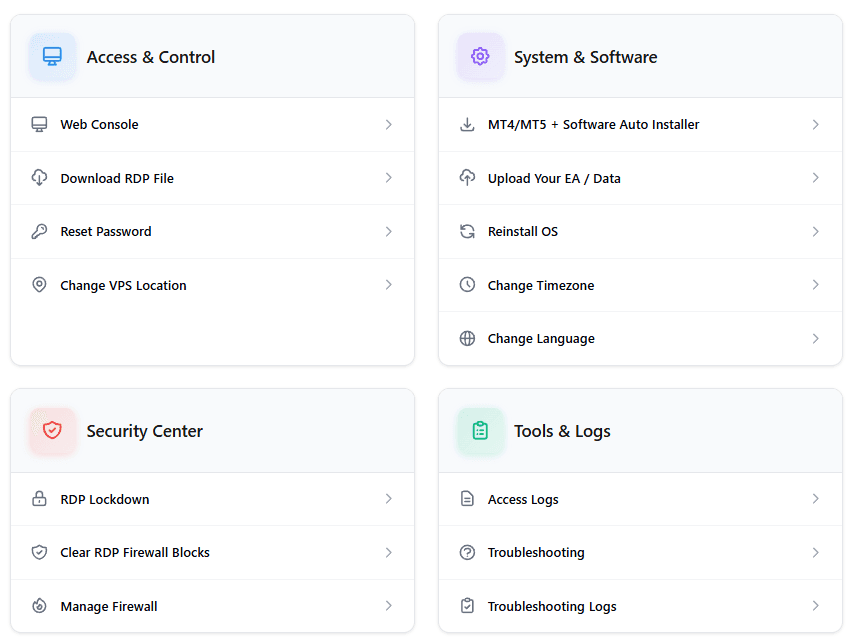
NYCServers: Provides an advanced VPS control panel designed specifically for Forex trading workflows. Some of the common tasks that traders can perform instantly without the need for contacting support include:
- One-click trading platform & software installation (100+ brokers, and support for multiple MT4/MT5 installations)
- Upload Expert Advisors and data files via browser
- Change VPS language and regional settings
- Manage firewall rules
- Remote power actions (restart, shutdown)
- and more!
This self-service approach allows traders to manage their environments on demand anytime they want, without the need for contacting support.
ForexVPS.net: Offers standard VPS management tools typical of general-purpose hosting environments. Advanced automation and trading-specific workflows are not prominently documented.
Monitoring & Alerting

NYCServers: Includes built-in monitoring with automated alerts, through it’s custom build software that comes pre-installed on each service. Traders can setup instant notifications for a number of events, allowing for instant response before trading activity is impacted.
ForexVPS.net: Publicly available documentation does not reference integrated monitoring or alerting tools. In such cases, traders may only become aware of problems after trades fail or platforms stop responding.
For automated trading systems, monitoring is critical and can make a real difference. For example, receiving an alert for high RAM usage on your VPS allows for immediate action to prevent performance slow downs or crashes. Without an alert, you won’t know there’s a problem until it’s too late.
Self-Service vs Support Dependency
When routine tasks require support intervention, resolution time depends on ticket queues and response speed. Self-service management tools allow traders to take immediate action on their terms, without the need to wait for support.

Pictured above is another recent review left on ForexVPSs’ Trustpilot page, documenting the reported experience with support. (Source)
For traders managing multiple VPS instances, accounts, or strategies, automation and visibility are not convenience features — they are operational necessities to ensure an optimal setup.
Next, we’ll review policies, billing practices, and account credits — areas where fine print can materially affect long-term value and trust.
Policies, Billing & Account Credits
Pricing and performance matter, but policies and billing practices determine the long-term relationship between a trader and a VPS provider. Clear terms, predictable billing, and fair account credit rules reduce friction and prevent unexpected surprises over time.
Refund Policies
Both NYCServers and ForexVPS.net offer a 14-day money-back guarantee, allowing traders to evaluate performance, latency, and stability without long-term commitment.
This policy provides a reasonable evaluation window for testing trading platforms, broker connectivity, and execution behavior under real market conditions.
Account Credit Expiration Rules
NYCServers: Account credits do not expire. Funds added to an account remain available until used, giving traders flexibility in how and when they apply credits to services.

ForexVPS.net: Account credits are subject to expiration rules. According to published terms (pictured above), credits older than six months are no longer eligible for refund, and customers are not notified prior to expiration.
For traders who prepay, manage multiple VPS instances, or pause services between trading strategies, credit expiration policies can materially affect perceived value.
Addons & Billing Transparency
Transparent pricing and clearly disclosed add-ons are critical for traders to understand exactly what they are paying for and receiving. Especially when it comes with something as important as critical backups of your VPS’s data.

When reviewing the service plans on the ForexVPS.net website it shows a check mark next to “Automated backups” for all VPS plans.

But when visiting the order form “No daily backups” are selected by default. If a trader wanted data backups of their service, this is an additional $120 fee that was not accounted for previously.
Furthermore, it is also unclear if there are other features like this as well; shown with a check mark on the pricing page – but may require an additional fee in order to be enabled or usable.
Support Experience & Company Focus
Support quality is often difficult to evaluate during normal operations, when everything is working as expected. Its true value becomes clear during incidents, configuration issues, or time-sensitive trading events. How a VPS provider communicates, responds, and resolves problems directly affects trader confidence and risk exposure.
Support During Normal Operations
NYCServers: Provides 24/7 support with a team focused exclusively on Forex VPS infrastructure. Because the platform includes extensive self-service tools, many routine tasks can be handled immediately without waiting for support intervention.
ForexVPS.net: Offers support for its VPS services alongside a broader portfolio of products. Routine VPS assistance is available, though there is no documentation about any automated support tools available.
Support During Critical Incidents
During infrastructure incidents, timely communication is as important as technical remediation. Clear status updates, realistic timelines, and proactive notifications help traders assess risk and make informed decisions.
Public reviews posted during the August 2025 New York outage at ForexVPS.net reference delayed responses and limited communication while services remained unavailable. While infrastructure failures can occur at any provider, incident communication plays a key role in maintaining trust.
NYCServers’ operational model emphasizes redundancy, monitoring, and rapid response during trading hours, with support aligned to the needs of active traders rather than general hosting workloads.
Dedicated Forex VPS Focus vs Multi-Brand Diversification
NYCServers operates with a singular focus on Forex VPS hosting. All infrastructure investment, development resources, and support processes are designed specifically around trading platforms, automated strategies, and low-latency execution. There are no competing priorities — the entire operation exists to serve Forex traders.

ForexVPS.net is just one of several brands operated by ThinkHuge Ltd, a holding company based in Hong Kong. ThinkHuge’s portfolio includes:
- Two separate Forex VPS brands — ForexVPS.net and FXVM.net, which compete in the same market
- Trading software tools — AlgoBuilder (EA creation) and TrackaTrader (analytics)
- Trading education — HowToTrade (Market analysis, signals, and more)
- Game server hosting — PingPlayers, an AI-powered game server platform
- Enterprise AI solutions — AI Agents for B2B automation
- B2B infrastructure services — white-label hosting across 60+ data centers
While diversification can provide ecosystem benefits, it also means that development resources, infrastructure investment, and support capacity are distributed across multiple product lines and industries rather than concentrated on a single service.
For Forex traders, the practical question is whether a provider’s primary operational focus aligns directly with the stability, performance, and reliability of their trading environment — or whether VPS hosting is one product among many competing for attention.
Next, we’ll summarize who each provider is best suited for and help narrow the decision based on trading style, priorities, and risk tolerance.
Who Should Choose Which Provider?
Both providers can work depending on your trading requirements. The best choice comes down to where your broker’s servers are located, how sensitive your strategy is to latency and downtime, and how much you value automation, transparency, and predictable long-term costs.
Choose NYCServers if you:
- Want a Forex VPS optimized for the main broker hubs (New York, London, Tokyo)
- Prioritize uptime during trading hours and operational resilience
- Prefer a ready-to-trade setup with pre-installed MT4/MT5/cTrader options
- Value hardware transparency and performance-focused infrastructure
- Want built-in monitoring, alerts, and a trading-specific control panel
- Prefer predictable policies, including account credits that do not expire
- Run automated strategies where downtime and setup mistakes create real risk
Choose ForexVPS.net if you:
- Need a VPS location outside the major financial hubs covered by NYCServers
- You don’t mind manually monitoring your service, and don’t need service monitoring alerts
- Prefer to manually choose locations and configure your own trading setup
- Want access to ThinkHuge’s broader ecosystem of tools and services (AlgoBuilder, TrackaTrader)
- Are comfortable reviewing published terms carefully for policies and add-on pricing
Final Verdict
NYCServers and ForexVPS.net are both established providers, but they are optimized for different priorities.
ForexVPS.net offers more geographic locations, which can be useful for traders with brokers hosted outside New York, London, or Tokyo. However, when evaluating total value for most Forex traders — including pricing clarity, automation, hardware transparency, and operational reliability — NYCServers provides a more purpose-built trading environment.
For traders running automated strategies, the key factors are simple: minimize latency to your broker, reduce downtime risk, and ensure your VPS is easy to manage without delays. NYCServers was built around those requirements, with broker-aligned provisioning, monitoring, and a trading-focused control panel designed to keep platforms running smoothly during market hours.
If your broker is hosted in one of the major financial hubs — or if you want a VPS designed specifically for Forex trading workflows — NYCServers is the stronger overall choice for most users.
Experience the Difference
Test our Forex VPS with a 14-day money-back guarantee. Select your broker at checkout and your VPS will be ready to trade in minutes. Get Started →
Frequently Asked Questions
Is ForexVPS.net reliable for automated trading?
ForexVPS.net has a large customer base and generally positive feedback, but it also experienced a documented ~24-hour New York outage in August 2025. For automated trading, reliability depends not only on average satisfaction, but also on incident duration, communication quality, and how well downtime risk is mitigated.
Why is NYCServers cheaper than ForexVPS.net?
NYCServers operates with a focused infrastructure strategy concentrated in the main trading hubs and invests heavily in automation and operational efficiency. A narrower location footprint and trading-specific tooling can reduce overhead and keep pricing competitive while still prioritizing performance and reliability.
Does VPS location affect execution speed and slippage?
Yes. Execution speed is influenced by latency between your VPS and your broker’s trading server. Lower latency generally reduces transmission delay and can help minimize slippage, particularly for scalping strategies and high-frequency automated systems.
Which provider is better for MT4 and MT5 Expert Advisors?
For EAs, the key requirements are consistent uptime, low latency to the broker server, and stable platform performance. NYCServers emphasizes broker-aligned provisioning, pre-installed platform options, and performance transparency, which can simplify setup and reduce operational risk for automated trading.
How do I choose the best Forex VPS for my broker?
Start by identifying where your broker’s MT4/MT5 servers are hosted and measure latency from candidate VPS locations. The best Forex VPS choice is typically the one with the lowest verified latency to your broker, strong uptime performance during trading hours, and management tools that reduce operational friction.
This comparison is based on publicly available information, including provider websites, published terms, status updates, and customer reviews as of December 2025. Features, pricing, and policies may change over time. Readers are encouraged to verify details directly with each provider before making a decision.

About the author
Matthew Hinkle
Lead Writer & Full Time Retail Trader
Matthew is NYCServers' lead writer. In addition to being passionate about forex trading, he is also an active trader himself. Matt has advanced knowledge of useful indicators, trading systems, and analysis.
Areas of Expertise