
How to Run MetaTrader 4 & 5 on macOS in 2026 (Plus the VPS Shortcut)
MetaTrader is Windows-first, but you can run MT4/MT5 on a Mac via Wine, Parallels, or the simpler path a low-latency forex VPS over RDP.
MetaTrader was built for Windows. MetaQuotes has never shipped a native, fully-supported macOS build, and Apple’s move to ARM-based silicon made the gap wider, not smaller. If you’re trading on a MacBook in 2026, you have three real choices: jam Windows onto your Mac with an emulation layer, run a virtual machine, or skip the whole compatibility problem and rent a Windows VPS sitting in the same datacenter as your broker.
This guide covers all three — Wine, Parallels, and the VPS shortcut — with honest performance numbers and the tradeoffs we see traders run into on Apple Silicon. If you already know you want the simplest path, skip ahead to the VPS section. Otherwise, start at the top.
Why MT4 and MT5 Are Still Tricky on macOS in 2026
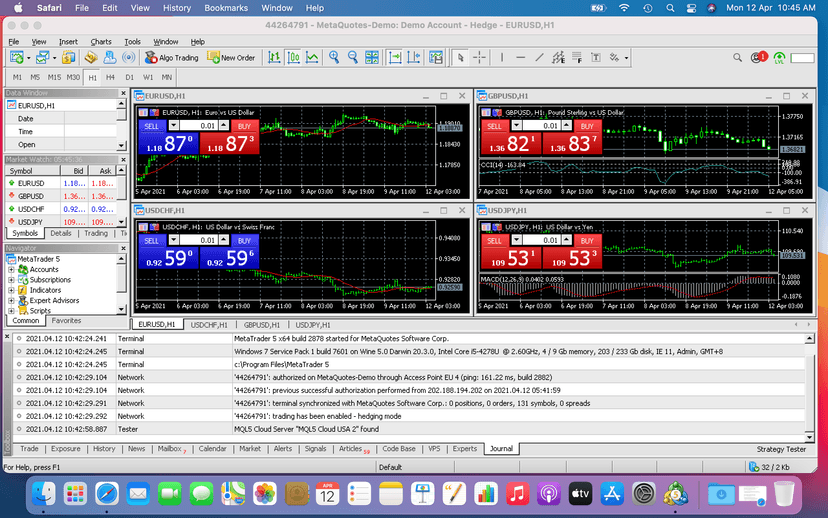
MetaTrader 4 and MetaTrader 5 were written as 32-bit and 64-bit Windows applications. There is no native ARM build. There is no Universal binary. The macOS installers MetaQuotes ships are Wine-based wrappers, not native ports — they run a slimmed-down Windows compatibility layer underneath the platform you actually use.
That was already awkward when Macs ran Intel chips. On Apple Silicon (M1, M2, M3, M4) it’s awkward and emulated: the Wine layer runs x86 Windows binaries on top of Rosetta 2, which translates them to ARM. Two layers of translation between your charts and the metal. It works. It’s not graceful.
The practical symptoms traders report on Mac:
- Custom DLL-based Expert Advisors and indicators that silently fail to load.
- Repeated Gatekeeper / “downloaded from the internet” prompts after every MT4 update.
- Higher CPU and battery drain than equivalent native apps.
- Charts that drop frames during fast tick streams on M-series MacBooks.
- Copy-trading and bridge tools that assume a “real” Windows environment refusing to install.
None of this is a bug in your Mac. It’s the cost of running a Windows-first platform somewhere it was never designed to live.
Apple Silicon: What Actually Changed for MT4/MT5
Apple’s switch from Intel to its own ARM chips, completed across the lineup by 2023, is the single biggest reason the “just install MT4 on a Mac” advice from older guides no longer fully applies. Intel-era Macs could in theory run Windows natively via Boot Camp. Apple Silicon Macs can’t — Boot Camp is gone.
That leaves you with three layers of indirection on M-series hardware, depending on the route you pick:
- Wine wrapper — runs x86 Windows binaries via Wine, which itself runs through Rosetta 2 on Apple Silicon. Two translation layers.
- Parallels with Windows 11 ARM — runs ARM Windows in a VM, which then uses Microsoft’s built-in x64 emulation to run MT4/MT5. Also two translation layers, but the lower one is Microsoft’s, not Wine’s.
- Forex VPS over RDP — runs MT4/MT5 natively on real x64 Windows in a datacenter. Zero translation. Your Mac is just a remote display.
Apple Silicon performance on options 1 and 2 is genuinely good for casual chart-watching. It gets thinner the moment you load custom DLLs, run several EAs in parallel, or care about every millisecond of execution latency. That’s where the VPS path stops being optional.
Option 1: The Official MetaQuotes Wine Wrapper
MetaQuotes provides a free, signed macOS installer for both MT4 and MT5 that bundles a self-contained Wine prefix. This is the path most “MT4 for Mac” downloads point to.
What it gives you:
- Officially supported and free — no Windows license, no third-party software.
- Works on both Intel and Apple Silicon Macs (the latter via Rosetta 2).
- Installs in under five minutes and looks visually like a native app.
What it costs you:
- Performance overhead on M-series chips — x86 emulation is real, and you’ll feel it under multiple EAs.
- Custom DLL-based EAs and indicators frequently fail to register.
- Gatekeeper security prompts repeat after every MetaQuotes update.
- The platform pauses or quits when your MacBook sleeps, hits low battery, or restarts.
The Wine wrapper is fine for chart-watching, learning the platform, or running a manual swing-trading workflow on a plugged-in Mac. It’s not the place to host an EA you need running through Sunday’s open while you’re asleep.
Option 2: Parallels Desktop with Windows 11 ARM
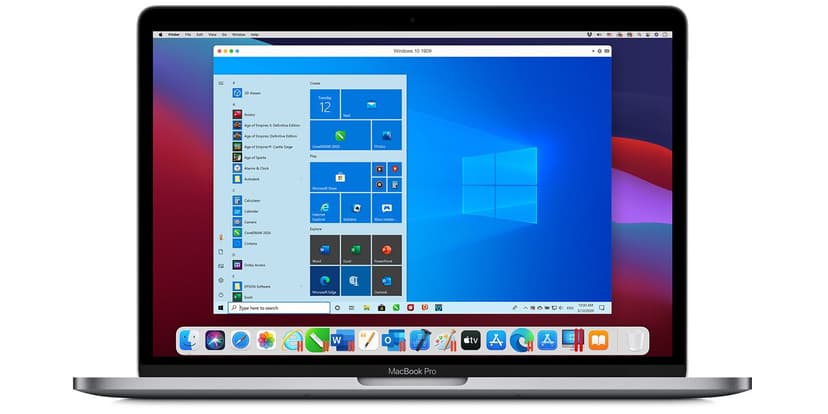
Parallels runs a full Windows 11 ARM virtual machine on your Mac. Inside that VM, Microsoft’s own x64 emulation layer executes MT4/MT5 — the same path used to run x86 Windows apps on ARM-based Surface devices. On M3 and M4 MacBook Pros with adequate RAM, the result is the closest you can get to “real Windows MetaTrader” without leaving your laptop.
Indicative performance on a recent M-series MacBook Pro inside Parallels with Windows 11 ARM:
| Metric | Parallels + Windows 11 ARM |
|---|---|
| Cold MT4 launch | ~4 seconds |
| Chart FPS (60-second window) | 32-40 fps |
| CPU load with 5 EAs running | 35-40% |
The fine print most “Parallels for MT4” guides skip:
- License cost. Parallels Desktop Standard runs roughly $99/year, and many EAs also expect an activated Windows license — that’s a separate purchase from Microsoft.
- RAM and battery. A usable Windows 11 ARM VM wants 4-6 GB of RAM allocated. On an 8 GB Mac that’s most of your machine. Battery life takes a meaningful hit any time the VM is running.
- It still stops when your Mac stops. Close the lid, the VM suspends. Restart the Mac, the VM has to boot again. EAs that need to run 24/5 don’t tolerate that well.
- Network is still your home internet. Even with a perfect VM, your trades still leave your house over residential broadband. Latency to your broker doesn’t improve.
Parallels is a defensible choice if you trade manually, you’re already living inside Windows 11 ARM for other reasons, and your strategies don’t depend on tight execution timing. For continuous EA hosting, it’s not the right tool — and that’s where most traders end up looking at a VPS. https://www.youtube.com/embed/wZbWnivCwbE
Option 3: CrossOver, PlayOnMac, and the DIY Wine Path
CrossOver (commercial) and PlayOnMac (open-source) are alternative ways to run Wine on macOS without the official MetaQuotes wrapper. They’re useful if MetaQuotes’ bundled prefix is misbehaving and you want more control over the underlying Wine version, registry settings, and winetricks recipes.
Honest assessment: these tools work well enough for demo accounts and learning the platform, and they’re a good fit if you enjoy tinkering with Wine. They’re not where we’d send a trader who just wants MT4 to open and stay open. The configuration time alone tends to outweigh the few dollars saved versus Parallels — and neither solves the “Mac sleeps, EA stops” problem.
Option 4: The Simpler Path — Run MT4/MT5 on a Forex VPS
A forex VPS is a Windows server hosted inside a financial datacenter (Equinix NY4, LD4, TY3) with sub-millisecond proximity to your broker’s matching engine. You connect to it from your Mac with Microsoft Remote Desktop, and the Windows desktop appears in a window — like a work computer you happen to remote into.
From the Mac side, you don’t run MT4 at all. You run a remote desktop client. MT4 and MT5 run on real x64 Windows on the VPS, talking to your broker over a datacenter cross-connect. Wine, Rosetta 2, and Windows licensing all stop being your problem.
What you actually get:
- 100% MT4/MT5 compatibility. Any EA, any custom DLL, any copy-trade bridge. It’s real Windows — if it runs anywhere, it runs here.
- 24/5 uptime. The VPS keeps trading when your MacBook is closed, asleep, restarting, or being carried through an airport.
- Sub-1ms latency to most popular brokers. NYCServers VPS in NY4 reaches IC Markets, FTMO, Axi, and Exness in 1ms or less. You can sanity-check your specific broker with our broker latency tool.
- Pre-installed broker software. You pick the broker at checkout; the VPS arrives with MT4/MT5 already set up. No manual install on Windows.
- Cheap RDP client. The Mac App Store ships a free Microsoft remote desktop client. No additional licenses.
Honest counterpoint: if you’re a manual swing trader who places one trade a week and you’re fine sitting at your laptop, you don’t need a VPS. The Wine wrapper is fine. The case for a VPS is strongest when you run EAs, scalp on tight spreads, trade prop-firm challenges, or want execution that doesn’t depend on your home internet staying up.
Quick Start: Connect to Your VPS From macOS
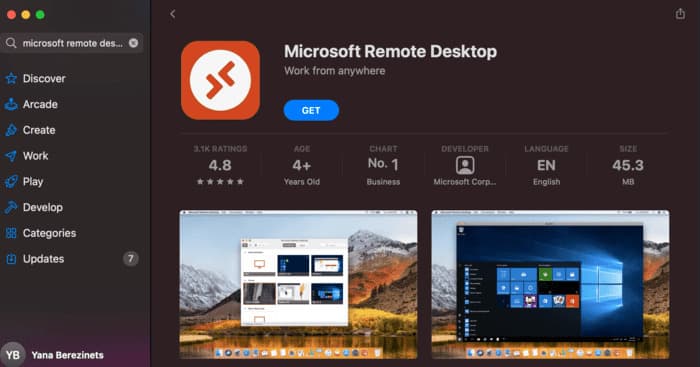
If you’ve never RDP’d into a Windows machine from a Mac, the setup is short. The official Microsoft Remote Desktop client is free on the Mac App Store and handles clipboard sync, fullscreen, and multi-monitor without extra config. For a screenshot-by-screenshot walkthrough, see our dedicated guide on connecting to a forex VPS from a Mac.
- Install the client. Open the Mac App Store, search for the Microsoft remote desktop client (currently published by Microsoft), install it like any other Mac app.
- Add the PC. Click “Add PC” and enter your VPS public IP from your NYCServers welcome email (e.g. 45.43.5.146).
- Enter credentials. Username is typically
Administrator; the password is in your welcome email. Save it in the connection so future logins are one-click. - Connect. Double-click the saved PC tile. Press Cmd + F for fullscreen, Cmd + Ctrl + F to exit it.
- Move your EA over. Clipboard sync is on by default — drag the .ex4/.ex5 file from your Mac, drop it on the VPS desktop, then place it in
MQL4/ExpertsorMQL5/Expertsas usual.
That’s the entire setup. From this point on, your Mac is just a screen for a real Windows MT4/MT5 instance running in NY4.
Home Mac vs VPS: Real Latency Numbers
The case for moving MetaTrader off your Mac and into a datacenter is partly about Windows compatibility — and partly about distance. Your home Wi-Fi to a New York broker is rarely under 50ms round-trip. A VPS in the same building as the broker is sub-1ms. Here’s how that translates in practical execution:
| Route | Ping to IC Markets (NY4) | Slippage on 1 lot EURUSD |
|---|---|---|
| Home Wi-Fi | 62-78 ms | 0.8-1.2 pips |
| NY4 Forex VPS | 0.6-1.0 ms | ≤0.2 pips |
Numbers are illustrative — your specific home connection and broker route will vary. The structural point holds: a VPS in the broker’s building beats home internet by roughly two orders of magnitude on round-trip time, and slippage tracks latency closely on tight-spread instruments.
When a VPS Is the Safer Choice for Mac Traders
We’re not selling a VPS to every Mac user. The honest decision tree:
- You run any EA at all — VPS. EAs assume continuous connection; a sleeping MacBook breaks that.
- You’re scalping or trading tight-spread strategies — VPS. The latency delta in the table above eats your edge.
- You’re on a prop-firm challenge with a daily-loss limit — VPS. A dropped Wi-Fi connection during a news spike can blow the limit before you reconnect.
- You manage 3+ MT4/MT5 instances — VPS. Wine and Parallels both struggle past 2-3 platforms; real Windows in a datacenter doesn’t.
- You travel or trade from coffee shops — VPS. Your charts and EA stay where they are; your Mac just connects to them.
- You’re a manual swing trader, on your couch, plugged into the wall — Wine wrapper or Parallels is fine. Save the VPS spend.
If you fall into one of the first five buckets, our forex VPS plans page lays out Basic / Standard / Professional side by side, all with broker pre-installation and a 14-day money-back guarantee. Already have an EA file ready? Our MT4 trading robot installation guide walks through the EA setup in five minutes once your VPS is provisioned.

Troubleshooting Cheat-Sheet
Common issues on Mac-to-MetaTrader setups, regardless of which path you took:
| Problem | Likely cause | Fix |
|---|---|---|
| Wine wrapper crashes on launch | Outdated or corrupted Wine prefix | Re-run the MetaQuotes installer or recreate the prefix from scratch |
| Parallels VM freezes mid-trade | Insufficient RAM allocation | Allocate 4-6 GB RAM to the VM; enable automatic graphics |
| RDP keeps prompting for Keychain access | macOS privacy / Keychain settings | Remove the old VPS entry from Keychain, then reconnect once and save |
| EA loaded but won’t trade | AutoTrading disabled (often after a crash or restart) | RDP into the VPS, click the AutoTrading button, check the Experts log tab |
| Custom DLL EA fails on Wine | Wine doesn’t support the DLL | Move that strategy to a real-Windows VPS — Wine isn’t the right environment for DLL-heavy EAs |
| RDP session keeps disconnecting | Mac going to sleep / Wi-Fi flapping | The VPS keeps running regardless — just reconnect. The EA never paused. |
Frequently Asked Questions
Can MT4 run on a Mac?
Yes, with caveats. MetaQuotes ships an official Wine-based macOS installer for MT4 that runs on Intel and Apple Silicon Macs. It’s free and works for chart-watching and manual trading. It’s less reliable for custom DLL-based Expert Advisors, and it stops running whenever your Mac sleeps. For EA-driven strategies, most traders end up running MT4 on a Windows forex VPS and connecting from the Mac via Remote Desktop.
Does MT5 work on Mac?
Same answer as MT4. MetaQuotes provides a Wine-wrapped MT5 installer for macOS that runs on M-series chips through Rosetta 2. It’s fine for manual trading. For continuous EA hosting, multi-account setups, or low-latency execution, an MT5 VPS is the cleaner path because there are no emulation layers between the platform and the broker.
Is a forex VPS better than Parallels for MetaTrader?
For continuous, automated, or latency-sensitive trading — yes, by a wide margin. Parallels still runs on your laptop, so it stops when your Mac stops, drains battery, and routes through your home internet. A VPS sits in a financial datacenter (NY4, LD4, TY3), runs 24/5, and reaches most popular brokers in 1ms or less. For pure manual chart-watching on a plugged-in Mac at home, Parallels is fine and cheaper after the first year.
Is MetaTrader 4 for macOS free?
The official MetaQuotes Wine wrapper is free and bundled with most broker downloads. Parallels Desktop is paid (~$99/year) and may need a Windows license on top. CrossOver is paid; PlayOnMac is free. A forex VPS is a paid service — the spend is justified by EA uptime and broker proximity, not by the cost of MT4 itself, which is always free from your broker.
Do I need a Windows license to run MT4 on a Mac?
It depends on the path. The Wine wrapper, CrossOver, and PlayOnMac don’t need a Windows license — they run MT4 without booting real Windows. Parallels Desktop technically needs an activated Windows 11 ARM license for full functionality. A forex VPS includes Windows Server licensing in the monthly price — you don’t buy a separate license.
What’s the best way to run MT4 on an M1, M2, M3, or M4 Mac?
For manual trading and learning, the official MetaQuotes Wine wrapper works on all M-series chips through Rosetta 2 — quick to install and free. For anything where uptime, latency, or DLL-based EAs matter, run MT4 on a Windows-based MT4 VPS and connect from your Mac with Microsoft Remote Desktop. The M-series chip is irrelevant in that setup; the VPS is doing all the work, your Mac is just a screen.
Can I run several MT4/MT5 instances at once on a Mac?
Locally, yes — but Wine and Parallels both get unhappy past 2-3 simultaneous instances on a typical MacBook. If you manage multiple accounts or copy-trade between several MT4/MT5 setups, run them on a forex VPS sized for the load (Standard or Professional tier on NYCServers). One RDP session shows you all of them at once.

Cut the Compatibility Layer. Keep Trading.
Running MetaTrader on macOS is solvable in 2026 — there’s nothing wrong with the Wine wrapper or Parallels for the right use case. But the real “Mac shortcut” for serious trading isn’t to wedge Windows onto your Mac. It’s to keep your Mac as a Mac, and put MT4/MT5 where they were designed to live: on real Windows, in a datacenter, next to your broker.
Compare our forex VPS plans with broker pre-installation and a 14-day money-back guarantee, or pick the platform-specific MT4 or MT5 VPS page if you already know which platform you’re running. If you want to see your broker’s actual latency from each of our datacenters before deciding, run it through the broker latency tool first.
Your Mac doesn’t have to be the bottleneck. It just has to be the screen.

About the author
Matthew Hinkle
Lead Writer & Full Time Retail Trader
Matthew is NYCServers' lead writer. In addition to being passionate about forex trading, he is also an active trader himself. Matt has advanced knowledge of useful indicators, trading systems, and analysis.
Areas of Expertise